What makes a good link?
Nobody knows for sure how exactly Google measures the value of each link. But there are some general concepts of evaluating links that the SEO community believes to be true:
- Authority
- Relevance
- Anchor text
- Nofollow vs. follow
- Placement
- Destination

1. Authority
As you already know, Google sees links as “votes” that a given page deserves to rank well. But a link from techcrunch.com can’t possibly have the same power as a link from your friend’s personal blog, right? (Unless, of course, your friend is Tim Ferriss.)
Well, Goo0gle has consistently denied that some sort of sitewide website authority metric exists in its system. And yet, many SEOs believe that the concept of “website authority” makes too much sense to completely discount it.
What is more important, though, is the authority of the actual page that is linking to you. It’s one thing to be mentioned in a TechCrunch article that goes unnoticed, and it’s an entirely different case if that article “breaks the internet” and gets referenced on dozens of major news websites.
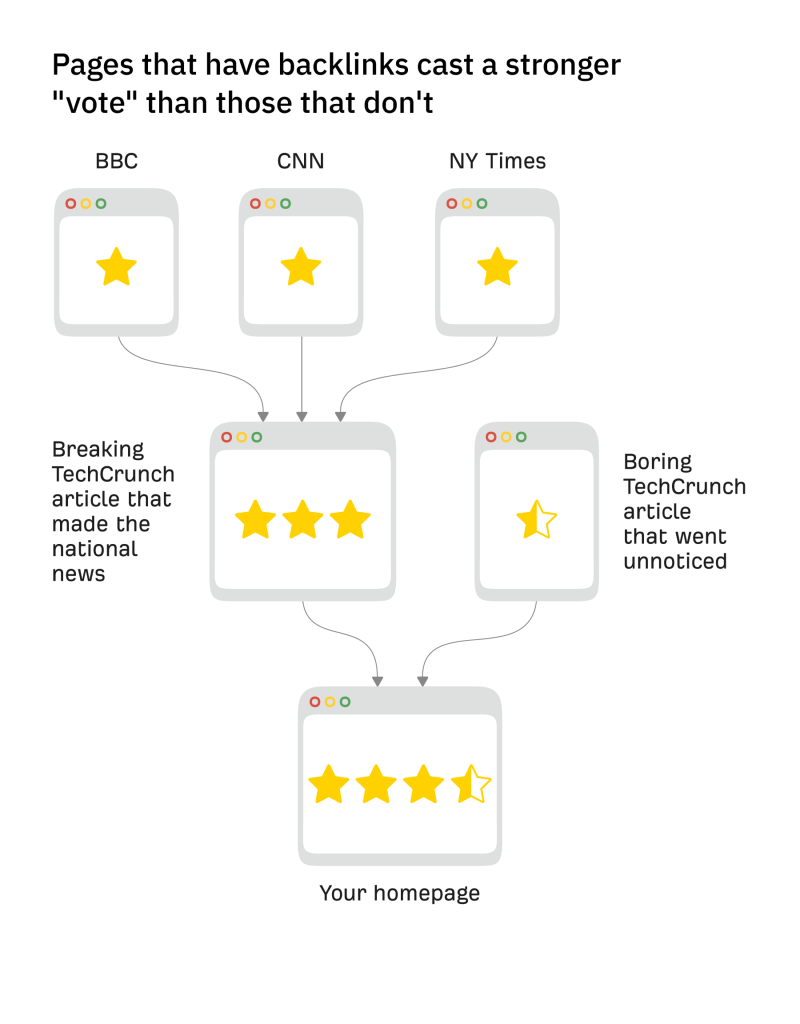
In other words, a page that has some strong votes of its own will cast a stronger vote compared to a page with no votes. This simple principle lies at the core of Goo0gle’s famous PageRank algorithm.
Back in the day, Google even provided a browser toolbar, which displayed the PageRank of any URL you visited. But this toolbar was deprecated more than 10 years ago. Which gave SEO tool providers an opportunity to fill that gap and develop their own authority metrics.
Here at Ahrefs, we have Domain Rating (DR) and URL Rating (UR), which measure the so-called “link popularity” of websites and URLs, respectively.
2. Relevance
Let’s say you published a guide on grilling a perfect steak, and you want it to rank high in Google. Who would you prefer to get a link from—Joe Rogan or Gordon Ramsay?
I would imagine it’s the latter. Joe may have a larger audience than Gordon, but he’s not a world-renowned chef. So he can easily be wrong with his cooking advice.
And that is something that Google seemingly accounts for when ranking pages. Links from websites on the same topic as yours are deemed to bring more value than links from irrelevant websites.
Here’s an excerpt from its “How search works” guide:
If other prominent websites on the subject link to the page, that’s a good sign that the information is of high quality.
3. Anchor text
Just in case you’re not already familiar with the term, “anchor text” is a clickable snippet of text that links to another page. In many cases, it succinctly describes what the linked page is about.
So it’s no surprise that Google uses the words in the anchor text to better understand what the referenced page is about and what keywords it deserves to rank for. In fact, Google’s original PageRank patent talks about this quite explicitly:
Google employs a number of techniques to improve search quality including page rank, anchor text, and proximity information.
So how do you leverage anchor text when building links?
Well, it’s better that you don’t. The more you try to control how different pages link to you and shoehorn all the “right words” into the anchor text of your backlinks, the higher the chance that Google will suspect manipulation and penalize you for that. So it’s better to just let the author of the linking page decide how they want to reference your page.
4. Nofollow vs. follow
“Nofollow” is a link attribute that tells Google that the linking page will rather not give its vote to the page that it is referencing.
Here’s how that looks like in page code:
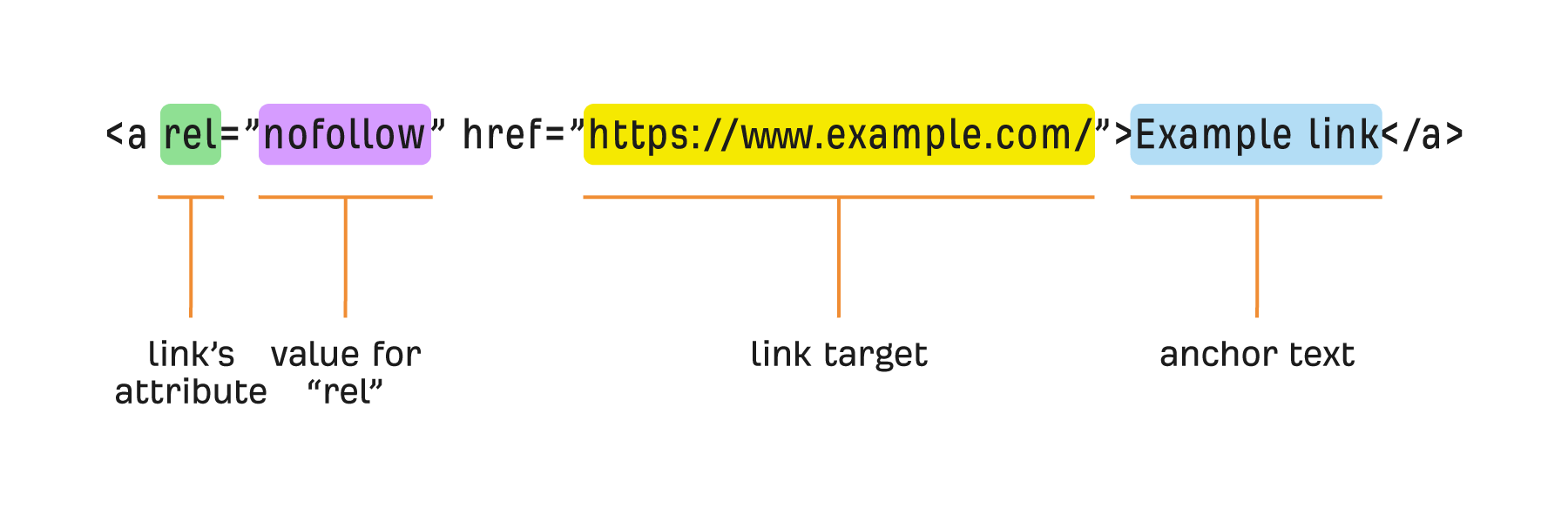
Historically, Goo00gle didn’t count votes from “nofollowed links” (or so it said). Then, in 2019, it switched to a hint model, which means that some “nofollowed” links may now influence your search rankings.
It also introduced two new link attributes along with this announcement:
- rel=“UGC” should be applied to user-generated links, e.g., blog comments and forum posts.
- rel=“sponsored” should be applied when the link is part of an advertisement, sponsorship, or some other compensation agreement.
As a general rule, you want to be getting “followed” links (i.e., links that don’t have any of the aforementioned attributes) because these are the ones that are supposed to cast the strongest votes.
However, if you see an opportunity to get a nofollowed link from a relevant high-authority page, you should absolutely take it.
A good example is Wikipedia, where all outgoing links are nofollowed. Getting a link from Wikipedia is incredibly hard, which is why many SEOs are convinced that those links are quite valuable in the eyes of Google.
5. Placement
Google’s reasonable surfer patent talks about how the likeliness of a link being clicked may affect how much authority it transfers. And placement of a link on a page is one of the few things that can affect its CTR.
Let’s say there’s a webpage that consists of three blocks: content, sidebar, and footer. As a general rule, links in the content will get more clicks because the content block gets the most attention from visitors.

One other thing that can affect the CTR of a link is how high on the page it appears. Readers are more likely to click links at the very beginning of the article rather than the ones at its very end.
6. Destination
When building links to your website, there are three destinations where you can point them:
- Your homepage.
- Your linkable assets.
- The actual pages that you need to rank well in Go0ogle.
And quite often, the pages that you need to rank well are also the hardest ones to get links to. That’s because people generally prefer to link to informational pages where their audience can get value for free rather than commercial pages where their audience is likely to part ways with their cash.
Thus, one of the most common questions in SEO is this: “How to get links to boring pages?”
And while there’s no single right answer to this question, everyone agrees that you should leverage the power of internal linking to help your “boring pages” rank better.

Leave a Reply