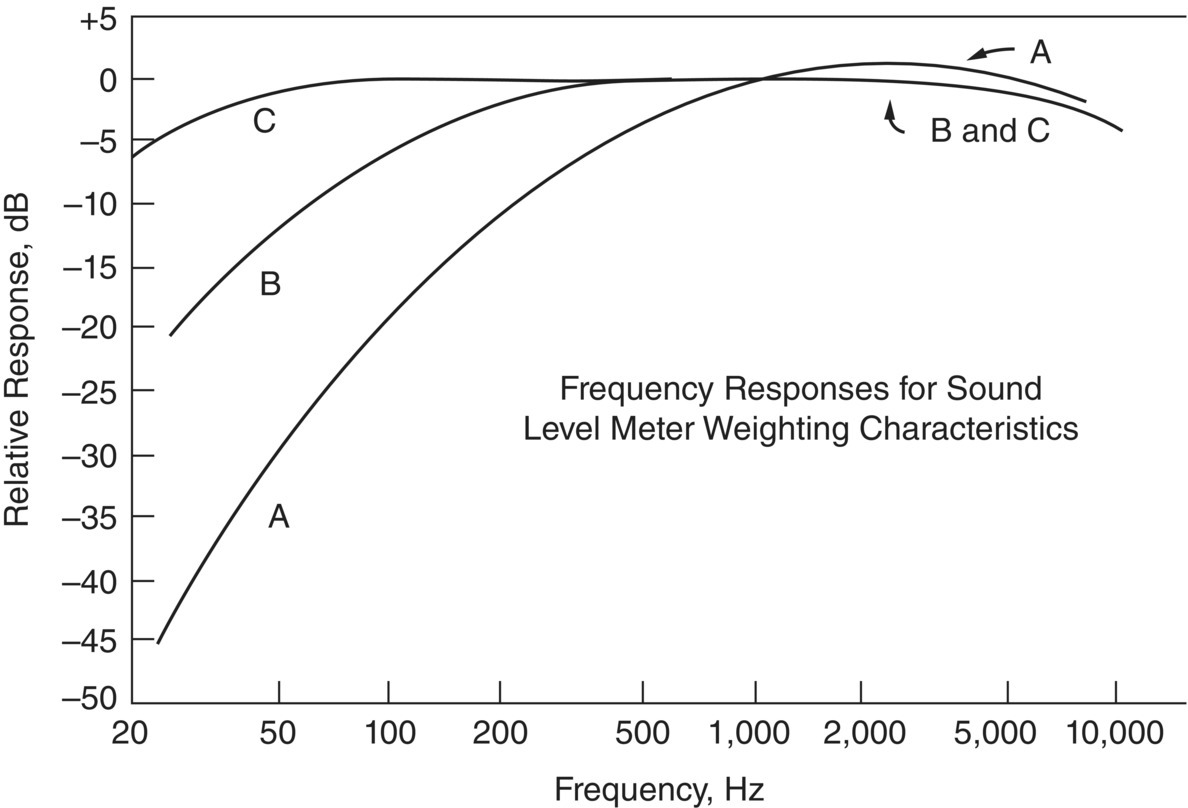
Figure 4.6 in this chapter shows that the ear is most sensitive to sounds in the mid‐frequency range around 1000–4000 Hz. It has a particularly poor response to sound at low frequency. It became apparent to scientists in the 1930s that electrical filters could be designed and constructed with a frequency response approximately equal to the inverse of these equal loudness curves. Thus A‐, B‐, and C‐weighting filters were constructed to approximate the inverse of the 40‐, 70‐, and 90‐phon contours (i.e. for low‐level, moderate, and intense sounds), respectively (see Figure 4.6). In principle, then, these filters, if placed between the microphone and the meter display of an instrument such as a sound level meter, should give some indication of the loudness of a sound (but for pure tones only).
The levels measured with the use of the filters shown in Figure 4.14 are commonly called the A‐, B‐, and C‐weighted sound levels. The terminology A‐, B‐, and C‐weighted sound pressure levels is preferred by ISO to reduce any confusion with sound power level and will be used wherever possible throughout this book. The A‐weighting filter has been much more widely used than either the B‐ or C‐weighting filter, and the A‐weighted sound pressure level measured with it is still simply termed by ANSI as the sound level or noise level (unless the use of some other filter is specified). Several other weightings have also been proposed in the past [13]. However, because it is simple, giving a single number, and it can be measured with a low‐cost sound level meter, the A‐weighted sound pressure level has been used widely to give an estimate of the loudness of noise sources such as vehicles, even though these produce moderate to intense noise. Beranek and Ver have reviewed the use of the A‐weighted sound pressure level as an approximate measure of loudness level [36].
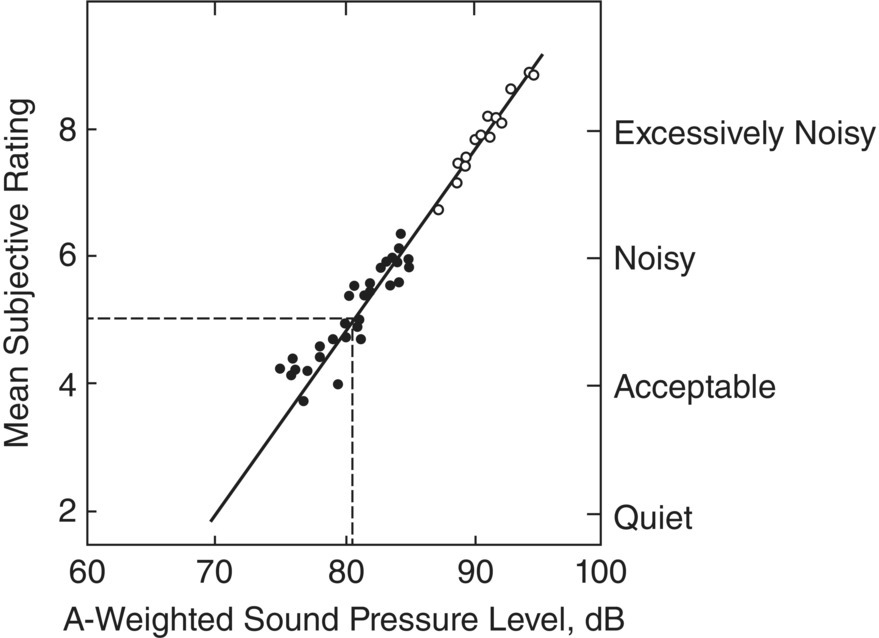
The A‐weighted sound pressure levels are often used to gain some approximate measure of the loudness levels of broadband sounds and even of the acceptability of the noise. Figure 4.15 shows that there is reasonable correlation between the subjective response of people to vehicle noise and the A‐weighted sound pressure levels measured of the vehicle noise. The A‐weighted sound pressure level forms the basis of many other descriptors for determining human response to noise described later in Chapter 6. The A‐weighted sound pressure level descriptor is also used as a limit for new vehicles (Chapter 14) and noise levels in buildings (Chapter 12) in several countries. Although the A‐weighting filter was originally intended for use with low‐level sounds of about 40 dB, it is now commonly used to rate high‐level noise such as in industry where A‐weighted sound pressure levels may exceed 90 dB. At such high levels the A‐weighted sound pressure level and the loudness level are normally in disagreement.
EXAMPLE 4.5
The factory noise spectrum (given in Table 4.1), was calculated to have a loudness level of 99 phon (see Example 4.2). Calculate the approximate A‐weighted sound pressure level from the octave band levels given in Table 4.1.
SOLUTION
Since we do not have the directly measured A‐weighted sound level, we can calculate this approximately using Figure 4.14. The A‐weighting corrections at the octave band center frequencies have been read off Figure 4.14 and entered in Column 3 of Table 4.2. The so‐called A‐weighted octave band sound pressure levels have been calculated in Column 4 and these values have been combined to give the A‐weighted sound pressure level of 89.8, i.e. 90 dB. Note this A‐weighted sound pressure level is dominated by the A‐weighted band levels in the 500, 1000, and 2000 Hz octave bands. These three band levels combine to give 89.5 dB. Similar calculations of the C‐weighted and linear (nonfiltered) sound pressure levels give 91.9 and 92.0 dB, respectively. Thus we see that the A‐weighted sound pressure level is 9 dB below the level in phons and no closer than the linear unweighted sound pressure level of 92 dB. A‐weighted levels should not be used to calculate the loudness level unless the noise is a pure tone – then a good loudness level estimate can be made using the A, B, or C filters (depending on the noise level).
Table 4.2 Combination of octave‐band sound pressure levels of factory noise to give the A‐weighted sound pressure level.
| Octave band center frequency, Hz | Octave band level, dB | A‐weighting correction, dB | A‐weighted octave‐band levels, dB |
|---|---|---|---|
| 31.5 | 75 | −42 | 33 |
| 63 | 79 | −28 | 51 |
| 125 | 82 | −18 | 64 |
| 250 | 85 | −9.0 | 76 |
| 500 | 85 | −3.0 | 82 |
| 1000 | 87 | 0 | 87 |
| 2000 | 82 | +1.5 | 83.5 |
| 4000 | 75 | +0.5 | 75.5 |
| 8000 | 68 | −2.0 | 66 |
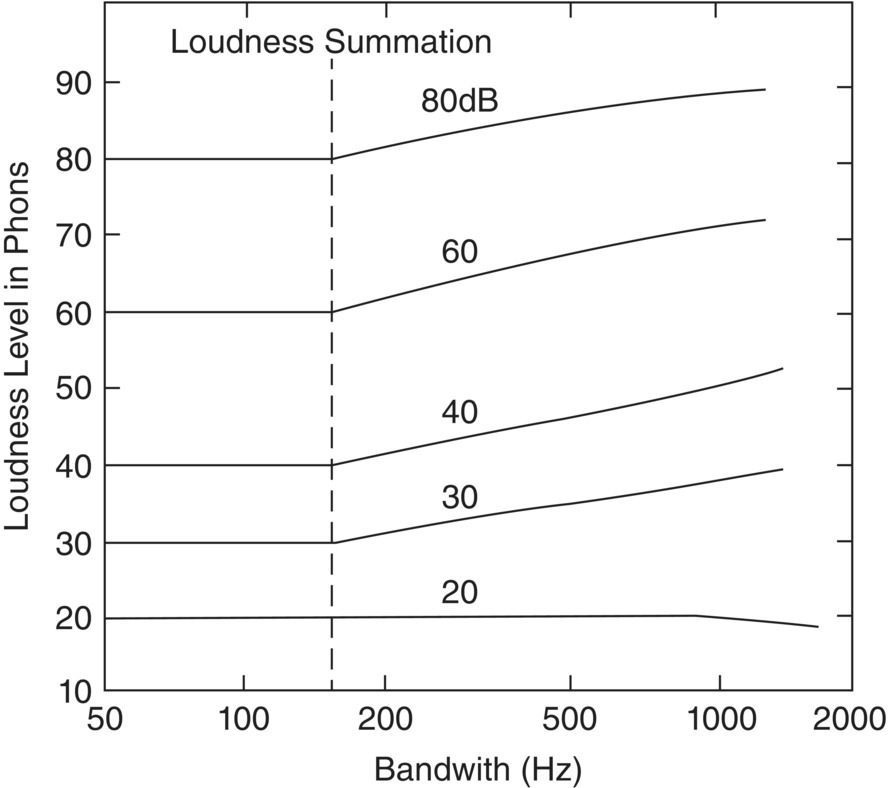
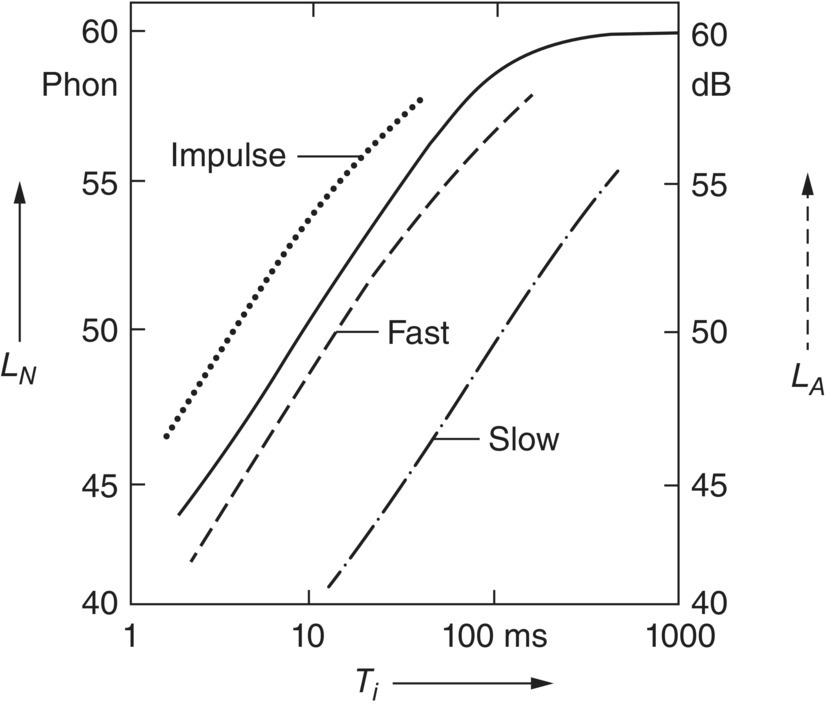
Another problem with A‐weighting is that it does not allow for the fact that loudness increases with the bandwidth of the noise and also with the duration of the noise event for very short impulsive‐type sounds of duration less than about 200 ms. The concept of the critical band is of fundamental importance in psychoacoustics. It is of concern in studies of loudness, pitch, hearing thresholds, annoyance, speech intelligibility, masking, and fatigue caused by noise, phase perception, and even the pleasantness of music.
Figure 4.16 shows the loudness level of bands of filtered white noise centered at 1000 Hz as a function of bandwidth for the different constant sound pressure levels shown on each curve. The curves were obtained by a matching procedure in which listeners equated the loudness of a 1000‐Hz pure tone with bands of noise of increasing bandwidth. The level at which the pure tone was judged to be equal in loudness to the band of noise is shown as the ordinate. Thus the curves do not represent equal loudness contours, but rather they show how the loudness of the band of noise centered at 1000 Hz changes as a function of bandwidth. The loudness of a sound does not change until its bandwidth exceeds the so‐called critical bandwidth. The critical bandwidth at 1000 Hz is about 160 Hz. (Notice that, except for sounds of very low level of about 20 phons, for which loudness is almost independent of bandwidth, the critical bandwidth is almost independent of level and that the slopes of the loudness curves are very similar for sounds of different levels.) Critical bands are discussed further in Section 4.3.6 of this chapter.
The solid line in Figure 4.17 shows that sounds of very short duration are judged to be very quiet and to become louder as their duration is increased. However, once the duration has reached about 100–200 ms, then the loudness level reaches an asymptotic value. Also shown by broken lines in Figure 4.17 are A‐weighted sound pressure levels recorded by a sound level meter using the “impulse,” “fast,” and “slow” settings. It is observed that the A‐weighted sound pressure level measured by the fast setting on the sound level meter is closest of the three settings to the loudness level of the sounds.
Further methods of rating loudness, noisiness, and annoyance of noise are discussed in Chapter 6.
Leave a Reply