The following assumptions are made:
- The steam flows through the nozzle without any work or heat transfer.
- The frictional forces are neglected.
Consider the flow of steam through a nozzle, as shown in Fig. 6.2. Applying the energy equation to sections 1 and 2 at entrance and exit of nozzle, we have


Usually c1 = 0,

where (Δh)isen = h1 − h2 = isentropic enthalpy change, kJ/kg
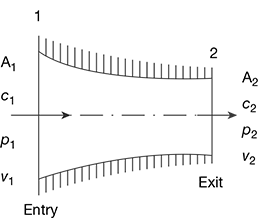
Figure 6.2 Flow through a nozzle
1 Flow of Steam Through the Nozzle
where n = 1.035 + 0.1 x1 for wet steam
= 1.135 for saturated steam
= 1.3 for superheated steam
As the steam pressure drops while passing through the nozzle, its enthalpy is reduced. This reduction of enthalpy of steam must be equal to the increase in kinetic energy. Hence,

where p1, p2 = pressure of steam at entry and exit, respectively, v1, v2 = specific volume at entry and exit, respectively.
If c1 << c2, then


Leave a Reply