A vacuum gauge is used to measure the vacuum in the condenser. Figure 8.10 shows a vacuum gauge. It consists of a glass tube containing mercury to indicate the barometric pressure and another mercury tube connected to the condenser and vacuum gauge. The vacuum gauge has readings marked in cm of Hg. It represents the height at which a column of mercury, the upper surface of which is in communication with the cylinder, will stand when supported by barometric pressure. The vacuum is dependent upon the barometric pressure and the absolute pressure in the condenser.
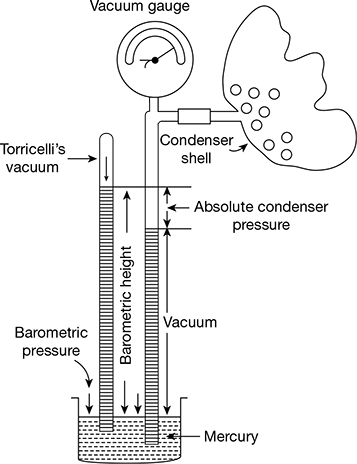
Figure 8.10 Vacuum gauge
Absolute pressure in the condenser = barometric pressure − vacuum gauge pressure
Usually, the vacuum gauge readings are corrected to standard barometer reading of 76 cm of Hg.
Thus,
Corrected vacuum in cm of Hg = 76 − absolute pressure in cm of Hg
= 76 − (actual barometric height − vacuum)
Let Hb = actual barometric height in cm of Hg
Hg = actual vacuum gauge reading in cm of Hg
Hb − Hg = absolute pressure in condenser in cm of Hg
p = absolute condenser pressure in bar
Now, 76 cm of Hg = 1.01325 bar



Leave a Reply