After the sound pressure levels within the mechanical room have been adequately and economically reduced, the next step is to introduce a massive layer between the room and the nearby critical areas. The primary purpose of this massive layer, normally called a floating floor, is to reduce airborne transmission through the floor rather than reduce vibration transmission [28, 29]. Although lightweight walls are used effectively as dividing partitions between two areas where speech privacy is required, these provide only little transmission loss at low frequencies.
Unfortunately, most of the mechanical room equipment (especially large centrifugal fans) radiate strongly at low frequencies, which causes a problem for the design engineer. Indeed, sound pressure levels in excess of 110 dB in the 63 and 125 Hz one-octave bands are quite common. Since doubling the mass of the floor slab results in an increase in its transmission loss of only about 5 dB, in order to attain the required transmission loss, the floor design would have to become both economically and structurally intolerable. This is exactly the same situation as discussed for dividing walls in Chapter 12 in which it was shown that a pair of double walls separated by an air space was very much more effective than an equivalent double‐weight single wall. In this case, a second layer is added to the floor, which is separated from the structural slab by an air space. The upper layer, which is generally known as a “floating floor,” is supported by and isolated from the structural slab.
The floating floor is normally constructed by pouring the floating concrete floor on plywood panels which are resiliently mounted on the structural slab by small vibration isolation pads (see Figure 13.32) [20, 27]. The floating floor slab usually has a minimum thickness of 100 mm with a separation of 25–100 mm between the floating and structural slabs. The natural frequency of the floating floor system depends on the stiffness of the vibration isolation pads and the stiffness of the airspace between the two slabs. With a 50 mm airspace and a 100 mm thick floating floor, the natural frequency is normally about 18 Hz.
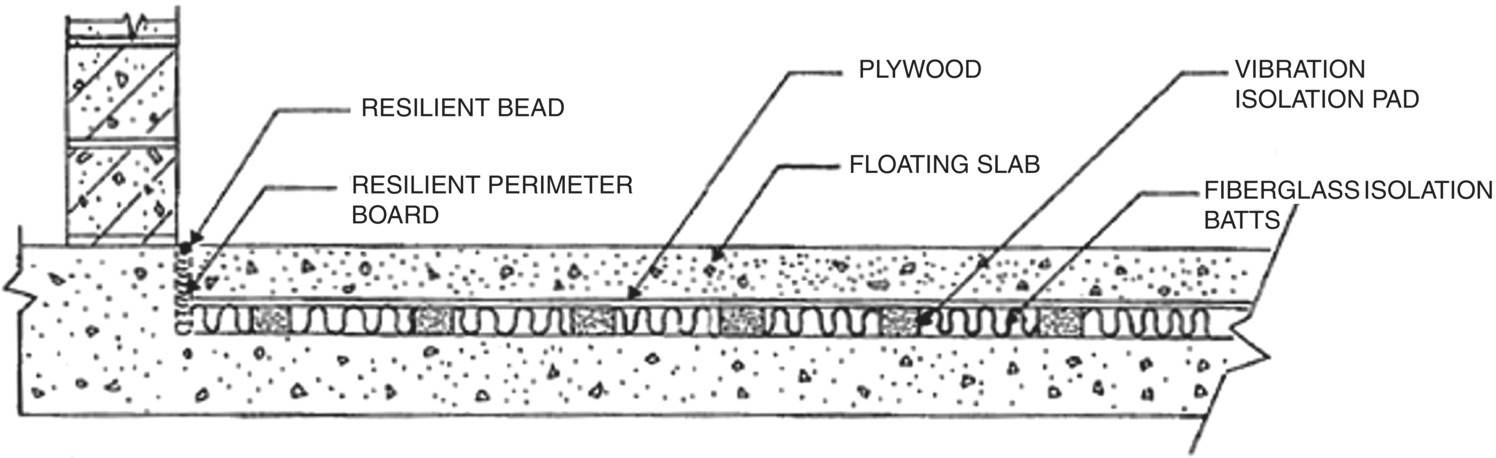
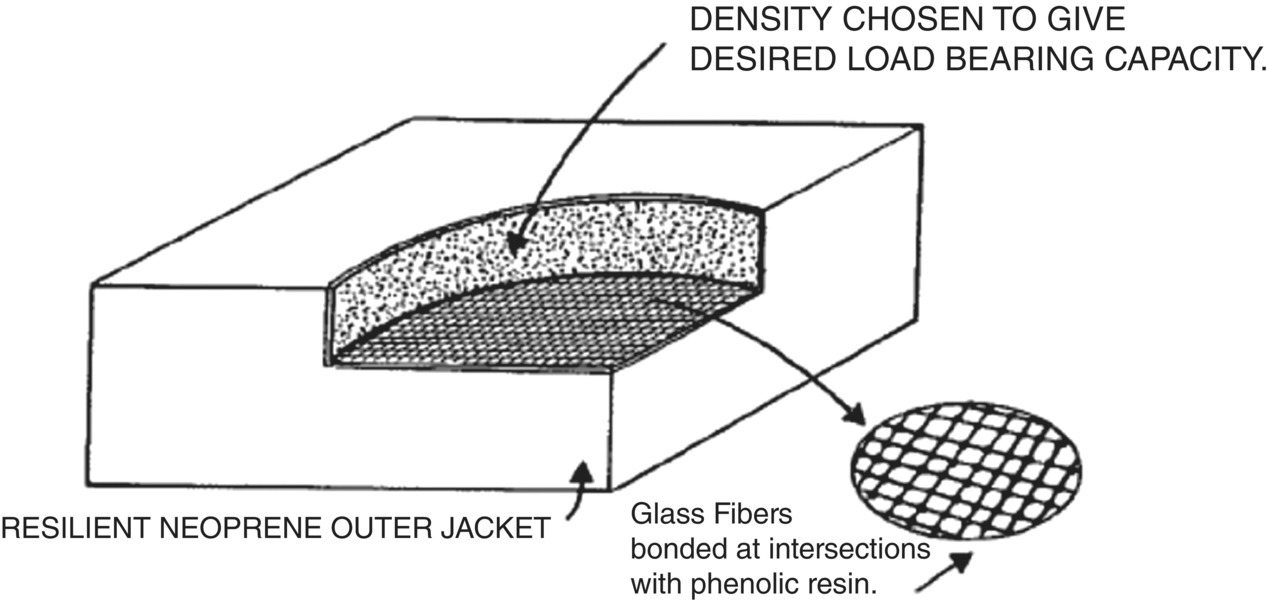
The vibration isolation pads are from 5 to 7.5 cm (2 to 3 in.) thick, spaced approximately 0.3 m (1 ft) apart, and made of molded glass fiber. They are coated with flexible, moisture‐impervious elastomeric membranes, usually made of neoprene, as shown in Figure 13.33. It is essential that the pads do not break down under load, even over a long period of time, and that they are resistant to attack by oil and water, which may leak through the floating floor slab. Once the floating floor and the mechanical room equipment have been installed, it would be extremely costly, if not impossible, to take up the floor and renew the isolation pads. Under load, these pads have the unique property of being able to maintain a constant natural frequency of approximately 14–16 Hz throughout their entire operating range, whether lightly or heavily loaded. Hence they can perform well, even though the exact floor load distribution may not have been accurately determined. This low‐frequency region (14–16 Hz) lies below the lower human audible limit and below the natural frequency of most mechanical room equipment. One should be careful to check that the natural frequency of the isolators does not correspond to the lowest natural frequency of the structural slab. This would cause resonance and not only result in zero or negative isolation, but could result in the fracture of the structural slab itself [27].
The resonance (natural) frequency, fn, of a standard concrete floor slab may be determined from
(13.4)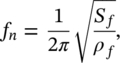
where Sf = dynamic stiffness per unit area in N/m3 and ρf = mass per unit area in kg/m2. A useful “rule of thumb” estimate for the natural frequency of such a concrete slab may be obtained from
(13.5)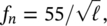
where ℓ is floor span in metres, or
(13.6)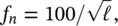
where ℓ is the floor span in feet.
EXAMPLE 13.4
Estimate the fundamental natural frequency of concrete floor span in feet and metres with (a) 9.09 m (30 ft) span, and (b) 18.18 m (60 ft) span.
SOLUTION
- From Eq. (13.5), fn = 55/√9.09 = 55/3.014 = 18.25 HzFrom Eq. (13.6), fn = 100/√30 = 100/5.48 = 18.25 Hz
- From Eq. (13.5), fn = 55/√18.18 = 55/4.26 = 12.91 HzFrom Eq. (13.6), fn = 100/√60 = 100/7.746 = 12.91 Hz.
The improvement ∆Ln in the impact sound transmission of a floating floor varies from between 30 dB per octave for resonantly reacting floors (usually the type used in mechanical rooms) to 40 dB per octave for locally reacting floors. See also discussion on impact sound transmission through floors in Chapter 12.
Apart from increasing the airborne transmission loss and the impact noise rating, a floating floor has one more extremely important advantage. It considerably reduces the amount of acoustical and vibrational energy flowing into the mechanical room structural slab and hence into the whole building structure. In modern concrete multistory buildings, vibration energy can be propagated to all parts of the building with very little attenuation and then can be easily re‐radiated as sound. Hence, the attenuation of this vibration energy must be increased and the floating floor meets this requirement extremely well. Of course, the use of floating floors is not confined to mechanical rooms, and they are often employed in other areas of a building. For example, with music practice rooms or with pedestrian malls, which may pass over low noise areas, floating floors can be used to considerably reduce impact and airborne noise to such an extent that it is undetectable below [27].
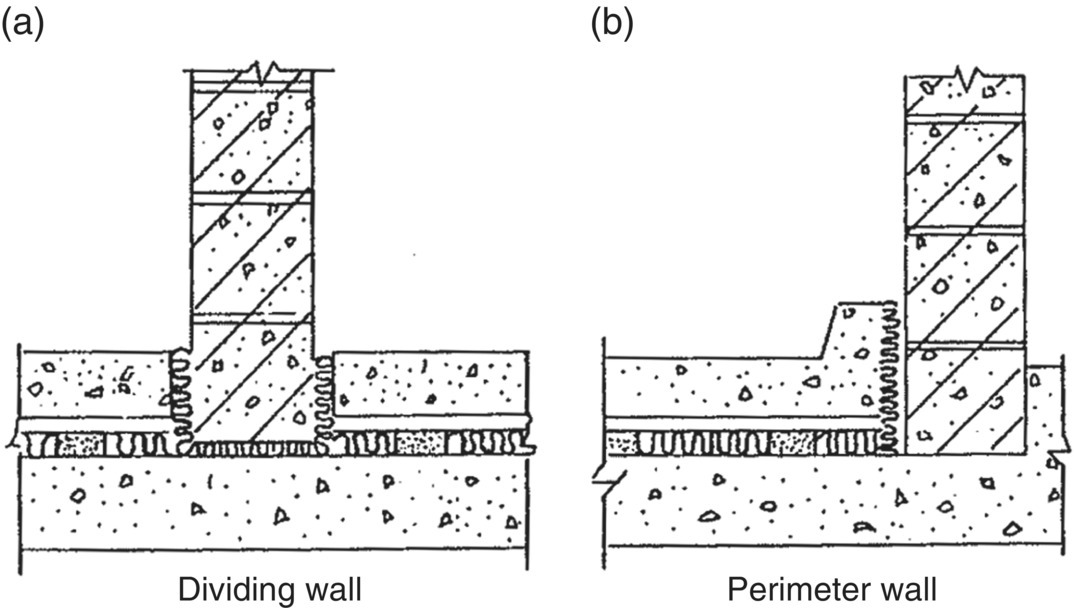
Some typical mechanical room floating floor perimeter and dividing wall structural details are shown in Figure 13.34. The waterproof membrane under the plywood on which the concrete is poured prevents water and oil from reaching the isolation pads and prevents the concrete from forming bridging paths between the floating and structural floor slabs. A completely continuous floating floor is not always necessary, and in some cases a floating base beneath certain noisy pieces of mechanical room equipment may be sufficient. When the sound pressure level in a fan plenum chamber far exceeds that from the surrounding mechanical room equipment, then the whole plenum chamber should be mounted on a floating floor.
Leave a Reply