At present, two groups of models can be identified, handling models and structural or high frequency models. Structural tire models like RMOD-K or F Tire are very complex. These models are computer time consuming and they need a lot a data. Handling models like the MF-formula or TMeasy rely also on measured and observed force-slip characteristics.
Steady State Tire Forces and Torques
For the calculation of the contact patch geometry the tire is considered as a rigid body. Then, the tire deformation, the orientation of the local contact area, the location of the contact point, and the contact point velocities can be calculated from the momentary state of the wheel rim and the description of the road surface. The rolling resistance torque Ty which is less important for vehicle dynamics may be approximated by a rolling resistance lever. Within handling models the steady state tire forces in longitudinal and lateral direction are approximated by appropriate functions
(3.1)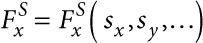
(3.2)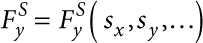
which mainly depend on the longitudinal and lateral slip sx and sy. The steady state torque TSz around an axis perpendicular to the local road plane consists of the self aligning torque 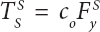 and the bore torque TSB
(3.3)
where co = co (sy) names the tire caster and sB denotes a bore slip.
Simple Dynamic Extension
Measurements show that the dynamic reaction of the tire forces and torques to disturbances can be approximated quite well by first order systems. Then, the dynamic tire torque TDz are given by first order differential equations
(3.4)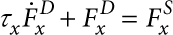
(3.5)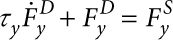
(3.6)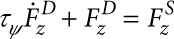
which are driven by the steady values FSx, FSy and TSz. The tread particles of a rolling tire move with the transport velocity rD|Ω| through the contact patch, where rD and Ω denote the dynamic rolling radius and the angular velocity of the wheel. Now, time constants τi, can be derived from so called relaxation lengths ri
(3.7)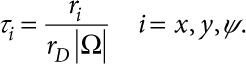
But it turned out that these relaxation lengths are functions of the longitudinal and lateral slip sx, sy and the wheel load Fz, Figure 2. Therefore, constant relaxation lengths will approximate the real tire behavior in zero order approximation only. An appropriate model for the dynamic tire performance would be of great advantage because then, the cumbersome task of deriving the relaxation lengths from measurements can be avoided.
Leave a Reply