Sound fields are usually described in terms of sound pressure, which is the quantity we hear. However, sound fields are also energy fields, in which kinetic and potential acoustic energies are generated, transmitted, and dissipated. The acoustic energy in a sound field is not only of interest theoretically, but it is of practical importance as well. Energy considerations are useful in room acoustics and also in noise control engineering problems. Determination of the sound power radiated by a source is a basic quantity needed in the control of noise. At any point in a sound field, in the absence of mean fluid flow, the instantaneous intensity vector I(t) expresses the magnitude and direction of the instantaneous flow of sound energy as follows:
(8.1)
where p(t) and u(t) are the instantaneous sound pressure and vector particle velocity at a point in the sound field.
By combining the fundamental equations that govern a sound field, the equation of mass continuity, the adiabatic relation between sound pressure and density change, and Euler’s equation of motion (Newton’s second law), one can derive the equation [23, 24]
(8.2)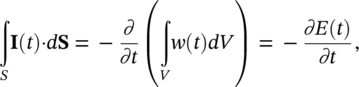
in which w(t) is the instantaneous total sound energy density, S is the area of an enclosing surface, V is the volume of fluid contained by the surface S, and E(t) is the instantaneous total sound energy within the surface. The left‐hand term is the net outflow of sound energy through the surface, and the middle and right‐hand terms are the rate of change of the total sound energy within the surface. This is the equation of conservation of sound energy, which expresses the simple fact that the net flow of sound energy out of a closed surface equals the (negative) rate of change of the sound energy within the surface, because the energy is conserved.
In practice the time‐averaged intensity
(8.3)
is more important than the instantaneous intensity. Examination of Eq. (8.2) leads to the conclusion that the time average of the instantaneous net flow of sound energy out of a given closed surface is zero unless there is generation (or dissipation by sound absorption) of sound power within the surface; in this case the time average of the net flow of sound energy out of a given surface enclosing a sound source is equal to the net sound power of the source. In other words,
(8.4)
unless there is a steady source (or a sink) within the surface, irrespective of the presence of steady sources outside the surface, and
(8.5)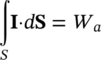
if the surface encloses a steady sound source that radiates the sound power Wa, irrespective of the presence of other steady sources outside the surface. In practice, Eq. (8.5) cannot be used to measure the sound power Wa of a source, if sources situated outside the surface S are unsteady (e.g. time‐varying background noise) and/or there is sound‐absorbing material inside the surface.
If the sound field is simple harmonic with angular frequency ω = 2πf, then from Eq. (8.1), the sound intensity in the r‐direction is of the form
(8.6)
where φ is the phase angle between the sound pressure p(t) and the particle velocity, ur(t) in the r‐direction. (For simplicity we consider only the component in the r‐direction here.) It is common practice for a simple harmonic wave in a stationary sound field to rewrite Eq. (8.3) as
(8.7)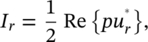
where both the sound pressure p and the particle velocity ur here are complex exponential quantities, and  denotes the complex conjugate of ur. The time averaging gives the factor of ½. We note that the use of complex notation is mathematically very convenient and that Eq. (8.7) gives the same result as Eq. (8.6). We note that by using the complex notation, we lose the time dependence of the instantaneous intensity, thus considerable care must be taken in making the correct physical interpretation of the mathematical results when using complex notation.
In a plane progressive wave (of any waveform) traveling in the r‐direction, the sound pressure p and the particle velocity ur, are in phase (φ = 0) and related by the characteristic impedance of the medium, ρc, where ρ is the density and c is the speed of sound:
(8.8)
Thus, for a plane wave, the time‐average sound intensity is
(8.9)
In this case the sound intensity is simply related to the mean square sound pressure p2rms, which can be measured with a single microphone. Eq. (8.9) also holds sufficiently far from any source of any arbitrary time history and frequency content since in the far geometric field the wave fronts can be regarded as locally plane surfaces. If the characteristic impedance, ρc, is assumed to be equal to 400 kg/m2s, then the sound intensity level normal to the wavefronts far from any source is
(8.10)
This is a result of the choice of reference values for sound pressure of pref = 20 × 10−6 Pa (N/m2) and sound intensity Iref = 10−12 watt/m2. However, in normal ambient conditions in air at sea level,
(8.11)
and the error in Eq. (8.10) is about 0.1 dB. In most practical cases, however, the sound intensity is not simply related to the sound pressure. Examination of Eq. (8.1) shows that both the sound pressure and the particle velocity must be estimated simultaneously and that their product must be time‐averaged. This requires the use of a more complicated device than a single microphone.
Leave a Reply