The purposes of drum used in boiler are as follows:
- To store water and steam sufficiently to meet varying load requirements.
- To aid in circulation.
- To separate vapour or steam from water-steam mixture, discharged by the risers.
- To provide enough surface area for liquid vapour disengagement.
- To maintain a certain desired ppm in the drum by phosphate injection and blow down.
A mixture of water, steam, foam and sludge is discharged into the drum by the risers. Steam must be separated from the mixture before it leaves the drum. Any moisture carried with steam to the superheater tubes contains dissolved salts. In the superheater, water evaporates and the salts remain deposited on the inside surface of the tubes to form a scale, which is difficult to remove. This scale reduces the rate of heat absorption which ultimately leads to the failure of the superheater tubes by overheating and rupture. The superheater tubes are exposed to the highest steam pressure and temperature on the inside and the maximum gas temperature on the outside. The superheater tubes are made of very costly material and utmost care should be exercised so that no damage is done to them by the excessive moisture in steam. Some of the impurities in steam may be vaporised silica, which may cause turbine blade deposits.
No vapour bubbles should flow along with saturated water from the drum to the downcomers. This will reduce the density difference and the pressure head for natural circulation. The bubbles tending to flow upward may also impede the flow in the downcomer and thus affect circulation. The drum has to secure moisture-free steam going to superheater and bubble-free water going to the downcomers as shown in Fig. 3.15.
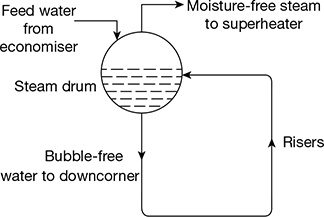
Figure 3.15 Functions of steam drum
Leave a Reply