The velocities of air encountered in centrifugal compressors are very high as compared to that in reciprocating compressors. Therefore, total head quantities should be taken into account in the analysis of centrifugal compressors. The total head quantities account for the kinetic energy of the air passing through the compressor.
Consider a horizontal passage of varying area of cross-section, as shown in Fig. 14.4, through which air flows from left to right. Assuming no external heat transfer and work transfer to the system, the steady flow energy equation for one kg mass of air flow can be written as:
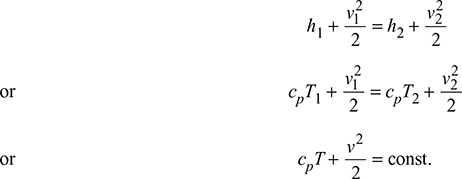
Temperature T is called the ‘static temperature’; it is the temperature of the air measured by a thermometer moving with the air velocity. If the moving air is brought to rest under reversible adiabatic conditions, the total kinetic energy of the air is converted into thermal energy, thereby increasing its temperature and pressure. This temperature and pressure of the air are known as ‘stagnation’ or ‘total head’ temperature and pressure. The stagnation quantities are denoted by a suffix notation o.
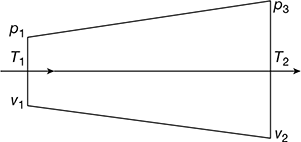
Figure 14.4 Passage of air through varying area of cross-section

where T0 = stagnation or total head temperature


where h0 = stagnation or total head enthalpy
The stagnation pressure can be obtained by using the following equation:

where p, T = static pressure and temperature
p0, T0 = stagnation pressure and temperature.
Leave a Reply