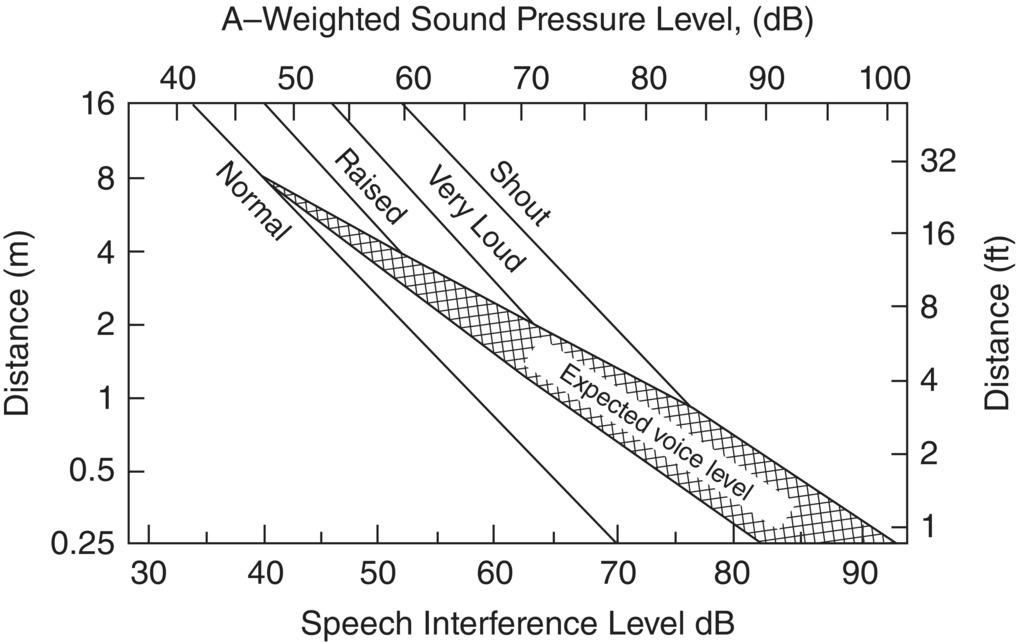
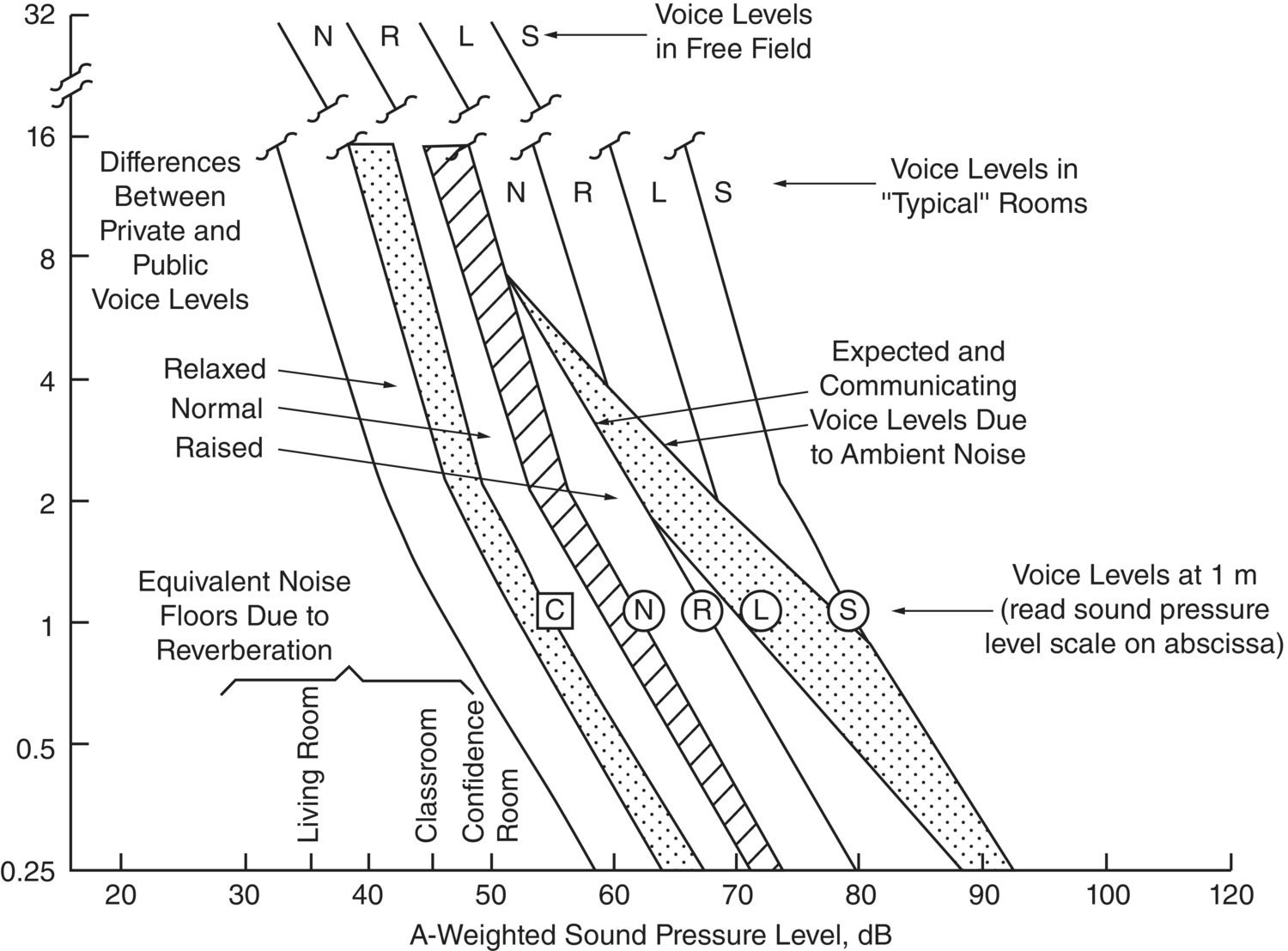
The SIL is a measure used to evaluate the effect of background noise on speech communication [17]. The SIL is the arithmetic average of the SPLs of the interfering background noise in the four octave bands with center frequencies of 500, 1000, 2000, and 4000 Hz (see ANSI S3.14–1977(R‐1986)). If the SIL of the background noise is calculated, then this may be used in conjunction with Figure 6.5 to predict the sort of speech required for satisfactory face‐to face communication with male voices (i.e. for at least 95% sentence intelligibility). As an example, if the SIL is 40 dB and the speakers are males, they should be able to communicate with normal voices at 8 m. If the SIL increases to 50, a raised voice must be used at 8 m. For females the SIL should be decreased by 5 dB (or the x‐axis moved to the right by 5 dB). The shaded area of Figure 6.5 shows the range of speech levels that normally occur as people raise their voices to overcome the background noise. Because it is simpler to measure than the SIL, the A‐weighted SPL is sometimes used as a measure of speech interference, but with somewhat less confidence. Webster has produced a comprehensive diagram (see Figure 6.6) that summarizes speech levels required for communication (at various distances) with 97% intelligibility of sentences for both outdoor and indoor situations [20]. Figure 6.6 is similar to Figure 6.5 but contains some additional information concerning voice levels in different situations. With noise levels above 50 dB, people tend to raise their voice levels as shown by the “expected line” (at the left) for nonvital communication and the “communicating line” (at the right) of the diagonal shaded area for essential communication.
EXAMPLE 6.2
Background noise levels for an industrial plant were measured to be 45, 54, 56, and 45 dB respectively in the 500‐, 1000‐, 2000‐, and 4000‐Hz center frequency bands. What is the SIL and at what distances could people communicate satisfactorily?
SOLUTION

Thus, from Figure 6.5, men could communicate satisfactorily at 2 m (perhaps even 2.5 m) with a normal voice and 4 m (perhaps even 5 or 6 m) with a raised voice. Women could communicate satisfactorily with a normal voice at 1 m (perhaps up to 1.5 m) and with a raised voice at 2 m (perhaps up to 2.5 m).
Leave a Reply