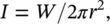
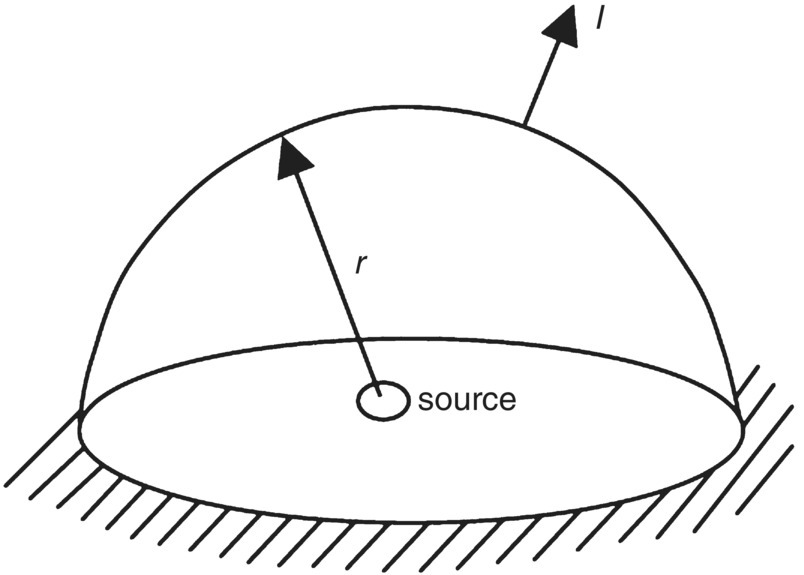
In practice many real engineering sources (such as machines and vehicles) are mounted or situated on hard reflecting ground and concrete surfaces. If we can assume that the source of sound power W radiates only to a half‐space solid angle 2π, and no power is absorbed by the hard surface (Figure 3.10), then
(3.52)
where LW is the sound power level of the source and r is the distance in metres.
In this discussion we have assumed that the sound source radiates the same sound intensity in all directions; that is, it is omnidirectional. If the source of sound power W becomes directional, the mean square sound pressure in Eqs. (3.48) and (3.46) will vary with direction, and the sound power W can only be obtained from Eqs. (3.41) and (3.47) by measuring either the mean‐square pressure (p2rms) all over a surface enclosing the source (in the far acoustic field, the far field) and integrating Eq. (3.47) over the surface, or by measuring the intensity all over the surface in the near or far acoustic field and integrating over the surface (Eq. (3.41)). We shall discuss source directivity in Section 3.9.
EXAMPLE 3.10
If the sound power level of a source is 120 dB (which is equivalent to 1 acoustical watt), what is the sound pressure level at 50 m (a) for sound radiation to whole space and (b) for radiation to half space?
SOLUTION
- For whole space: I = 1/4π(50)2 = 1/104 π (W/m2), then



- Since we may assume r = 50 m is in the far acoustic field, Lp ≅ LI = 75 dB as well (we have also assumed ρc ≅ 400 rayls).
- For half space: I = 1/2π(50)2 = 2/104 π (W/m2), then



and Lp ≅ LI = 78 dB also.
- It is important to note that the sound power radiated by a source can be significantly affected by its environment. For example, if a simple constant‐volume velocity source (whose strength Q will be unaffected by the environment) is placed on a floor, its sound power will be doubled (and its sound power level increased by 3 dB). If it is placed at a floor–wall intersection, its sound power will be increased by four times (6 dB); and if it is placed in a room comer, its power is increased by eight times (9 dB). See Table 3.2. Many simple sources of sound (ideal sources, monopoles, and real small machine sources) produce more sound power when put near reflecting surfaces, provided their surface velocity remains constant. For example, if a monopole is placed touching a hard plane, an image source of equal strength may be assumed.
| Intensity | Source | Condition | Number of Images |  | Power | D | DI |
|---|---|---|---|---|---|---|---|
| I |  | Free field | None |  | W | 1 | 0 dB |
| 4 I | 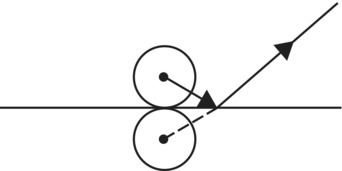 | Reflecting plane | 1 |  | 2W | 4 | 6 dB |
| 16 I | 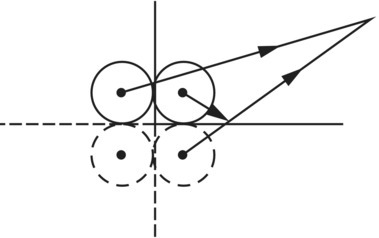 | Wall‐floor intersection | 3 |  | 4W | 16 | 12 dB |
| 64 I | 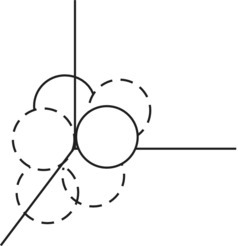 | Room corner | 7 |  | 8W | 64 | 18 dB |
Leave a Reply