When comparing different wall constructions, it is often convenient to use a single‐number rating instead of the complicated transmission loss (or normalized NR) which varies with frequency. Early single‐number ratings were obtained by simply averaging the TL (or normalized NR) in the frequency range of interest. Although such a system may be useful in rating walls, it can be misleading because frequency information is lost. This approach is probably satisfactory for brick walls since the critical coincidence frequency is very low (about 80 Hz), and the TL tends to increase continually with frequency in the range of interest. However, with the increasing use of lightweight partitions in buildings, coincidence dips often appear in the frequency range 100–3150 Hz; hence, two partitions with very different TL against frequency curves may have the same average TL. This could be quite serious if the transmission room noise source were intense in the frequency range of the coincidence dip of one of the partitions.
Obviously, knowledge of the noise source spectrum would be necessary in order to specify the acoustical performance required of a partition. However, often the source spectrum is not precisely known and can vary with time and the particular building. For this reason, some researchers have assumed typical transmission room source spectra and criteria for the levels to be tolerated in the receiving room (see Chapter 6 of this book). Another approach which was adopted in the early 1950s in Great Britain and other European countries resulted from several social surveys in Britain, Sweden, Netherlands, and France [81–84]. The British and Swedish studies were conducted on several hundred semidetached houses and apartments. About half of the houses had common 9 in. (230 mm) solid brick party walls, while half had common two‐layer concrete party walls separated by an air cavity. The concrete party walls provided higher TL at high frequency than the brick walls. The inhabitants of the houses and apartments were questioned about their living conditions and were asked if they felt the walls provided sufficient sound insulation. In short, it appeared that the single brick party wall provided acceptable sound insulation between houses and apartments in most cases. Interestingly, the massive single brick party wall is intended to serve primarily as a fire, rather than an acoustical, barrier.
Since the brick party wall appeared to be acceptable acoustically in most cases, it was adopted in Great Britain in the 1950s as the criterion against which other lightweight structures have to be judged. The approach now used in most countries is to judge the insulation performance of a partition relative to a standard reference curve which is a little higher in the mid‐frequency range. The weighted sound reduction index (Rw) is the value of the ISO reference curve at 500 Hz when it is shifted vertically so as to ensure that the sum of unfavorable deviations is as large as possible, but not more than 32 dB (for measurements in one‐third octave bands) or 10 dB (for one‐octave bands). The reference value of the ISO curve is 52. Measurements should comply with ISO 10140‐2 [67] or ISO16283‐1 [79], although measurements carried out in accordance with the outdated ISO140‐1 [85] and ISO140‐5 [86] standards are also allowed.
In the U.S., the ISO contour has been adopted by ASTM for use in the STC scheme [87]. Measurements should comply with the standard E90 [68] or E336 [78]. There are some differences between the procedure to calculate Rw and STC values. In the ASTM procedure, measurements of sound attenuation are obtained only in one‐third octave bands. The STC value is calculated so that the sum of the deficiencies (the differences between the data points below the contour and the contour value) must be less than or equal to 32 dB. In addition, no deficiency can exceed 8 dB at any one frequency (the 8‐dB rule). The STC contour covers the range 125–4000 Hz, while the ISO contour covers the range 100–3150 Hz. For this reason, a partition may have a slightly higher STC rating than the ISO rating because the TL of most partitions increases with frequency. However, the numerical values of the two single‐number ratings are usually very similar. The 8 dB maximum deficiency limitation was introduced to prevent considerable transmission in a narrow frequency band caused by a narrow‐band noise source. Note that sharp TL dips are often found in lightweight panels because of coincidence effects. An example of the calculation of a STC rating is illustrated in Figure 12.44 [88]. In Figure 12.44a, ¼‐in. (6.4 mm) monolithic glass is shown to have an STC rating of 31. In this example, the STC contour placement is constrained by the maximum allowed 8 dB deficiency at 2500 Hz. In Figure 12.44b, which shows TL data for ¼‐in. (6.4 mm) laminated glass, the sharp dip in the TL data, characteristic of ¼‐in. monolithic glass, is removed by use of the damping interlayer and the ¼‐in. laminated glass is shown to have an STC rating of 35, In this case, the STC contour placement is constrained by the maximum 32‐dB deficiency requirement.
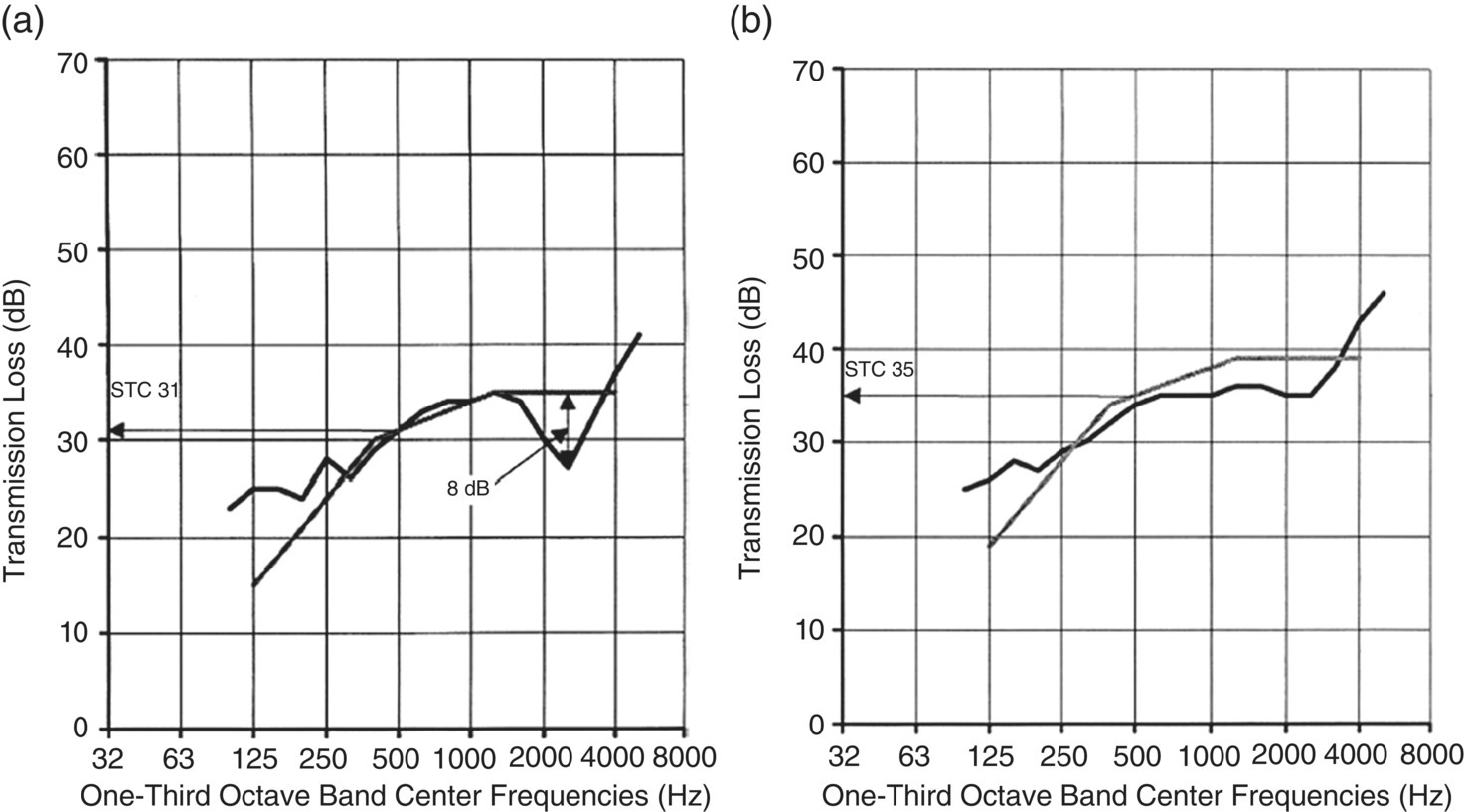
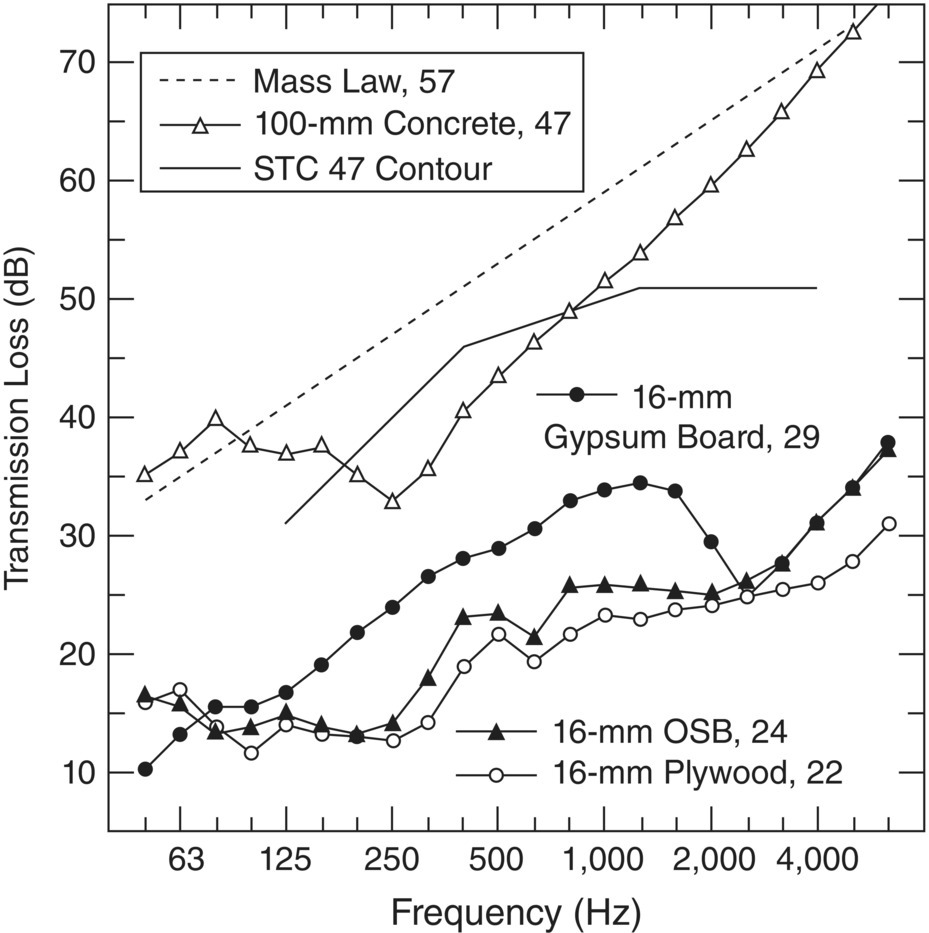
Figure 12.45 shows the STC contour fitted to the data for a concrete slab and the STC ratings of some common building materials reported by Warnock [20]. Warnock states that rough representative values of STC for block walls [89] can be estimated from STC = 0.51 × block weight (kg) + 38. (The dimensions of the block face are 190 × 390 mm). The estimated values are valid if the wall surfaces are properly sealed and the mortar joints well made.
ISO 717‐1 [90] takes into consideration the greater importance of low frequencies in noise sources inside a building and traffic outside a building using weighted summation methods. These methods produce corrections (called spectrum adaptation terms) to the Rw ratings by using either an A‐weighted pink noise or a specific urban traffic noise spectrum defined in the standard. Note that the overall spectrum levels are normalized to 0 dB for both types of noise sources. Single‐number ratings can be combined with one of the spectrum adaptation terms as a sum to characterize the sound insulating properties of building elements or the acoustical performance between rooms inside buildings or from the outside to the inside [91]. In addition, national, special rules have been added in some countries to compensate for shortcomings or difficulties of field test procedures and conditions [92]. ASTM uses a single‐number rating called the outdoor–indoor transmission class (OITC), calculated in accordance with standard E1332 [93]. This rating is used for comparing the sound insulation performance of building facades and façade elements and its value increases with increasing sound isolation ability. The rating has been devised to quantify the ability of these to reduce the perceived loudness of ground and air transportation noise transmitted into buildings. Like ISO, the procedure to determine the OITC also uses a standard source spectrum and sound transmission loss data. However, the OITC does not involve a contour fitting process.
The field sound transmission class (FSTC) rating is used by the ASTM to assess the sound isolation performance from TL measured in the field in accordance with the standard E336 [78]. This rating is similar to weighted apparent sound reduction index (R′w) used in Europe and in the ISO standard [90].
Although single number ratings determined from laboratory and field measurements are intended by standards to be equivalent, practical experience has indicated that field‐measured ratings tend to be up to five rating points less than laboratory‐measured ratings [88]. Over the years, several other rating or grading schemes have been proposed. Tocci has presented a comprehensive discussion on ratings and descriptors for the built acoustical environment [88].
EXAMPLE 12.19
A partition of total area of 11 m2 consists of a double brick wall (STC of 50 and area of 10 m2) and a 3‐mm fixed glazing window (STC of 25 and area of 1 m2). What is the effective STC of the partition?
SOLUTION
The STC of the composite wall can be approximately calculated using the same procedure described in Section 12.5 with STC treated as TL. Then, the effective STC of the combination is STCeff = 10 × log[11/(10 × 10−5 + 1 × 10−2.5)] = 10 log(11 × 306.5) = 35.
EXAMPLE 12.20
A wall in a recording studio must incorporate a window unit. The wall has an STC = 56. The wall and the window have fractional areas of 0.75 and 0.25 of the total area, respectively. For design purposes the required combined sound transmission class is STC = 50. What are the insulation requirements for the window?
SOLUTION
We write STCeff = 10 × log[1/(0.75 × 10−5.6 + 0.25 × 10−STC/10)] = 50. Solving for the STC of the window unit:


Therefore, the insulation requirements for the window unit are high and a special acoustical window made of either double or triple glazing would be a solution for the recording studio.
Leave a Reply