Spark ignition engine emissions are divided into three categories as exhaust emission, evaporative emission, and crank case emission.
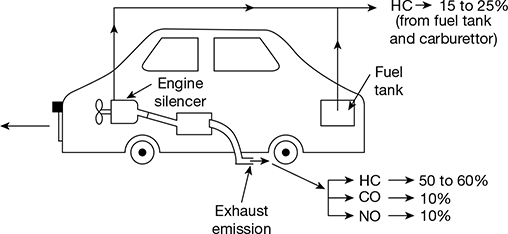
Figure 11.19 Emissions from SI engines
The major constituents which contribute to air pollution are CO, NOx, and hydrocarbons (HC) coming from SI engine exhaust. The percentages of different constituents coming out from the above three mentioed sources are shown in Fig. 11.19.
The relative amounts depend on the engine design and operating conditions but are of order, NOx → 500 to 1000 ppm (20 g /kg of fuel), CO → 1 to 2% (200 g /kg of fuel) and HC → 3000 ppm(25 g /kg of fuel). Fuel evaporation from the fuel tank and the carburettor exists even after engine shut down and these are unburned HCs. However, in most modern engines, these non-exhaust unburned HCs are effectively controlled by returning the blow-by gases from the crank case to the engine intake system by venting the fuel tank and through a vapour-absorbing carbon cannister which is purged as some parts of the engine intake air during normal engine operation.
The other constituents include SO2 and lead compounds. Petrol rarely contains sulphur; therefore, SO2 is not a pollutant from the SI engine exhaust. Petrol contains lead in small percentages but its effect is more serious on human health.
The processes by which pollutants form within the cylinder in a conventional SI engine are qualitatively illustrated in Fig. 11.19. It shows the formation of pollutants during four strokes of the cycle. NO forms throughout the high temperature burned gases behind the flame through chemical reactions. NO formation rate increases with an increase in gas temperature. As the burned gases cool, during expansion stroke, the reactions involving NO freeze and leave NO concentrations far in excess of levels corresponding to equilibrium temperature at exhaust conditions.
CO also forms during combustion process with lean A:F mixtures, and there is sufficient O2 to burn all the carbon in the fuel to CO2. However, in high temperature products even with lean mixtures, there is sufficient CO in exhaust because of dissociation of CO2. Later, in expansion stroke, the CO oxidation process also freezes as the gas temperature falls.
The unburned hydrocarbon emission comes from different sources. During compression and combustion, the increasing cylinder pressure forces some of the gases in the cylinder into crevices connected to combustion chamber, the volumes between the piston rings and cylinder wall are the largest of these. Most of this gas entering into crevices is unburned air fuel mixture escaped from primary combustion zone. This happens because the flame cannot enter these narrow crevices. The gas which leaves these crevices later in the expansion and exhaust processes is one source of unburned HC emissions. The combustion chamber walls are another possible source. A quench layer containing unburned and partially burned A:F mixture is left at the wall when the flame dies as it approaches the wall. This unburned HC in this layer (0.1 mm) burns rapidly if the combustion chamber walls are clean. The next source of HC is the thin layer of lubricating oil on cylinder wall, and the piston which absorbs HC before and after combustion. A final source of HC in engines is incomplete combustion due to bulk quenching of the flame in that fraction of engine cycle where the combustion is especially slow. This unburned HC near the cylinder wall is exhausted during exhaust stroke as the piston pushes the gases out.
1 Exhaust Emissions
The major exhaust emissions are as follows:
- Unburnt hydrocarbons, (HC)
- Oxides of carbon, (CO and CO2)
- Oxides of nitrogen, (NO and NO2)
- Oxides of sulphur, (SO2 and SO3)
- Particulates
- Soot and smoke
The various exhaust emissions from petrol engine are as follows:
- Unburnt hydrocarbons (HC): The causes for the emissions of HC are incomplete combustion, crevice volumes and flow in crevices, leakage past the exhaust valve, valve overlap, deposits on walls, and oil on combustion chamber walls.The reasons for incomplete combustion are improper mixing of air and fuel, and flame quenching at the walls of the cylinder. Low load and idle conditions increase HC.
- Oxides of Carbon (CO and CO2): Carbon monoxide is generated with a rich fuel-air ratio mixture. This happens during starting and accelerating under load. Poor mixing, local rich regions, and incomplete combustion are the sources of CO emissions.
- Oxides of Nitrogen (NOx): NOx are created mostly from nitrogen in the air and fuel blends.In addition to temperature, the formation of NOx depends on pressure, A/F ratio, combustion duration, and location of spark plug.
- Oxides of Sulphur (SOx): These are generated due to the presence of sulphur in the fuel. SO2 and SO3 react with water to give rise to H2SO3 and H2SO4, which causes acid rain.
The variation of emissions from a petrol engine with A/F ratio is shown in Fig. 11.20.
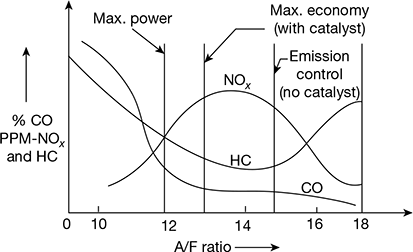
Figure 11.20 Variation of emissions with A/F
2 Evaporative Emission
As mentioned earlier, there are two main sources of evaporative emissions—the fuel tank and the carburettor. The main factors governing the tank emissions are fuel volatility and ambient temperature but the tank design and location can also influence the emissions as location affects the temperature. Insulation of the fuel tank and vapour collection systems have all been explored with a view to reduce the tank emissions.
Carburettor emission may be divided into two categories as running losses and parking losses. Most internally vented carburettors have an external vent which opens at idle throttle position. The existing pressure forces prevent outflow of vapours to the atmosphere. Internally vented carburettor may enrich the mixture which, in turn, increases exhaust emission. Carburettor losses are significant only during hot conditions when the vehicle is in operation. Fuel volatility also affects the carburettor emissions.
3 Crankcase Emission
It consists of engine blow by-gases and crank case lubricant fumes. From the point of view of pollution, blow-by gases are the most important. The blow-by is the phenomenon of leakage past the piston from the cylinder to the crankcase because of pressure difference. The blow of HC emissions is about 20% of the total HC emission from the engine. This is further increased to 30% if the piston-rings are worn.
4 Lead Emission
Lead emissions come only from SI engines. The lead is present in the fuel as lead tetraethyl or tetramethyl, to control the self-ignition tendency of fuel-air mixtures that is responsible for knock.
Leave a Reply