1 Selection of Inside Design Conditions
The inside design conditions depend on the particular air-conditioning system. The important air-conditioning systems are:
1. Cold storage, 2. Industrial air-conditioning, 3. Comfort air conditioning
Table 20.1 Storage conditions and properties of food products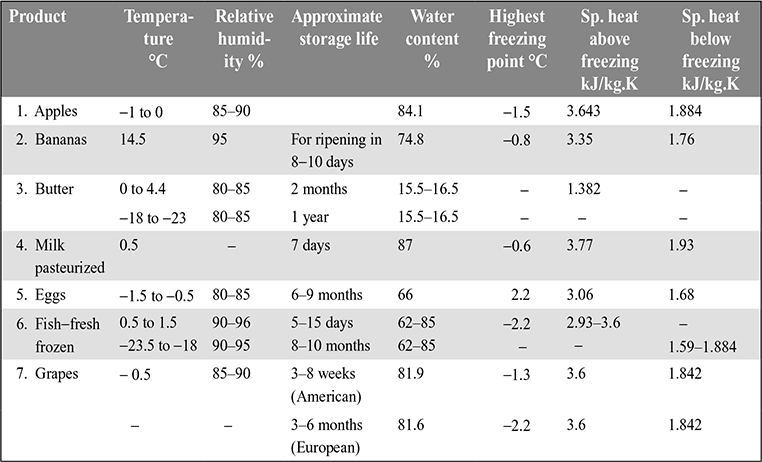
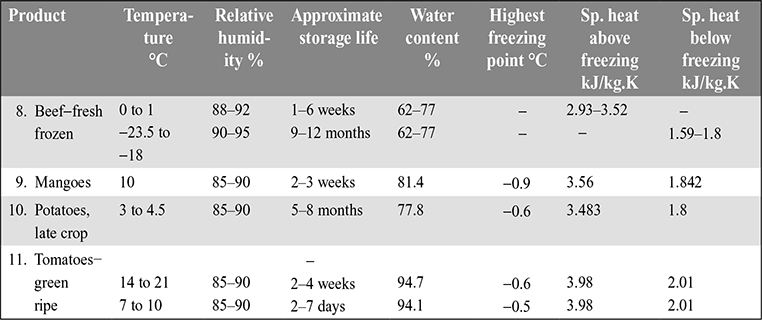
- Cold Storage: In a cold storage air-conditioning system, the room air is cooled to much lower temperature over a cooling coil and supplied back to the storage space. The condition-maintained inside the storage space depend on the nature of the product stored. In cold storages, strict control of both temperature and relative humidity is required. The required storage conditions for a number of products are given in Table 20.1.
- Industrial Air-conditioning: The inside design conditions for industrial air-conditioning depend on the category of application. One category comprises those where constancy of temperature is the prime consideration, such as metrology laboratories, precision machine tools, computer centres, etc. In these applications a variation in relative humidity of 10 to 20 percent will not have much effect. The other category may comprise paper and textile mills where the relative humidity is to be maintained constant at a high value of 70 to 75 percent. The temperature requirements of such spaces are not severe. In another category of applications, strict control of both temperature and relative humidity is required, such as chemical and biological process industries.
- Comfort air-conditioning: This has been dealt with in art 20.11.
2 Selection of Outside Design Conditions
For the outside design conditions in summer, it is recommended to use the mean monthly maximum dry bulb temperature and its corresponding wet bulb temperature.
During winter it has been observed that the fuel consumption for heating of buildings varies also directly as the difference between the outside temperature and a reasonably comfortable inside temperature of 18.5°C. Thus the power consumption would be practically nil if the outside temperature is 18.5°C. On the other hand, the power consumption would double if the outside temperature drops from 18.5°C to 8.5°C. A degree-day is obtained for every degree when the mean outside temperature is below 18.5°C during the 24 hour period. If in a given locality the outside temperature average of 30 days is 10°C, then the degree days (D) for the period would be
D = (18.5 − 10) × 30 = 255
The outside design temperature may be calculated as follows:

where tdo = outside design temperature.
Leave a Reply