For a homogeneous plane sound wave at normal incidence on a fluid medium of different characteristic impedance ρc, both reflected and transmitted waves are formed (see Figure 3.13).
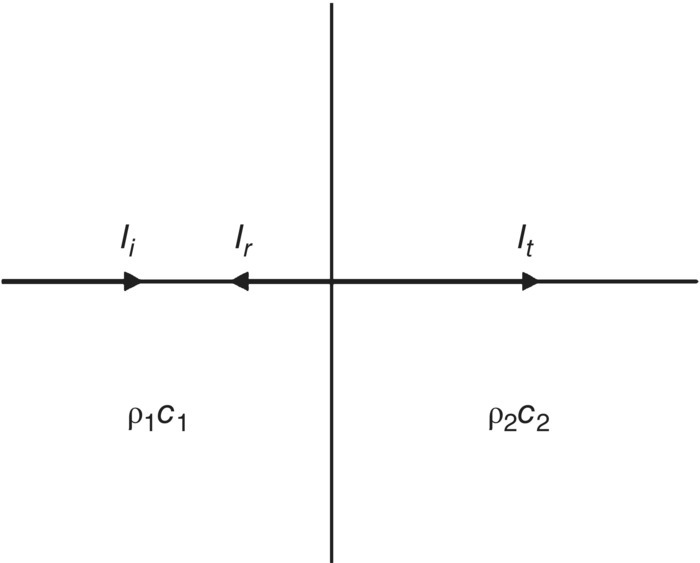
From energy considerations (provided no losses occur at the boundary) the sum of the reflected intensity Ir and transmitted intensity It equals the incident intensity Ii:
(3.64)
and dividing throughout by Ii,
(3.65)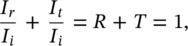
where R is the energy reflection coefficient and T is the transmission coefficient. For plane waves at normal incidence on a plane boundary between two fluids (see Figure 3.13):
(3.66)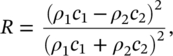
and
(3.67)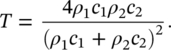
Some interesting facts can be deduced from Eqs. (3.66) and (3.67). Both the reflection and transmission coefficients are independent of the direction of the wave since interchanging ρ1 c1 and ρ2 c2 does not affect the values of R and T. For example, for sound waves traveling from air to water or water to air, almost complete reflection occurs, independent of direction; the reflection coefficients are the same and the transmission coefficients are the same for the two different directions.
EXAMPLE 3.12
A plane sound wave in air is incident normally on a boundary between air and water. If each medium can be assumed to be infinite in extent, compute the energy reflection and transmission coefficients.
SOLUTION
At standard temperature and atmospheric pressure we have that in water ρ = 998 kg/m3 and c = 1480 m/s. Then, the characteristic impedance of water is ρc = 1 480 000 rayls.
Then, R = [(415–1 480 000)/(415 + 1 480 000)]2 = 0.999 and
T = 4(415)(1 480 000)/(415 + 1 480 000)2 = 0.001, or simply T = 1–R = 0.001. Therefore, when a sound wave passes from air to water most of its energy is reflected back because of the impedance offered by the liquid medium.
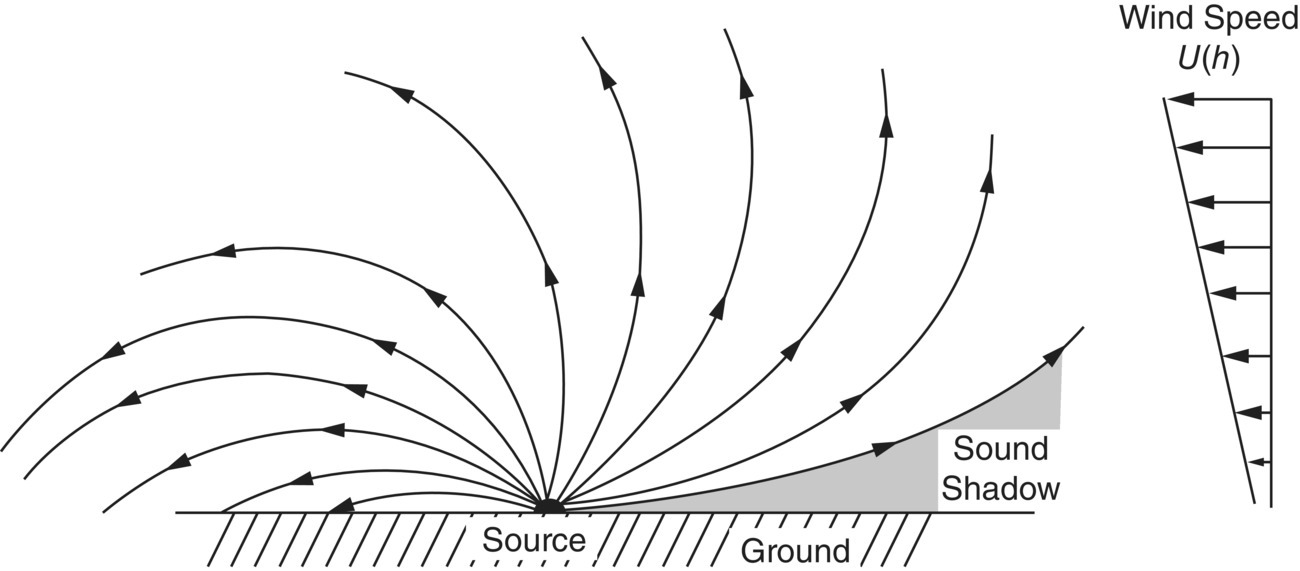
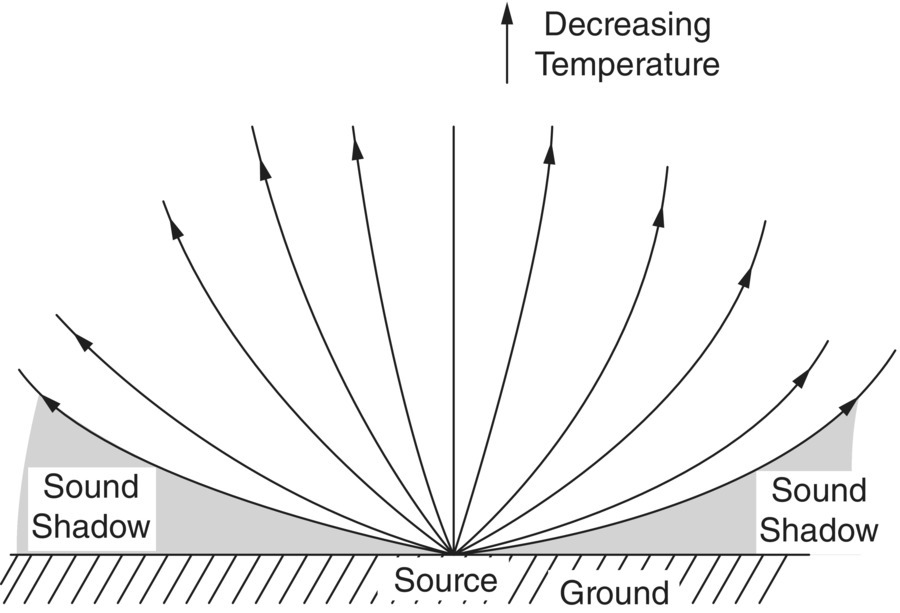
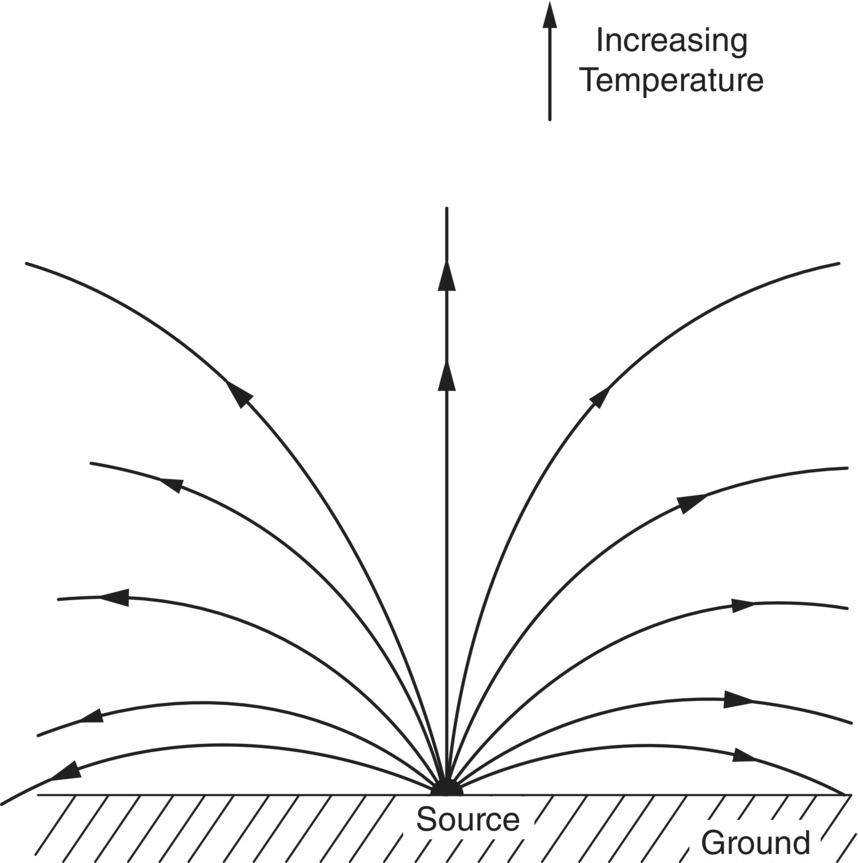
As discussed before, when the characteristic impedance ρc of a fluid medium changes, incident sound waves are both reflected and transmitted. It can be shown that if a plane sound wave is incident at an oblique angle on a plane boundary between two fluids, then the wave transmitted into the changed medium changes direction. This effect is called refraction. Temperature changes and wind speed changes in the atmosphere are important causes of refraction.
Wind speed normally increases with altitude, and Figure 3.14 shows the refraction effects to be expected for an idealized wind speed profile. Atmospheric temperature changes alter the speed of sound c, and temperature gradients can also produce sound shadow and focusing effects, as seen in Figures 3.15 and 3.16.
When a sound wave meets an obstacle, some of the sound wave is deflected. The scattered wave is defined to be the difference between the resulting wave with the obstacle and the undisturbed wave without the presence of the obstacle. The scattered wave spreads out in all directions interfering with the undisturbed wave. If the obstacle is very small compared with the wavelength, no sharp‐edged sound shadow is created behind the obstacle. If the obstacle is large compared with the wavelength, it is normal to say that the sound wave is reflected (in front) and diffracted (behind) the obstacle (rather than scattered).
In this case when the obstacle is large a strong sound shadow is caused in which the wave pressure amplitude is very small. In the zone between the sound shadow and the region fully “illuminated” by the source, the sound wave pressure amplitude oscillates. These oscillations are maximum near the shadow boundary and minimum well inside the shadow. These oscillations in amplitude are normally termed diffraction bands. One of the most common examples of diffraction caused by a body is the diffraction of sound over the sharp edge of a barrier or screen. For a plane homogeneous sound wave it is found that a strong shadow is caused by high‐frequency waves, where h/λ ≥ 1 and a weak shadow where h/λ ≤ 1, where h is the barrier height and λ is the wavelength. For intermediate cases where h/λ ≈ 1, a variety of interference and diffraction effects are caused by the barrier.
Scattering is caused not only by obstacles placed in the wave field but also by fluid regions where the properties of the medium such as its density or compressibility change their values from the rest of the medium. Scattering is also caused by turbulence (see chapters 5 and 28 in the Handbook of Acoustics [1]) and from rain or fog particles in the atmosphere and bubbles in water and by rough or absorbent areas on wall surfaces.
Leave a Reply