14.4.1 Wheel–Rail Interaction Noise
Noise produced by wheel–rail interaction continues to be of concern in railway operations. Many studies have been conducted on wheel–rail interaction noise. Most of the studies have involved various measurement approaches [77–85]. Main wheel–rail sources include (i) rolling noise, which is caused by small‐scale vertical profile irregularities (roughness) of wheel and rail, (ii) impact noise caused by discrete discontinuities of the profile such as wheel flats, rail joints, or welds, and (iii) squeal noise that occurs in curves. In each case, the noise is produced by vibrations of the wheels and track. The dynamic properties of the wheel and track have an affect on the sound radiation. Control measures for rolling noise include reduced surface roughness, wheel shape optimization and added wheel passive damping treatments, increased rail support stiffness, or use of local wheel–rail shielding. The use of trackside noise barriers is becoming common for railways [86]. For squeal noise, mitigation measures include friction control by lubrication or friction modifiers. Reference [87] discusses causes of wheel–rail noise and methods for its control.
A train running on straight unjointed track produces rolling noise. This is a broadband, random noise radiated by wheel and track vibration over the range of about 100–5000 Hz. The overall radiated SPL increases at about 9 dB per doubling of train speed. This represents almost a doubling of subjective loudness for a doubling of speed. Rolling noise is induced by small vertical profile irregularities of the wheel and rail running surfaces. This is often referred to as roughness, although the wavelength range is between about 5 and 250 mm, which is greater than the range normally considered for microroughness. Wheel and rail roughness may be considered incoherent and their noise spectra simply added. The roughness causes a relative displacement between the wheel and rail and makes the wheel and rail vibrate and radiate noise [87].
14.4.2 Interior Rail Vehicle Cabin Noise
The main concern in the design of railroad passenger cars and rapid transit system (RTS) vehicles is the provision of a comfortable noise environment for the passengers. A balance must be achieved between acoustical privacy and speech interference. Passengers want the SPL to be low enough so that they can carry on conversations and use cell (mobile) telephones easily. On the other hand, they do not want the level to be so low that their conversations can be overheard by other passengers nearby. The noise environment in railroad car and RTS vehicles is caused by a variety of sources that depend mostly upon the power plant setting and vehicle speed.
Figure 14.17 shows the various noise and vibration sources that exist within railroad cars and RTS vehicles [88]. At low speed, interior noise is caused mainly by the power plant and air‐conditioning systems. Wind noise is normally unimportant for slow or medium‐speed RTS vehicles, but it can become the dominant noise source with railroad systems when they are operated at very high speeds. The balance between acoustical privacy and speech interference changes with speed and it is difficult to optimize this balance without the use of artificial masking noise during low speed or stationary operations of the vehicles.
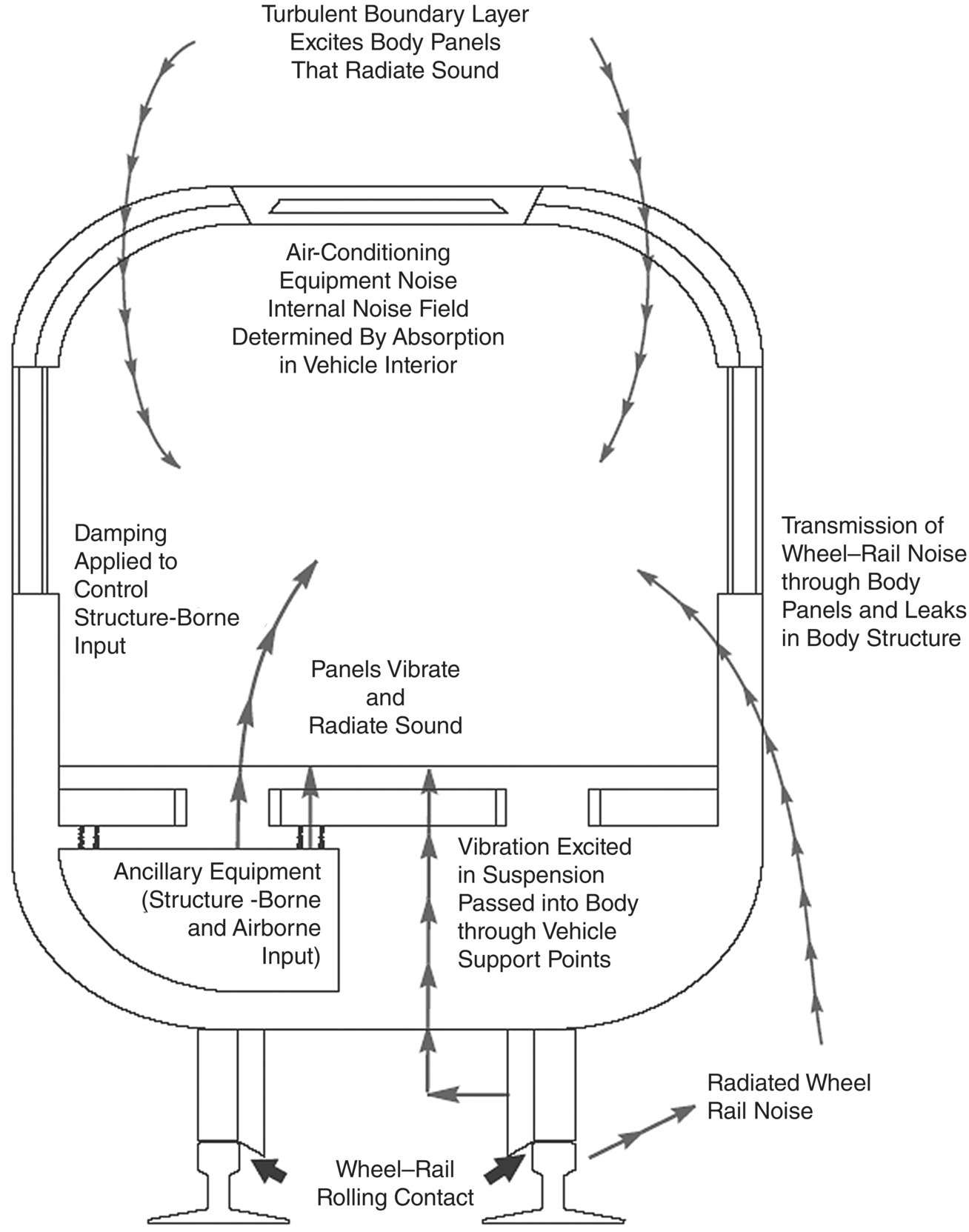
Various power plants are used to propel the railroad and RTS vehicles. In some high‐speed railroad vehicle designs several sets of traction motors are used to drive each passenger car, instead of just the locomotive. In some cases, individual electric motors are employed to drive the vehicle wheels directly. Wheel–rail noise becomes important at medium and high speeds and depends upon rail roughness and wheel wear [89–91].
Soft rubber wheel suspensions have been used on some RTSs (e.g. Mexico City) in an attempt to reduce noise. Rubber or elastomeric damping blocks have also been built into the wheel systems of some other passenger railcars and crew locomotives [80]. If damping blocks and damping rims are implemented, they should be properly tested to demonstrate that they can be used safely in service.
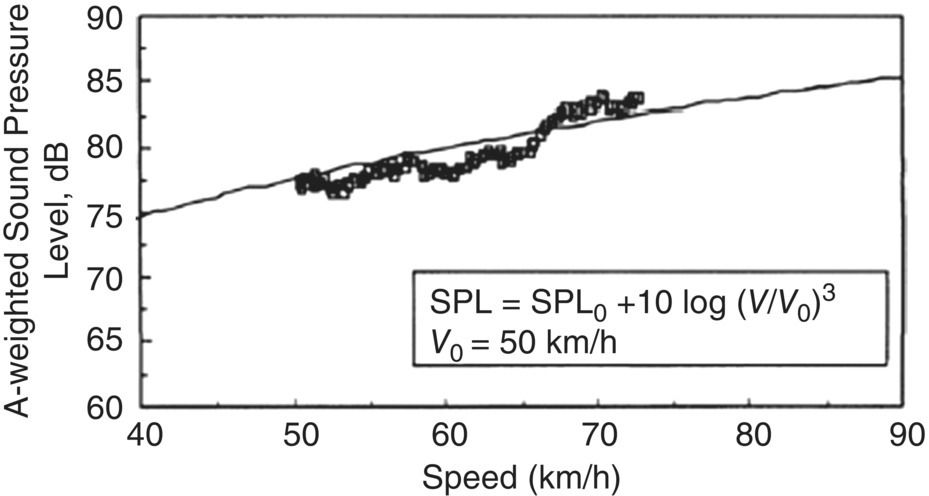
Figure 14.18 shows the A‐weighted interior noise level at moderate speeds for one particular railcar [80]. It is observed that the A‐weighted SPL increases at a rate of 9–10 dB for each doubling of speed in the range of measurements shown. Subjectively, this amounts to approximately a doubling of linear loudness (in sones) for a doubling of train speed. It should be emphasized, however, that this result may be somewhat different for other railcar designs.
EXAMPLE 14.3
Estimate the change in A‐weighted interior SPL in a railcar when the speed is increased from 50 to 85 km/h.
SOLUTION
Considering the empirical formula in Figure 14.18, we obtain the SPL at 50 km/h as: SPL (at 50 km/h) = SPL0 + 10 × log (50/50)3 = SPL0. Now, the SPL at 85 km/h is
SPL (at 85 km/h) = SPL0 + 10 × log (85/50)3 = SPL0 + 6.9 dB. Therefore, the change in SPL is ΔSPL = SPL (at 85 km/h) − SPL (at 50 km/h) = 6.9 dB. Thus, the A‐weighted SPL is increased by 7 dB, approximately.
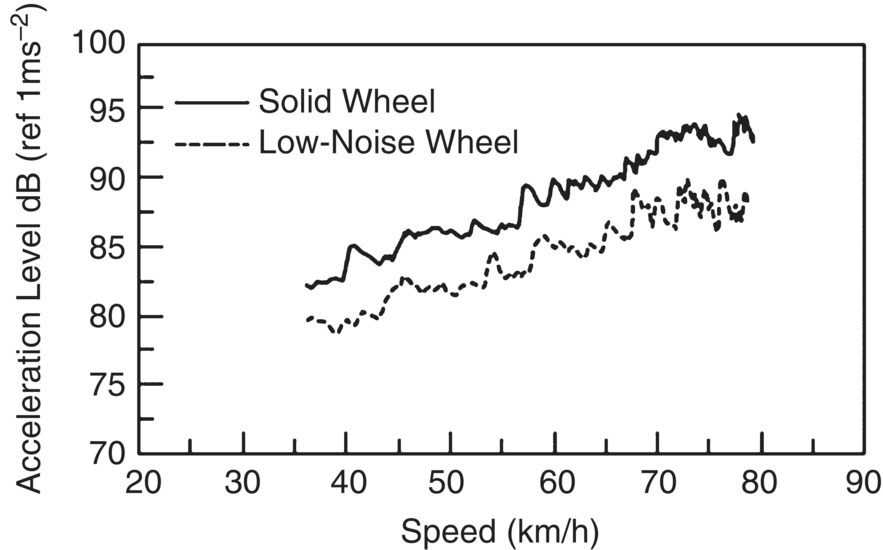
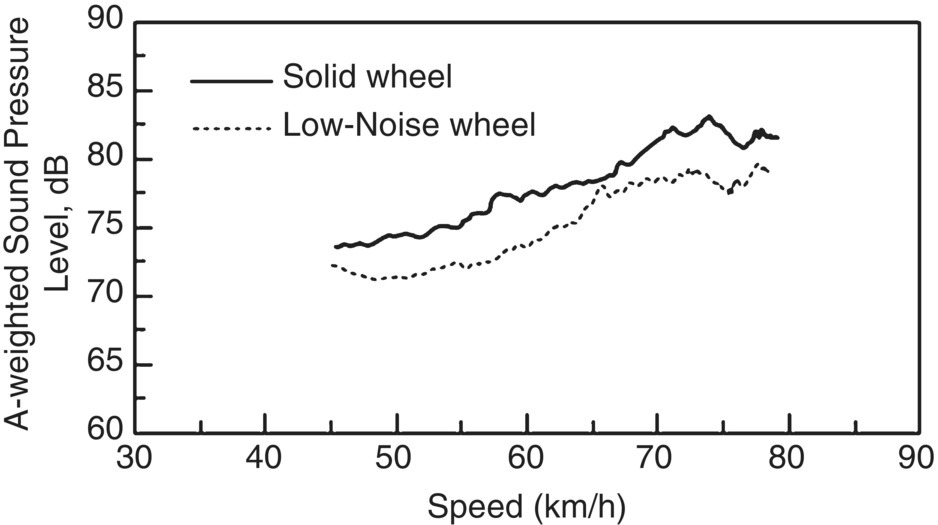
Figure 14.19 shows acceleration levels measured on the railcar floor with conventional solid wheels and low‐noise wheels. Figure 14.20 shows a comparison of the interior A‐weighted SPL of the same railcar as in Figure 14.18 with conventional wheels and with the low noise wheels. Figure 14.20 demonstrates that in this particular railcar, at the speeds shown, the wheel/rail interaction noise is very important. This study shows that there is not complete correspondence between the reduction in the floor acceleration level and the reduction in interior SPL, achieved by the use of low noise wheels. This indicates the presence of other noise sources, such as power plant, wind noise, and air‐conditioning noise.
It is normal practice to set target noise level goals for passenger comfort and to specify maximum power plant and air‐conditioning system source sound powers from equipment manufacturers and suppliers in order to achieve the noise targets [88]. Target A‐weighted equivalent interior SPLs of between 65 and 70 dB are commonly chosen. To achieve such target noise levels, the vehicle structure must also be carefully designed from the start so that the noise and vibration paths sufficiently attenuate the power plant, wheel/rail, wind, and air‐conditioning noise reaching the passenger compartments.
The contribution to the internal noise caused by wheel/rail interaction can be predicted from knowledge of the roughness of the rails. It is important for the rail roughness levels to be defined at the beginning of the acoustical design process. Both airborne and structure‐borne paths must be considered. Cabin wall airborne sound transmission properties, structural damping, and interior sound absorption all affect the transmission of sound and vibration and the resulting SPL in the cabin interior. Accurate prediction of the interior cabin noise can only be made with a knowledge of all of the external and internal cabin noise and vibration sources and paths.
There is extensive literature on noise and vibration sources and paths in rail vehicles [77, 81, 84, 85, 92–96]. Squeal noise is a problem experienced on curved tracks [92, 94]. Reference [88] discusses noise sources and noise level targets in high‐speed railroad cars. Reference [97] describes target noise levels in RTS cars and the acoustical design processes commonly used to achieve them.
Leave a Reply