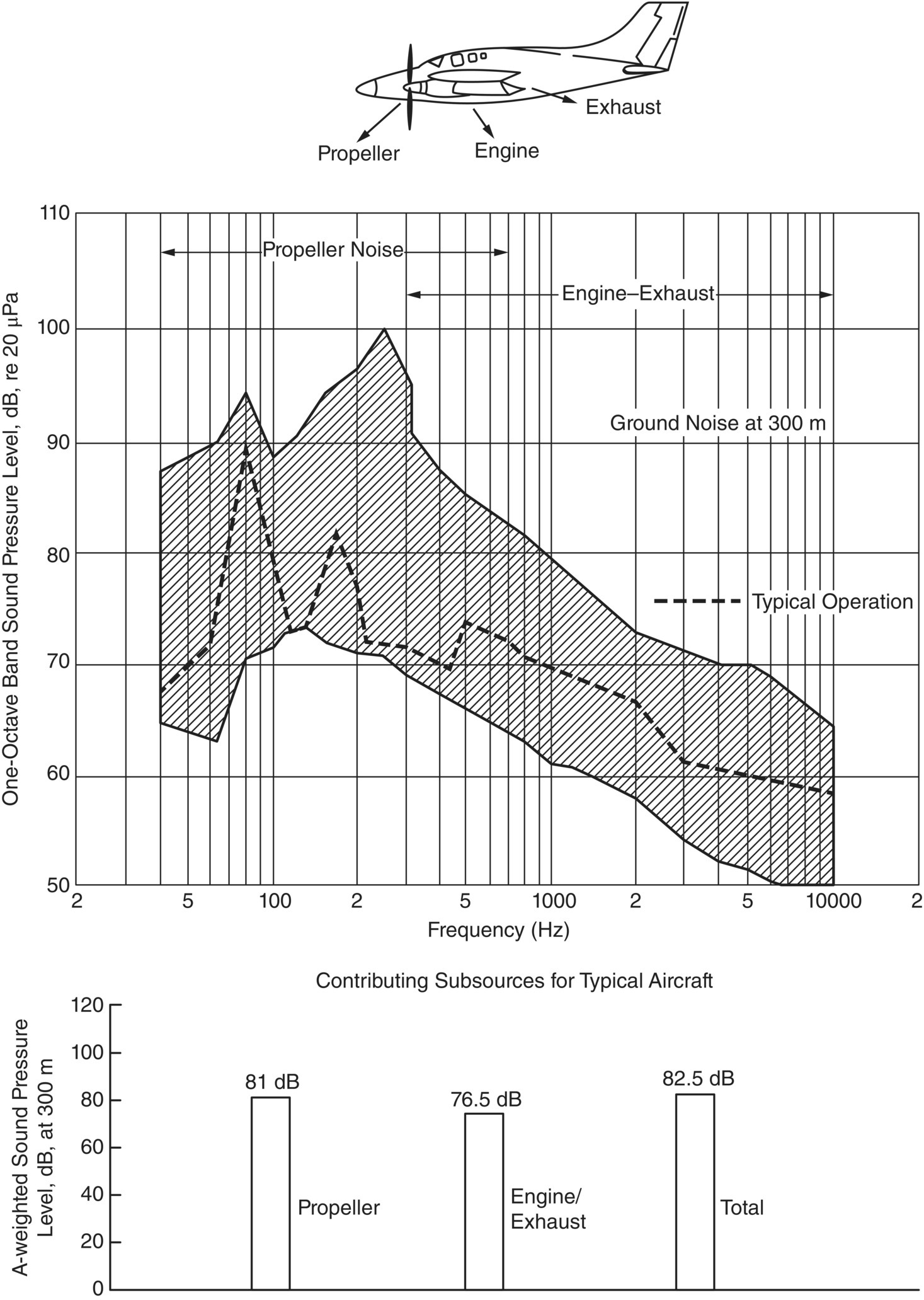
As described in Ref, propellers are used on small general aviation aircraft as well as small to medium‐sized passenger airliners (See Figure 15.2). In small general aviation aircraft, propellers operate with a fixed‐blade pitch. In larger general aviation and commuter aircraft, they operate with adjustable pitch to improve aircraft take‐off and flight performance. Smaller aircraft have two‐blade propellers while larger aircraft have three or more blades. The propeller operation gives rise to blade thrust and drag forces.
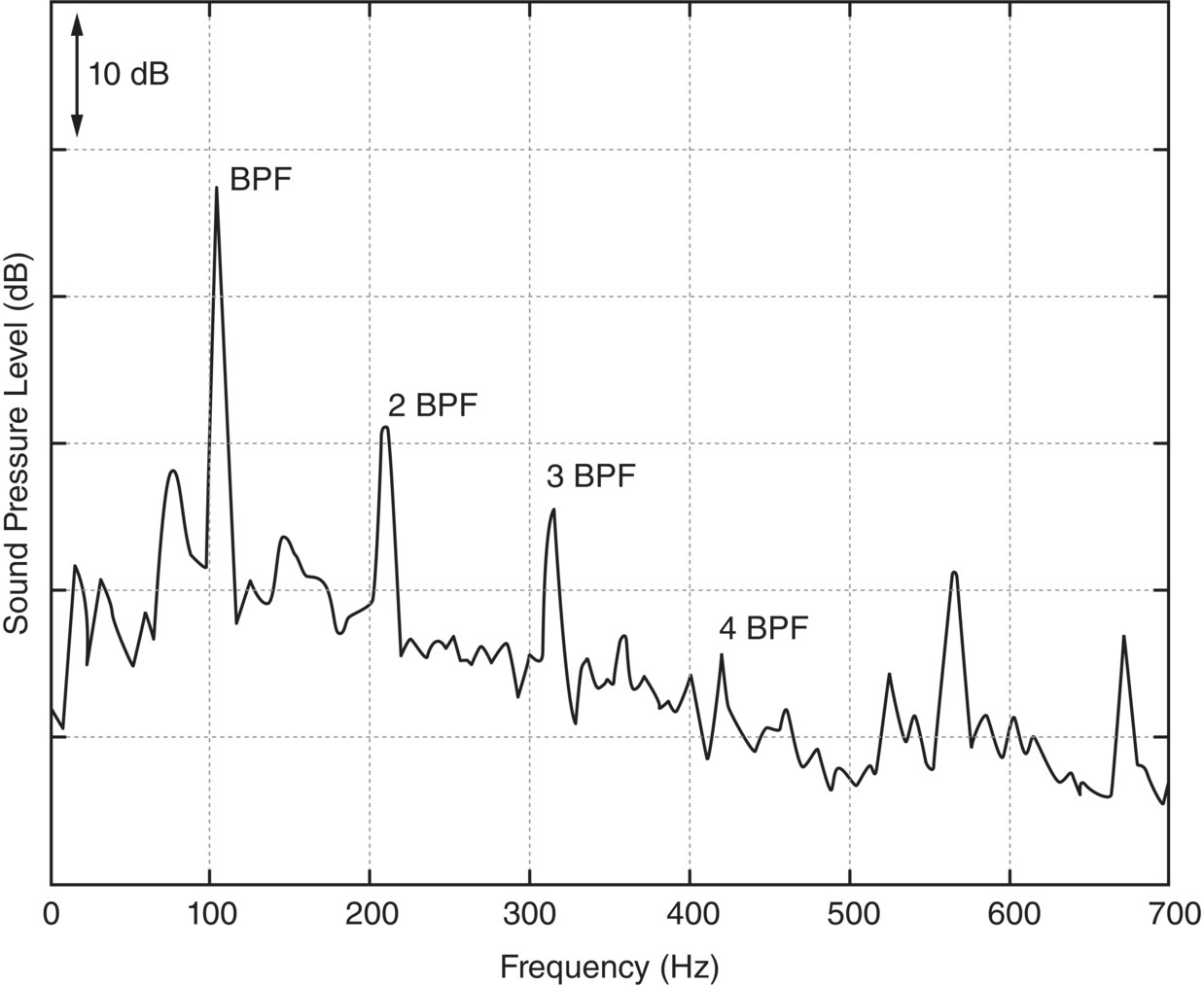
For a single propeller, tones are generated, which are harmonics of the blade passing frequency. This phenomenon occurs even for the case of tones generated by blade–turbulence interaction, which is caused by turbulent eddies in the airflow approaching the propeller. The BPF is the product of the shaft frequency and the blade number.
Theoretically, the BPF is a discrete frequency, fBPF, which is related to the number of blades, N, and the engine rpm, R, and is given by fBPF = NR/60 Hz. Since the thrust and drag forces are not purely sinusoidal in nature, harmonic distortion occurs as in the case of the noise generated by fans, diesel engines, pumps, compressors, and the like. Thus, blade passing harmonic tones occur at frequencies fBPn given by fBPn = nNR/60 Hz, where n is an integer, 1, 2, 3, 4… Figure 15.3 shows a typical spectrum of the cabin noise level in a turboprop aircraft during cruise flight. To avoid unpleasant acoustical beating, aircraft are equipped with a unit to synchronize the rotational speed of propellers [8].
Prediction of propeller noise is complicated. Accurate noise predictions require methods that include the influence of the flow field in which the propeller operates. Predictions may be made both in the time domain and the frequency domain. Noise reduction approaches are normally based both on experimental tests and theoretical predictions [6].
The spectrum of the propeller noise has both discrete and continuous components. The discrete frequency components are called tones. The continuous component of the spectrum is called broadband noise. There are three main kinds of propeller noise sources. These are (i) thickness (monopole‐like), (ii) loading (dipole‐like), and (iii) nonlinear (quadrupole‐like) noise sources. All three of these source types can be steady or unsteady in nature. The loading dipole axis exists along the local normal to the propeller plane surface. For the first few harmonics of a low‐speed propeller, the simple Gutin formula [9] gives the noise level in terms of the net thrust and torque. Unsteady sources can be further classified as periodic, aperiodic, or random. Steady and periodic sources produce tonal noise while random sources produce broadband noise.
Quadrupole sources are normally only important when the flow over the propeller airfoil is transonic or supersonic. Quadrupole sources are not important noise generators for conventional propellers, but they can be important in the generation of the noise of highly loaded HS propellers such as propfans. See Refs. [5] and [10] for more detailed discussions on aerodynamic noise and nonlinear acoustics.
Leave a Reply