The piezoelectric accelerometer is a seismic mass type of accelerometer that works on the principle described above. The main types include the following: compression, delta shear, planar shear, theta shear, annular shear, and ortho shear. These are all designed to accentuate certain advantages that are useful in different environmental conditions and are described in more detail in Ref. [4]. As already discussed, the heavier accelerometers have the greatest sensitivity but the lowest resonance frequency and vice versa.
Several characteristics of piezoelectric accelerometers need to be considered. The piezoelectric accelerometer produces a charge after deformation. After the signal is passed through a charge converter (incorporated in modern piezoelectric accelerometers), it can be considered as a voltage source. Hence, the sensitivity is given in mV/m/s2. Besides being sensitive to acceleration in the longitudinal axis, the accelerometer is also slightly sensitive to vibration in the transverse axis due to irregularities in construction and alignment of the piezoelectric disks. (See Figure 7.14.)
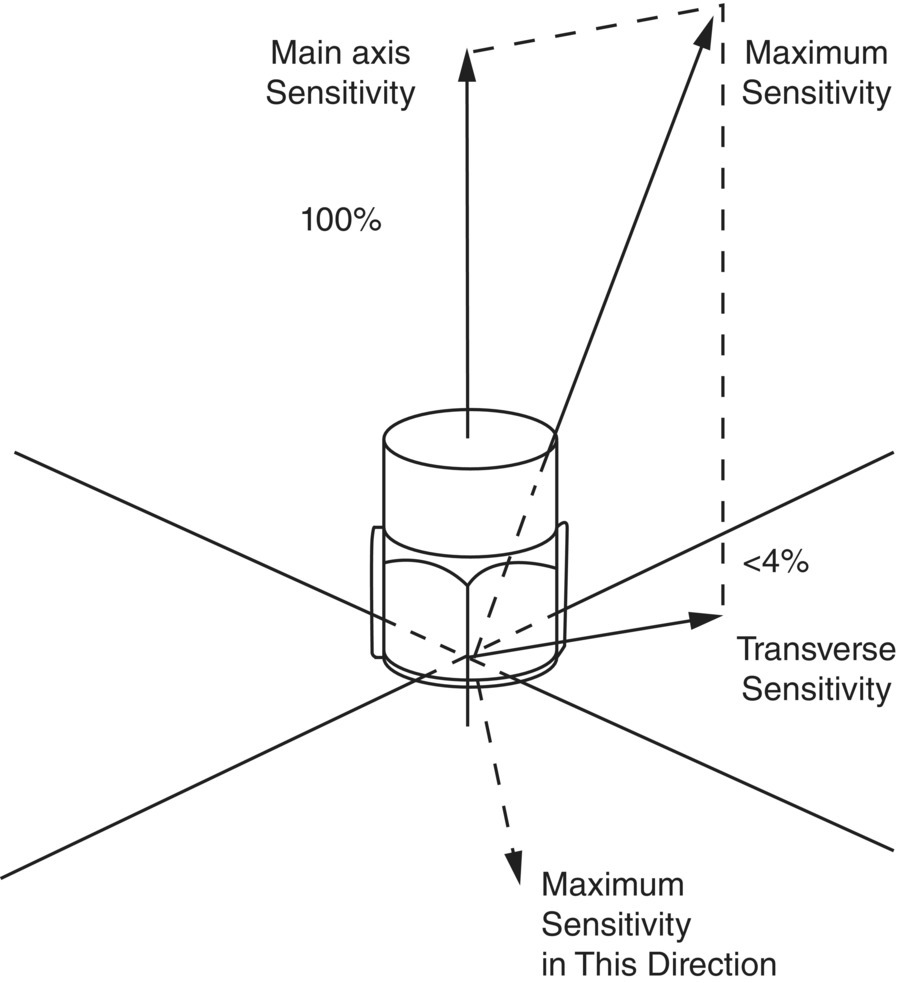
Good accelerometers should have a lateral sensitivity less than 5% of the longitudinal (or main axis) sensitivity. The transverse sensitivity will vary in the base plane having maximum and minimum values in certain directions. The sensitivity of an accelerometer will be somewhat temperature dependent (one should always consult the manufacturer’s instructions), however, provided the maximum (Curie point) temperature is not exceeded, the piezoelectric material will not be damaged and will retain its properties.
Piezoelectric accelerometers produce some output signal when subjected to acoustic signals or base strains. Normally the acoustic sensitivity is low (producing a false response output of less than 1 g for a sound pressure level input of 160 dB). As the test object vibrates, it will induce strain in the accelerometer base with a consequent output signal. Most accelerometer bases are made thick and rigid to reduce this effect.
As was discussed above (also see Ref. [4]), all accelerometers exhibit a fundamental resonance frequency. The frequency range of an accelerometer is usually assumed to be bounded by an upper frequency limit of one third of the resonance frequency for less than 1‐dB error or one fifth the resonance frequency for less than 0.5‐dB error. This assumes that the accelerometer design has low damping. The upper frequency limit is extended in some accelerometer designs by using high damping. Today TEDS accelerometers are also available with built‐in amplitude response information, so that the upper frequency limit is increased by about 50% to about one half of the resonance frequency.
The lower limiting frequency depends on the type of preamplifier used to follow the accelerometer. Two types may be used and are commercially available. If the preamplifier is designed so that the output voltage is proportional to the input voltage, it is called a voltage amplifier. If the output voltage is proportional to the input charge, it is called a charge amplifier. When a voltage amplifier is used, the accelerometer output voltage is very sensitive to cable capacitance. This is because typically the capacitance of a piezoelectric accelerometer is several hundred picofarads (usually between 100 and 1000 pF). This is somewhere between the very low capacitance of a condenser microphone and the higher capacitance of a piezoelectric microphone (see Section 7.4.1). The effect of cable capacitance on the voltage sensitivity (in mV/m/s2) of an accelerometer is determined as: [25]
(7.11)
where MV is the voltage sensitivity, MV0 is the open circuit (unloaded) accelerometer voltage sensitivity, and CA, CC, and CP are the accelerometer, cable, and preamplifier capacitances, respectively.
EXAMPLE 7.7
While taking a vibration measurement with cable A, a requirement has arisen for a longer cable B. Knowing that the capacitance of cable A is 110 pF, the capacitance of the accelerometer (including cable A) is 1117 pF, the capacitance of cable B is 260 pF, and the open circuit voltage sensitivity of the accelerometer is 9.73 mV/m/s2, calculate the new voltage sensitivity due to the new cable.
SOLUTION
We assume that the preamplifier capacitance can be neglected. The capacitance of the piezoelectric element alone is CA = 1117–110 = 1007 pF.
Therefore, using Eq. (7.11) we obtain

Therefore, the voltage sensitivity has been reduced simply by changing the cable.
When a charge amplifier is used, the output voltage is not sensitive to changes in cable length. Broch [27] describes the reasons for this in some detail. If a voltage amplifier is used, the lower limiting frequency (3‐dB down point) is given by
(7.12)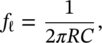
where R is the input resistance of the voltage preamplifier and C = CA + CC + CP is the effective circuit capacitance. It should be noted that making the total capacitance as large as possible or designing a preamplifier with a high input resistance may ensure that the low frequency limit is low enough to provide useful operation at frequencies down to 1 Hz or less.
The dynamic range of the piezoelectric accelerometer is determined by the low frequency limit set by electrical noise in the system and the upper frequency limit governed by the preloading of the accelerometer and the mechanical strength of the piezoelectric element. Small accelerometers usually have a higher upper limit [4]. It should also be noted that accelerometers have a main direction of sensitivity. (See Figure 7.14.)
It is also possible to simultaneously measure acceleration in three orthogonal directions. This is the principle of the triaxial accelerometer. Each unit incorporates three separate built‐in piezoelectric elements that are oriented at right angles with respect to each other. The output signals of the triaxial accelerometer, each representing the vibration for one of the three axes, are connected to a multichannel signal analyzer for processing. This type of accelerometer is particularly suited for application in building vibrations, modal testing in structures, and to assess occupational vibration exposure (see Section 5.10 in Chapter 5 of this book). They can be mounted in a seat pad which can be placed directly on the seat cushion, floor or fixed to the back of a seat to measure whole‐body vibration exposure. Through some adaptors, the triaxial accelerometer is also commonly used to assess occupational exposures to hand‐transmitted vibration in hand tool operators.
Leave a Reply