According to studies carried out on workers exposed to A‐weighted noise levels over 85 dB in the U.S. [26], the types of occupations that present the highest risk for hearing damage in terms of numbers of workers overexposed are: manufacturing and utilities, transportation, military, construction, agriculture, and mining. In 1981, the Occupational Safety and Health Administration (OSHA) estimated that 7.9 million people in the United States working in manufacturing were exposed occupationally to daily A‐weighted sound pressure levels at or above 80 dB. In the same year, the U.S. Environment Protection Agency (EPA) estimated that more than nine million U.S. workers were exposed occupationally to daily A‐weighted levels above 85 dB. More than half of these workers were involved in manufacturing and utilities. From Australian data, it has been estimated that around 20.1% of the workforce regularly work in A‐weighted noise levels above 85 dB and 9.4% above an exposure of 90 dB [27]. A review on noise‐induced hearing loss in countries in Eastern Europe has also been published recently [28].
A World Health Organization study on the burden of disease associated with hearing impairment from occupational noise [29] reported that overall in the Americas, more than 300 000 disability‐adjusted life years were lost to noise‐induced hearing loss. In this region, Canada and the U.S. accounted for almost half of the years of healthy life lost, as they have large industrial populations.
As previously discussed the hearing loss produced by exposure to hazardous noise depends on many factors, including the sound pressure level, spectral content, exposure duration, and the temporal pattern (continuous, varying, intermittent, or impulsive). The commonly accepted eight‐hour average A‐weighted sound pressure level (permissible exposure limit, PEL) is based on the exposure during a typical daily work shift. The use of A‐weighted sound pressure levels to predict the effect of noise on hearing is based on the response of the human ear at moderate sound pressure levels and is supported by numerous studies (see Chapter 4).
The relationship between noise level and exposure duration is commonly known as the exchange rate (q). This “dose‐trading relation” or “trading ratio” is expressed as the number of decibels by which the sound pressure level may be decreased or increased for a doubling or halving of the duration of exposure. For example, the U.S. regulations allow eight hours of exposure at an A‐weighted sound pressure level of 90 dB (PEL) and only four hours if the level is 95 dB (exchange rate of 5 dB).
The U.S. was the first western country to introduce occupational noise regulations. In 1969, new standards for industrial noise became effective under a revision of the Walsh‐Healey Act [26]. These standards only applied to firms which had federal contracts of $10 000 or more during the course of one year. These standards originally affected only 28 million out of the 40 million U.S. nongovernmental and nonagricultural work forces. It called for a PEL of 90 dB with a q of 5 dB, the reduction of noise levels to the PEL by engineering or administrative controls whenever feasible, the provision and wearing of hearing protection devices above the PEL, and in section (c), the conducting of a “continuing, effective hearing conservation program” for employees exposed above the PEL [30].
Later, in 1971 these standards were extended to apply to the employees of all U.S. companies engaged in interstate commerce when the OSHA of the U.S. Department of Labor increased inspection in subsequent years which encouraged compliance from companies. In 1972 and 1973 OSHA did not classify violations under noise, air, or water, but total OSHA inspections in 1973 averaged approximately 1695 per week, compared to 919 per week a year earlier. In 1973 and 1974, a standards advisory committee reporting to OSHA considered the proposal by the NIOSH that the A-weighted noise exposure level of 90 dB for an eight-hour day should be reduced to 85 dB in the OSHA regulations but the committee did not recommend this reduction. In a 1974 study commissioned by OSHA, the estimated cost to selected U.S. industries most directly affected, of complying with the OSHA regulations was $13.6 billion. If the A‐weighted noise exposure level for an eight‐hour workday were reduced from 90 to 85 dB, the compliance cost would increase to $31.6 billion [14].
The U.S. noise regulation was amended in 1981 to dictate specific obligations at an A‐weighted action level of 85 dB [31]. At this action level, OSHA requires noise measurement, the use and care of hearing protection devices, audiometric testing, employee training and education, and record keeping. The agency promulgated a revision of the hearing conservation amendment in 1983, which is still currently in effect [32]. This amendment replaced section (c) of the noise standard. However, sections (a) and (b) detailing the PEL and the requirement for feasible engineering or administrative controls remained unchanged.
The OSHA regulations permit state agencies to issue their own regulations, as long as these regulations are at least as protective as those promulgated by the federal OSHA. About half of the states have selected to do this, whereas the rest chose to rely on federal enforcement. Some other regulations in the U.S. have been issued by the U.S. Mine Safety and Health Administration, U.S. Departments of Transportation and Energy, U.S. Coast Guard, and NASA. These regulations are discussed in the literature [15].
In 1977, the General Conference of the International Labor Organization adopted Convention 148, regarding the protection of workers against occupational hazards due to air pollution, noise, and vibration in the workplace [33]. This convention established in 24 articles the bases of legislation, considering measures of prevention and protection, the establishment of criteria and exposure limits for occupational noise, the promotion of occupational health research, and official recognition and concern for the health of the exposed workers. The ratification of this convention has generated similar legislation in several different countries. Others have adopted the convention, limiting it to only some of the pollutants such as air and noise, but leaving out vibration [15].
One of the most commonly used standards is ISO 1999 [18]. This international consensus standard can be used to predict the amount of hearing loss expected to occur in various centiles of the exposed population at particular audiometric frequencies as a function of exposure level and duration, age and sex. The standard provides a complete description of NIPTS for various exposure levels and exposure times. It is important to note that ISO 1999 does not explicitly establish limits for the level of occupational exposure, which is defined in the occupational noise legislation or regulation in each particular country. In some countries, technical standards may be typically direct copies of the ISO standards, without the benefit of enabling legislation or regulation [15].
In general, the most relevant acoustical factors in occupational noise regulation in the majority of nations are: The normalized eight‐hour PEL, the exchange rate (q), the maximum upper limits for exposure to impulsive sounds, and requirements for engineering controls. Nevertheless, there are notable differences among countries in the defined values for PEL and exchange rate. Of the countries that have regulations, the majority use a PEL of 85 dB with a q value of either 3 or 5 dB. The Canadian federal regulation is one of the few legislations that establishes a PEL of 87 dB with a q of 3 dB. It is important to notice that the U.S. OSHA regulation is one of the few in the world that uses a PEL of 90 dB and the 5‐dB exchange rate [34].
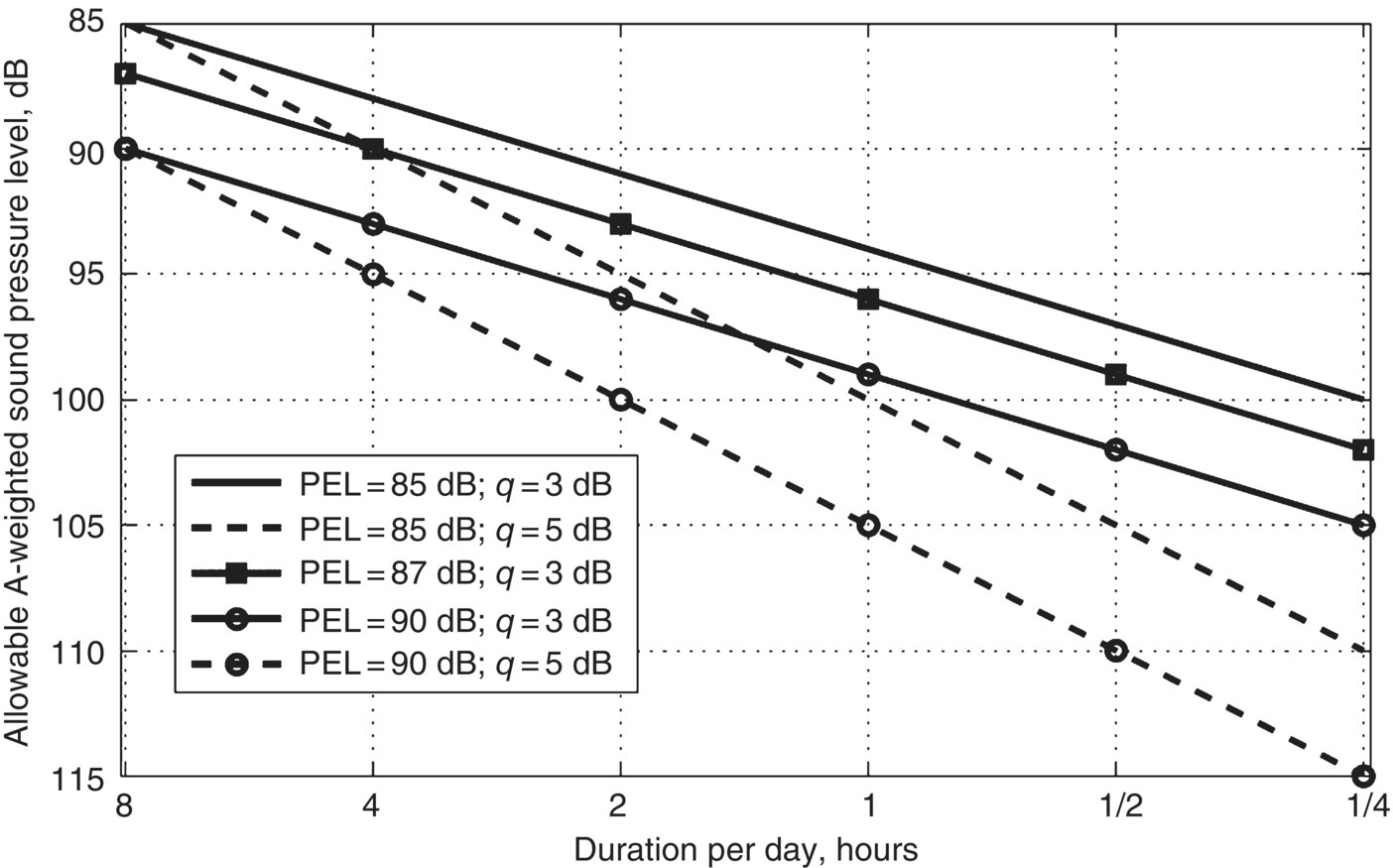
Figure 5.6 shows a comparison of duration per day to allowable noise exposure level (100% dose) for different values of PEL and q as used in national standards [15]. This figure shows that the use of an 85 dB PEL with a q of 3 dB, provides the best protection for workers. Legislation using a PEL of 90 dB and q of 3 dB provides better protection than legislation using a PEL of 85 with a q of 5 dB, but only when the A‐weighted noise level is above 97.5 dB. Below this level, less protection is provided. Canadian federal law, (PEL 87 dB and q of 3 dB), offers better protection than the regulations using a PEL of 85 dB with a q of 5 dB, at least when the A‐weighted noise level is greater than 90 dB.
Noise regulations in several nations treat impulse noise separately from continuous noise. A common approach in some countries (usually those using a q of 5 dB) has been to limit the number of impulses at a given peak sound pressure over a workday, although the exact figures vary slightly. Alternatively, other nations have considered impulse noise jointly with any continuous noise present. Most nations limit impulsive noise exposure to a peak unweighted sound pressure level of 140 dB (or C‐weighted levels), while a few use slightly lower noise level limits (130 dB or C‐weighted noise levels of 120 dB). International legislation and standards on occupational noise have been extensively discussed by Suter [30].
Leave a Reply