6.4.1 Noisiness
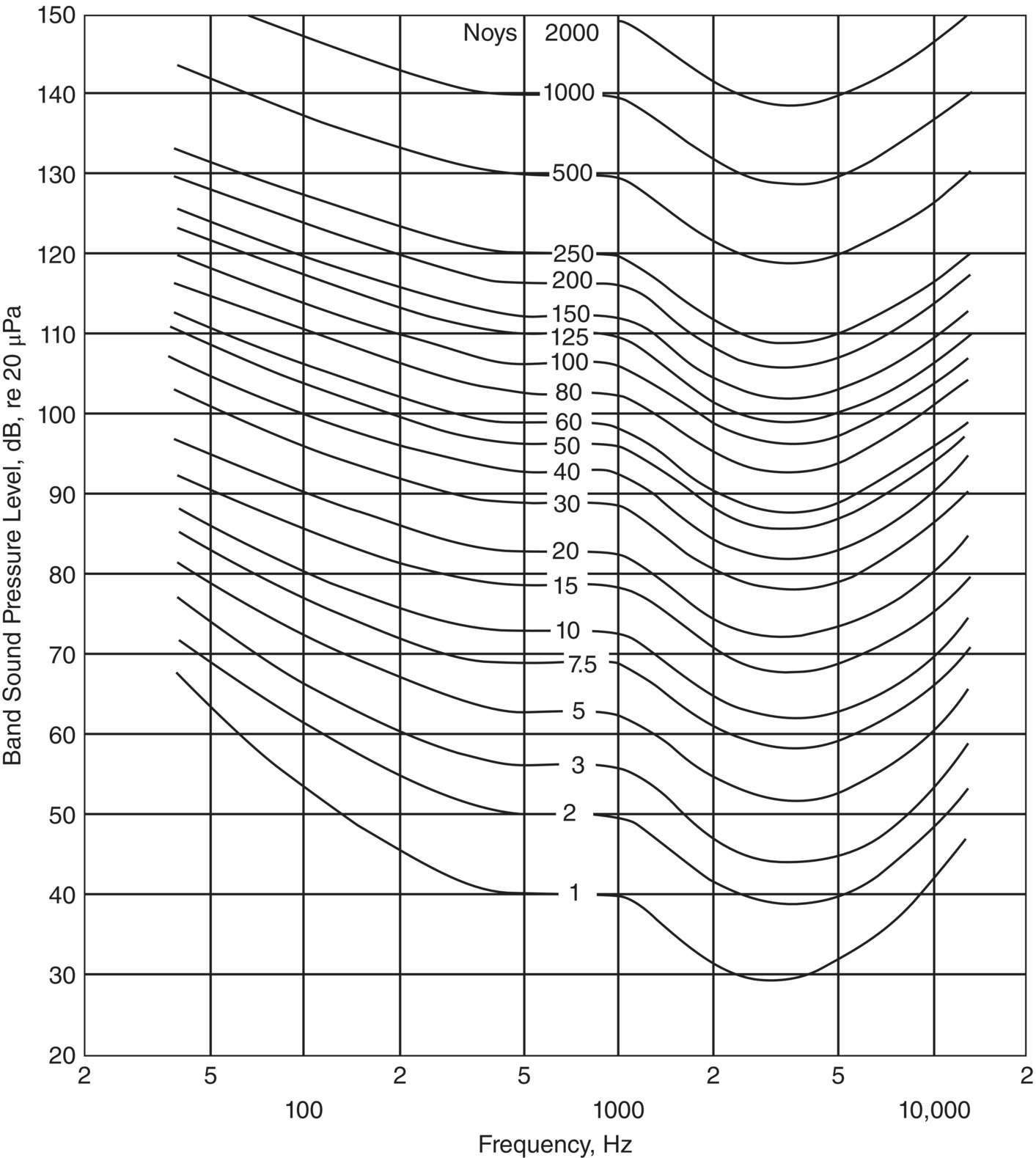
Although the level of noise or its loudness is very important in determining the annoyance caused by noise, there are other acoustical and nonacoustical factors that are also important. In laboratory studies, people were asked to rate sounds of equal duration in terms of their noisiness, annoyance, or unacceptability [9, 10]. Using octave bands of noise, Kryter and others have produced equal noisiness index contours. These equal noisiness contours are similar to those for equal loudness, except that at high frequency less sound energy is needed to produce equal noisiness and at low frequency more is needed. The unit of noisiness index is the noy N. Equal noisiness index curves are shown in Figure 6.2. The procedure to determine the logarithmic measure, the perceived noise level (PNL), is quite complicated and has been standardized [11]. It has also been described in several books [12–14]. Briefly, it may be stated as follows. Tabulate the one-octave band (or one‐third‐octave band) sound pressure levels (SPLs) of the noise. Calculate the noisiness index in noys for each band in Figure 6.2. Then calculate the total noisiness index Nt, from
(6.1)
where Nmax is the maximum noisiness index and ∑N is the sum of all the noisiness indices. If one‐third octave bands are used, the constant 0.3 for octave bands in Eq. (6.1) is replaced by 0.15.
The total perceived noisiness index Nt (summed over all frequency bands) is converted to the PNL or LPN from
(6.2)
The procedure is similar to that described in Section 4.3.2 for calculating loudness level (phons) from loudness (sones). Some have questioned the usefulness of this procedure since listeners in laboratory experiments do not seem to be able to distinguish between (i) loudness and (ii) noisiness, and (iii) annoyance. Despite this, the procedure has been widely used in assessing single‐event aircraft noise. In the United States the Federal Aviation Administration (FAA) has adopted the effective perceived noise level (EPNL) for the certification of new aircraft. As an example, the noisiness of the spectra given in Figure 16.6 of Chapter 16 can be calculated. The take‐off noise shown by the upper dashed line of Figure 16.6 of Chapter 16 has a noisiness of 170 noys and a PNL of 114 PNdB. PNL has received wide acceptance in many countries as a measure of aircraft noisiness with and without tone corrections.
EXAMPLE 6.1
At one instant in time the sound pressure levels (dB) of a turbojet engine airplane were recorded in one‐octave bands (see first and second columns of Table 6.2). The turbojet engine airplane noise spectrum is relatively smooth indicating broadband noise with no appreciable tones. Compute the PNL (PNdB).
SOLUTION
Each sound pressure level is converted to perceived noisiness using Figure 6.2 (see third column of Table 6.2). We observe that the maximum value of noisiness index is at 400 Hz, Nmax = 30. The perceived noisiness values are combined using Eq. (6.1),

The total perceived noisiness index Nt is now converted to the PNL or LPN using Eq. (6.2),

Table 6.2 Sound level values for Example 6.1.
| Octave band center frequency, Hz | Lp, dB | Noisiness index, noys |
|---|---|---|
| 50 | 75 | 3.0 |
| 100 | 80 | 10.0 |
| 200 | 86 | 20.0 |
| 400 | 89 | 30.0 |
| 800 | 84 | 20.0 |
| 1600 | 80 | 25.0 |
| 3150 | 72 | 19.0 |
| 6300 | 60 | 7.5 |
6.4.2 Effective Perceived Noise Level
Although PNL can be used to monitor the peak noise level of an aircraft pass‐by (or flyover or flyby), this measure does not take into account the variation of the noise or its duration. Experiments have shown that annoyance and noisiness increase both with the magnitude and with the duration of a noise event. Noise that is of long duration is normally judged to be more annoying than noise of short duration. Figure 6.3 shows a PNL time history of a flyover of a typical fanjet aircraft. As the airplane approaches, the discrete frequency whine caused by fan and compressor noise radiated from the engine inlets is very evident.
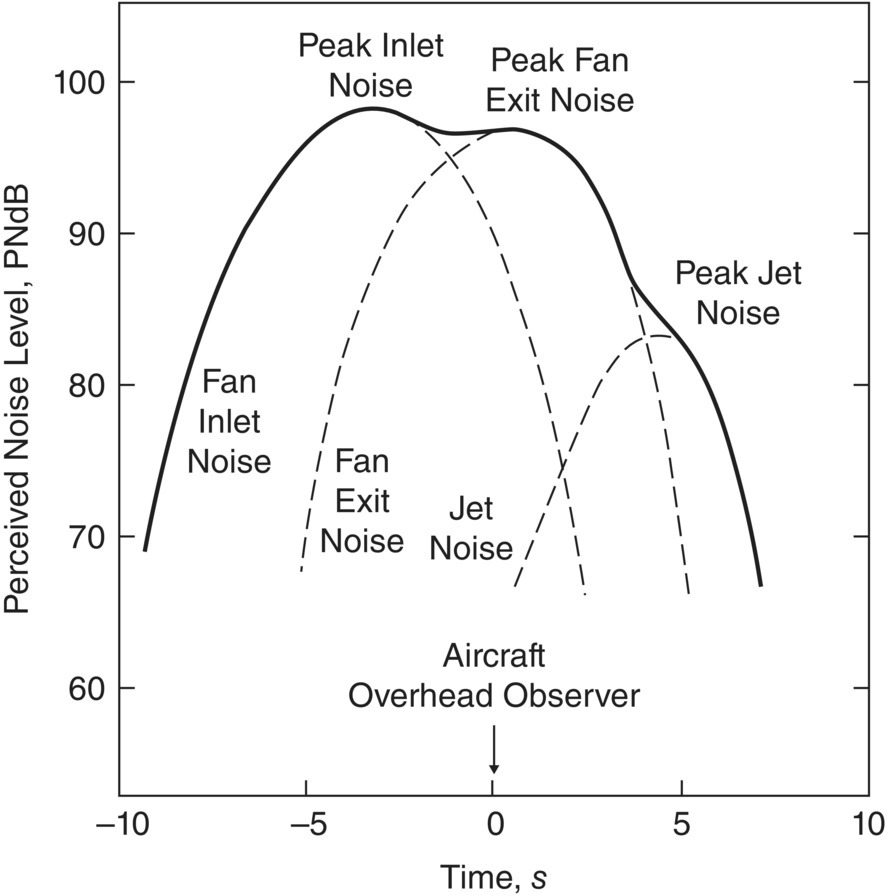
When the airplane is overhead, the noise is dominated by that from the fan exit and is again mostly whine. When the plane has passed, the low‐frequency jet rumble is heard. The peaks for each source occur at different times since each source is very directional. The inlet noise is mainly “beamed” forward in the flight direction, while the jet noise is mainly radiated backward about 45° to the jet exhaust direction. In addition to the effects of noise level and duration, the effects of tonal content must be considered. If the noise contains pure tones along with the broadband noise spectrum, it is also judged to be noisier than without such tones. To account for these effects the EPNL or LEPN has been defined as
(6.3)
where C is the correction factor for pure tones (between 0 and 6 dB, depending on frequency and the tone magnitude in relation to the broadband noise in adjacent frequency bands) and D is a correction for duration [10–12]. EPNL is simply a time integration of the tone‐corrected PNL. Equation (6.3) does not directly reveal the time integration. However, EPNL is defined in Federal Aviation Regulations (FAR) Part 36, and also International Civil Aviation Organization (ICAO) Annex 16 as
(6.4)
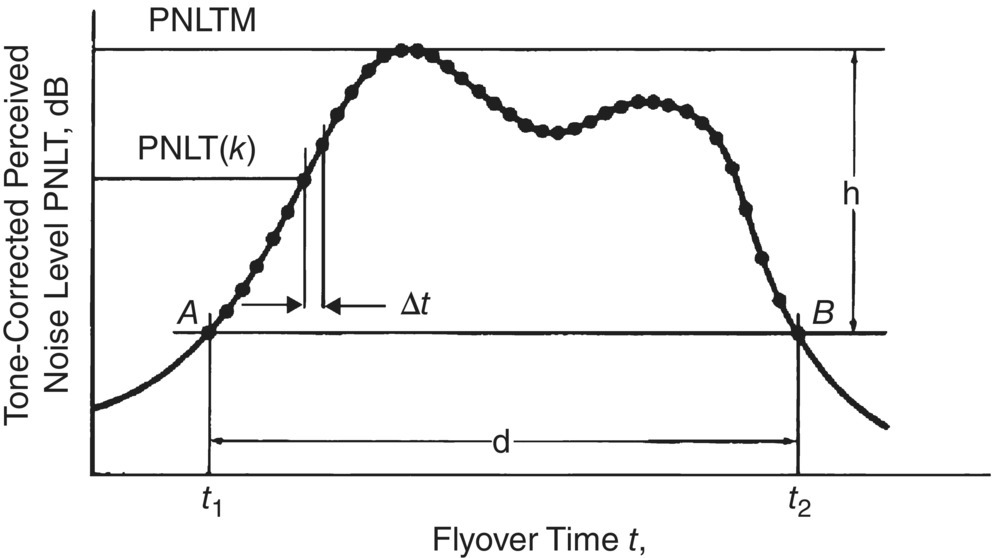
where LPN (k) is the PNL plus the tone correction of the kth sample in the time history. There are some complexities regarding the maximum value of LPN (k) also known as PNLT(k) if the tone correction at that moment is not as large as the average tone correction for the two preceding and two succeeding samples, in which case this average replaces the tone correction value for sample k. But essentially Eq. (6.4) states the summation process that is actually taking place, just as in any time‐integrated measure of noise level.
The EPNL takes into account tonal content, duration, and the level of the noise by integrating the tone‐corrected PNL over the duration of the event. An example of how the tone‐corrected PNL varies with an aircraft flyover is shown in Figure 6.4. For aircraft certification purposes h is equal to 10 PNdB, Δt is equal to 0.5 second, and the duration, d, is determined by the 10‐dB down points shown as A and B in Figure 6.4.
The procedure for calculating LEPN is quite complicated, and its description is beyond the scope of this book. It is fully described in standards [9, 14, 15] and in some other books [10–12]. There is a useful, approximate relationship between A‐weighted SPL, L(A) and PNL. For aircraft noise spectra this is generally taken to be PNL = L(A) + 13, and EPNL = SEL + 3. (SEL is the sound exposure level. See Section 6.9.) The A‐weighting filter and A‐weighted SPL were discussed in Section 4.3.5.
Leave a Reply