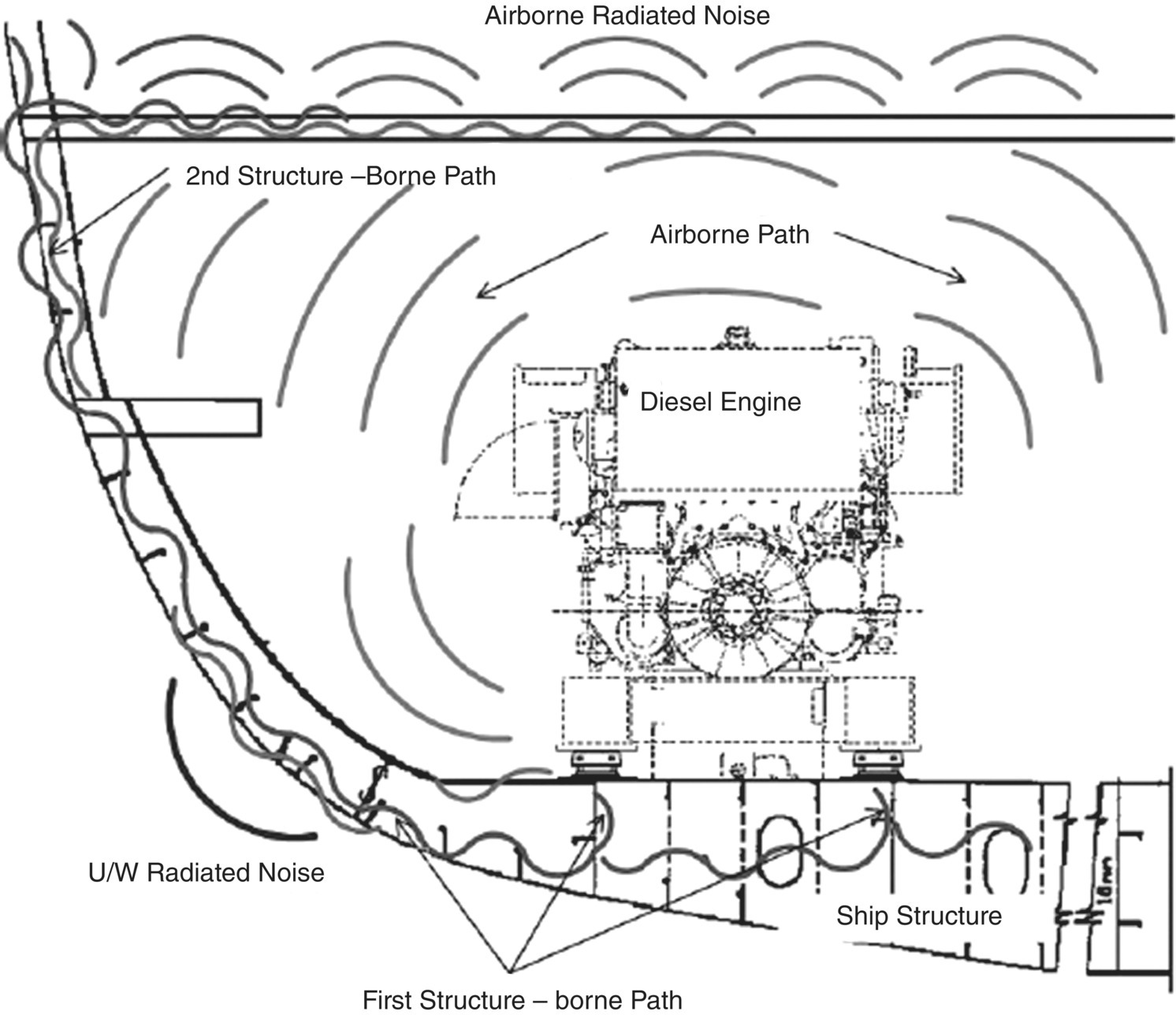
Many of the same noise problems exist in passenger ships as in surface transportation vehicles and aircraft. Airborne and structure‐borne paths from noise and vibration sources can be of similar and sometimes of equal concern during different ship operations. The main sources include the power plant machinery and the propulsion units including screws and propellers. Figure 14.21 shows the noise transmitted over airborne, structure‐borne, and secondary structure‐borne paths in a ship model [98]. The latter results from airborne noise impinging on the structure, which then transmits the noise along the structural path.
Noise levels can be intense in the engine room compartments of ships, and consideration needs to be given to providing low enough SPLs so that speech communication is possible and audible alarm signals can be heard. Crew comfort must also be considered in crew rest areas so that they can recuperate from the high noise levels experienced in engine rooms and other high‐noise regions of ships.
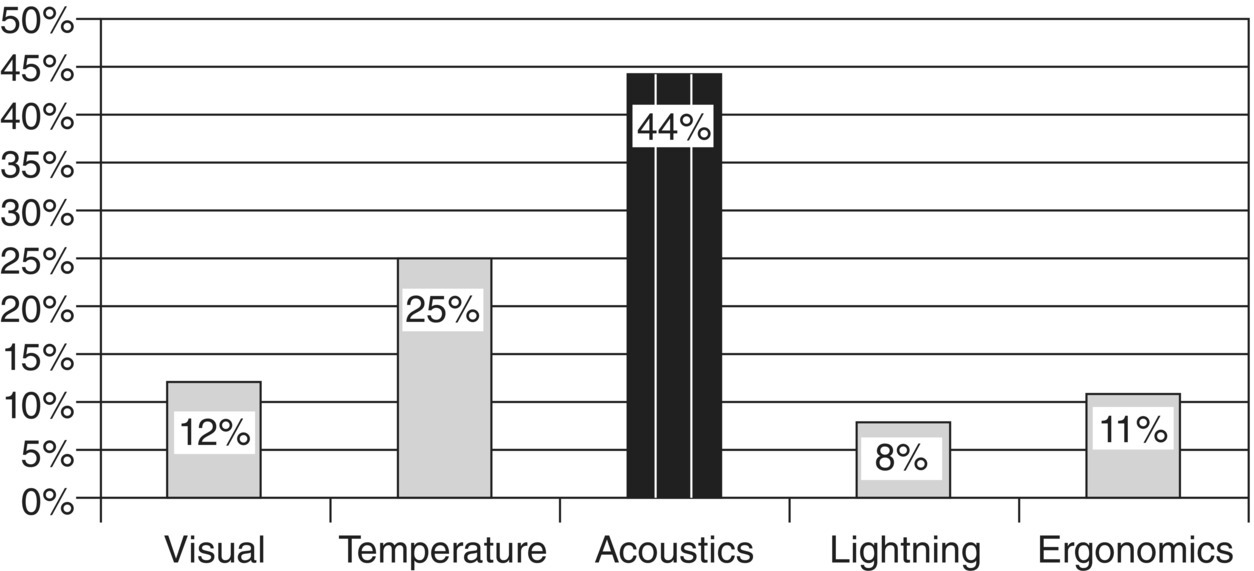
Noise levels in rest areas must be low enough so that the effects of noise on sleep and overall crew performance are minimized. Figure 14.22 shows that the acoustical environment on cruise ships often receives most complaints [99]. This study also showed that the most irritating noises for cruise passengers fall into three categories: (i) squeaking, clattering, cracking, creaking noises, (ii) noise of engines, and (iii) ventilation and whistles [99].
Some A‐weighted noise level criteria for crew rest areas are as low as 45 dB, while others permit levels as high as 60 dB in such areas. Noise levels in passenger spaces in ships are generally low enough that speech communication and sleep interference are not issues; providing passenger comfort is the predominant concern in this case. Acoustical prediction methods and the design of ships to achieve effective noise and vibration control are discussed in Ref. [98]. Various studies have been made on the noise in ships [99–101]. Studies have been made using sound intensity to identify noise sources in ships. In one shipboard study the sound intensity field was measured close to a double cabin window to try to identify the source of ship cabin noise problems [100].
The turbine and engine room is usually the noisiest place on a ship, and noise levels can be reduced using composite multilayer structures similar to the layers used in a car hoodliner. In addition, honeycomb panels made of raw fibers are used in ship hulls, bulkheads, fixed walls, and other interior structures of ships to reduce weight and avoid corrosion. Corrosion‐resistance composites are also being used internally in ships as space dividers and doors, replacing metal to reduce weight [44].
EXAMPLE 14.4
An engine room of dimensions 7 m × 10 m with a height of 4 m in a cargo ship has an average SPL in the reverberant field of 95 dB at 500 Hz. Suppose the average absorption coefficient is  = 0.02 at 500 Hz. It is required to reduce the sound pressure to 85 dB at that frequency by placing a sound absorption material with a sound absorption coefficient of
  = 0.6 at 500 Hz to completely cover the ship’s engine room overhead. Does this noise control work?
SOLUTION
The NR can be calculated using Eqs. (3.81) and (3.82). The engine room surface area = 2(70) + 2(28) + 2(40) = 276 m2, therefore the room constant R1 = 276(0.02)/0.98 = 5.6 sabins (m2). The new average absorption coefficient is  = [206(0.02) + 70(0.6)]/276 = 0.17, and the new room constant is 276(0.17)/0.83 = 56.53 sabins (m2). Thus, the predicted noise level reduction is 10 × log(56.53/5.6) = 10 dB. Therefore, the average SPL in the reverberant field of the engine room is reduced to 85 dB.
In crew and passenger’s rest areas, in particular in luxury cruise ships, high noise levels are expected to adversely impact sleep, comfort, and speech intelligibility. Sound absorption is usually provided by carpeting cabins in passenger ships. Furnishing acoustical textiles used in ships comply with strict fire retardant standards [44]. Floating floors have also been used for noise and vibration reduction in ship cabins. In some cases where cabins are located above extremely noisy rooms such as engine or auxiliary machinery rooms, use of floating floors may be the only alternative for reducing the noise levels in the cabin. Commonly, the floating floor consists of an upper panel and mineral wool or recycled textile, which is in turn laid on the steel deck plate. Mathematical models to predict IL of floating floors used in ship cabins have been reported by some authors
Leave a Reply