The methods of refrigeration are:
- Vapour compression refrigeration.
- Vapour absorption refrigeration.
- Ejector-compression refrigeration.
- Electro-Lux refrigeration.
- Solar refrigeration.
- Thermo-electric refrigeration.
- Vortex-tube refrigeration.
1 Vapour Compression Refrigeration System
The schematic diagram of simple vapour compression refrigeration system is shown in Fig. 18.1.
It consists of the following five essential parts:
- Compressor: The low pressure and temperature vapour refrigerant from evaporator is drawn into the compressor through the inlet or suction valve A, where it is compressed to a high pressure and temperature. This high pressure and temperature vapour refrigerant is discharged into the condenser though the delivery, or discharge valve B.
- Condenser: The condenser or cooler consists of coils of pipe in which the high pressure and temperature vapour refrigerant is cooled and condensed. The refrigerant, while passing through the condenser, gives up its latent heat to the surrounding condensing medium which is normally air or water.
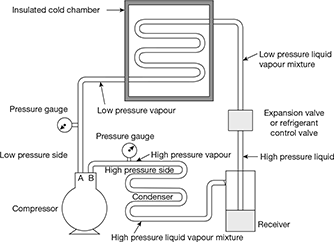 Figure 18.1 Simple vapour compression refrigeration system
 - Receiver: The condensed liquid refrigerant from the condenser is stored in a vessel known as receiver from where it is supplied to the evaporator through the expansion valve or refrigerant control valve.
- Expansion valve: It is also called throttle valve or refrigerant control valve. The function of the expansion valve is to allow the liquid refrigerant under high pressure and temperature to pass at a controlled rate after reducing its pressure and temperature. Some of the liquid refrigerant evaporates as it passes through the expansion valve, but the greater portion is vapourised in the evaporator at the low pressure and temperature.
- Evaporator: An evaporator consists of coils of pipe in which the liquid vapour refrigerant at low pressure and temperature is evaporated and changed into vapour refrigerant at low pressure and temperature. In evaporating, the liquid vapour refrigerant absorbs its latent heat of vaporisation from the medium (air, water or brine) which is to be cooled.
Note: In any compression refrigeration system, there are two different pressure conditions. One is called the high pressure side and other is known as low pressure side. The high pressure side includes the discharge line (i.e. piping from delivery valve B to the condenser), condenser, receiver and expansion valve. The low pressure side includes the evaporator, piping from the expansion valve to the evaporator and the suction line (i.e. piping form the evaporator to the suction valve A).
2 Vapour Absorption System
A simple vapour absorption system consists of a condenser, an expansion device, an evaporator, an absorber, a pump, a generator and a pressure reducing valve. The system can be improved by incorporating a regenerative heat exchanger between the poor and rich solutions. The two commonly used refrigerant absorbent pairs are ammonia-water (aqua ammonia) and lithium bromide-water. Lithium bromide-water system is superior to ammonia water system. In aqua ammonia, ammonia works as the refrigerant and water as the absorber, whereas in the other pair, water acts as the refrigerant and lithium bromide as the absorber.
A schematic diagram of absorption refrigeration system is shown in Fig. 18.2. The working of the ammonia absorption system is described below:
Ammonia vapour is produced in the generator at high pressure from aqua ammonia by external heating. The water vapour are removed by passing through an analyser and rectifier. The dehydrated ammonia enters the condenser where vapours are condensed. The sub-cooled high pressure liquid ammonia is passed through a throttle valve to further lower its temperature. Now they enter the evaporator and leave as saturated vapour. The saturated vapour goes to absorber to become strong after absorbing ammonia vapour and the strong solution is pumped to the generator through the pump and heat exchanger. The solution in the generator becomes weak as ammonia vapour comes out of it. The weak ammonia solution from the generator is passed to the heat exchanger through the pressure reducing valve. The cycle is repeated.
3 Ejector-Compression System
The system using water as the refrigerant in a vapour compression cycle in which compression is achieved by the principle of jet compression employing its own vapour as the motive vapour is called steam–ejector system. Refrigeration effect is obtained by direct evaporation and subsequent self cooling of water.
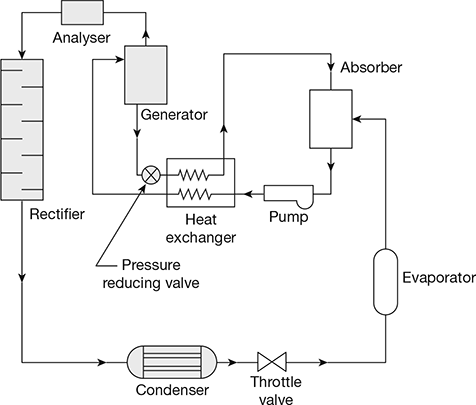
Figure 18.2 Ammonia absorption system
Bubble point temperature is the temperature at which a liquid mixture begins to boil. Azeotrope is a constant temperature boiling mixture.
4 Electro-Lux Refrigeration
This vapour absorption system uses ammonia as the refrigerant and hydrogen as the inert gas medium. The inert gas is confined only to the low side of the system, i.e., evaporator and absorber. In the evaporator, ammonia evaporates in the presence of hydrogen atmosphere. The partial pressure of ammonia is much lower than its pressure and thus give very low temperature. Hydrogen has the advantage of being non-corrosive and insoluble in water. This system is used for domestic refrigeration.
5 Solar Refrigeration
This uses the strong aqua ammonia vapour absorption system by utilizing the solar energy as the heat source to produce the refrigeration effect. This is an intermittent cycle. Lithium chloride-water system has also been used.
6 Thermo-electric Refrigeration
It is based on the thermoelectric effects: Seebeck effect, Peltier effect, and the Thomson effect. These effects are reversible in nature. The other two irreversible effects associated with thermoelectricity are the energy. Joule effect and conduction effect. It has low COP but infinite life expectancy, no leakage problem.
7 Vortex Tube Refrigeration
Vortex tube is a simple device for producing cold. It consists of a nozzle, diaphragm, valve, hot air side and cold air side. This is the only device to produce the refrigeration effect by utilizing the waste heat energy.
Leave a Reply