11.2.1 Gears
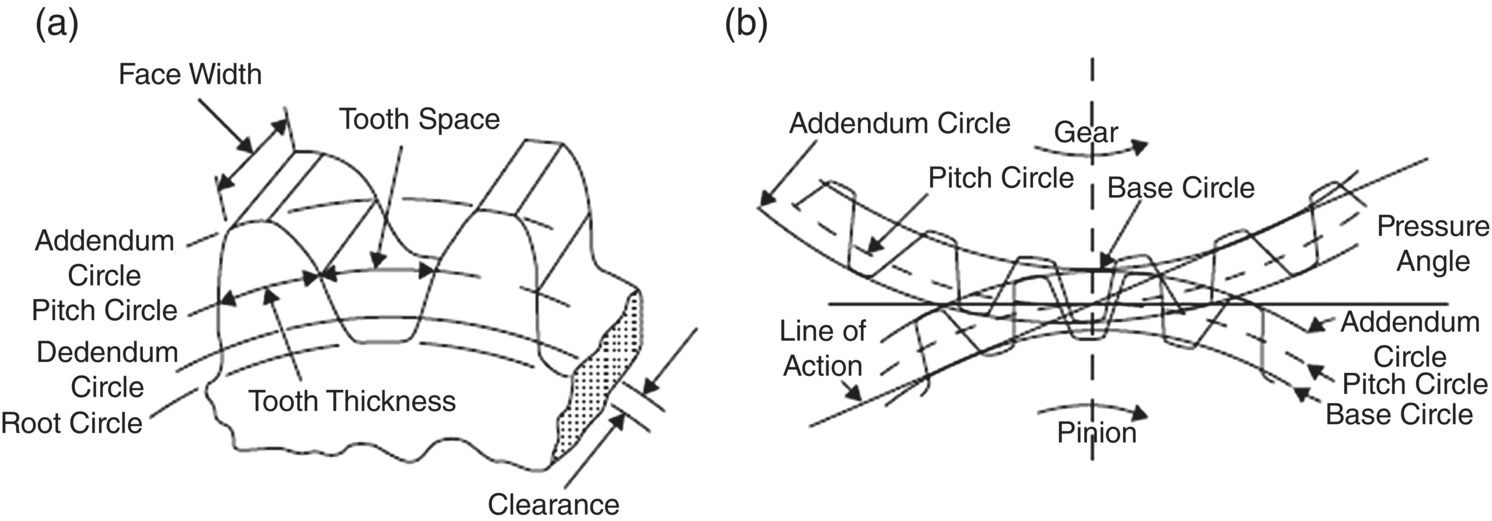
Gears are used in a number of applications where mechanical power is transmitted. Gears can emit annoying and harmful noise levels when a fraction of the transmitted power is converted to noise [16]. Most modern gear teeth have an involute profile, although some have circular‐arc profiles [1, 2]. Figure 11.1a shows some of the terms used with involute gears and Figure 11.1b shows two parallel‐axis spur‐type gears meshing together.
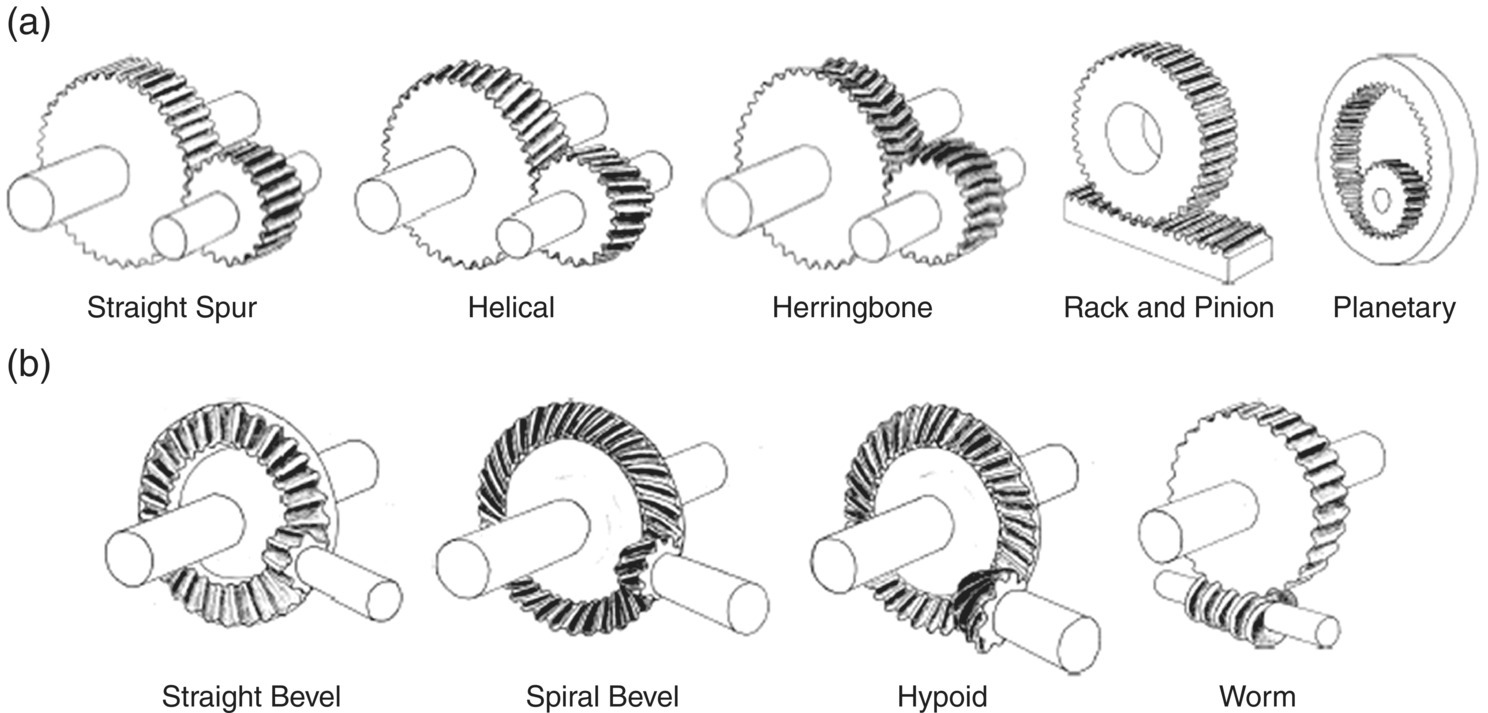
There are several different types of gears in common use, as shown in Figure 11.2. They are of two main classes, either having (i) parallel axes (spur, helical) or (ii) nonparallel axes (straight bevel, spiral bevel, hypoid). Spur gears and straight bevel gears are usually the noisiest, while helical spiral bevel gears are usually the quietest in their respective classes. This is because the load between gear wheel teeth is transferred more gradually with helical and spiral‐bevel gears and rather more abruptly with spur and straight‐bevel gears.
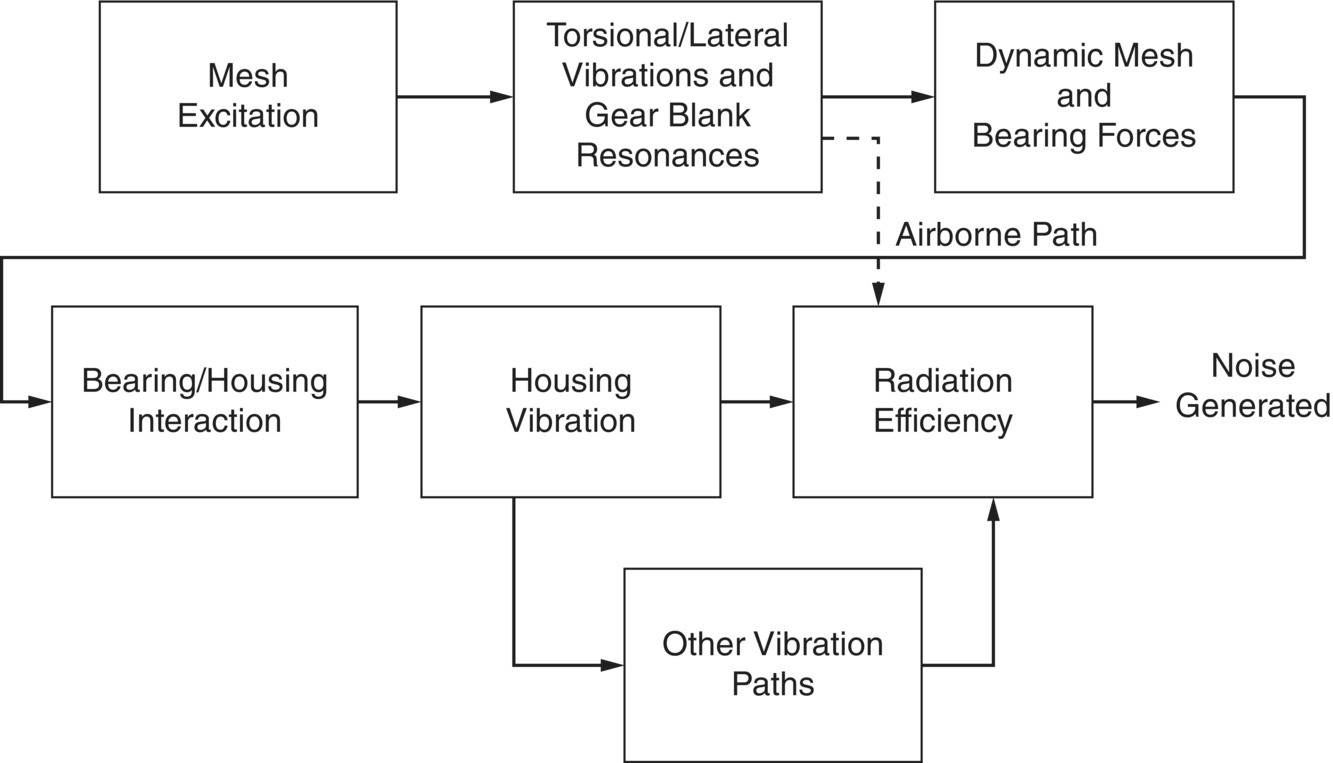
Gear noise can arise from a variety of causes. As the gear teeth mesh, a pulsating force occurs at the gear tooth meshing frequency fm and its harmonics. Harmonics are present because the pulsating force on the gear teeth is not purely sinusoidal. The strength of the harmonics depends on the force pulse shape and also on other impulsive forces caused by tooth deformation, production machinery errors, bearing misalignment, pinion wheel deformation, and so on. At high gear speeds, air or lubricating fluids can be expelled from between the meshing teeth at supersonic speeds and can even become the dominant source of noise. At low speed and load, the sound pressure level produced by a gear increases by about 3 dB for a doubling of load; while at higher speeds and loads the sound pressure level increases by about 6 dB for a doubling of speed or load [17]. Houser [16] discussed the energy flow in gears in schematic form (see Figure 11.3). This figure is useful to identify the steps in developing models to predict noise and vibration and to identify transducer locations along the gear noise and vibration paths.
The noise of a gear set is quite dependent on the quality of manufacture and the tolerances achieved. Theoretical and experimental studies have been made that attempt to relate gear surface deformation and profiles to noise [19–21]. Precision gear sets can now be manufactured [22], which make very low noise levels, although the cost is higher. In some cases, where low noise levels are required, it is more cost‐effective to choose a gear set of moderate cost and to vibration‐isolate the pinion and gear bearings, apply damping to the gear housing, and, if necessary, completely enclose it. With gears used to transmit only small loads (e.g. those in electric clocks), very low noise levels can be achieved by the use of soft plastic gears (which reduce the gear tooth force impulses) and by other means [23]. Manufacturing deficiencies can result in variations in pitch and profile from tooth to tooth and eccentricity of the gear wheel, which causes increased noise and vibration [1–4, 17]. There would, however, be some noise generated even if the gears were without any imperfections. The frequency of this noise (and vibration) would only occur at the gear meshing frequency fm and its harmonics:
(11.1)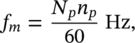
where Np is the number of pinion teeth and np is the pinion speed in revolutions/minute (rpm). The mesh frequency computation for planetary gears is more complex and depends upon the gear configuration. Noise and vibration measurements have also been used to produce a gear noise and vibration rating index in an attempt to avoid the necessity for using a jury test for this purpose [24].
EXAMPLE 11.1
Calculate the gear meshing frequency for a spur gear having 36 teeth rotating at 2000 rpm.
SOLUTION
Using Eq. (11.1), the gear mesh frequency is fm = 36 × 2000/60 = 1200 Hz.
EXAMPLE 11.2
Determine the mesh frequency and two higher harmonic frequencies of a 25‐tooth gear rotating at 1200 rpm.
SOLUTION
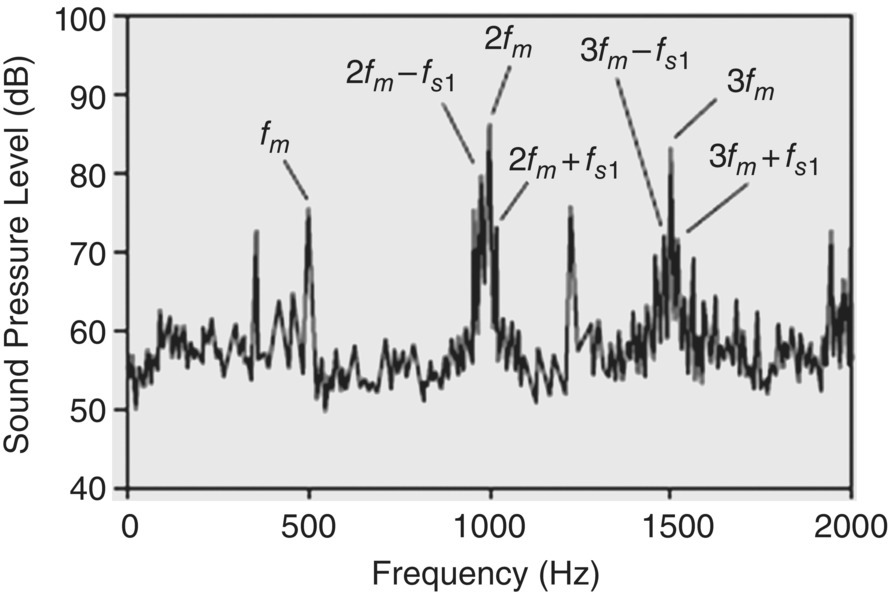
The mesh frequency is determined using Eq. (11.1) as fm = 25 × 1200/60 = 500 Hz. Gear whine noise also occurs at harmonics of mesh frequency (2 fm, 3 fm, etc.). Therefore, two higher harmonic frequencies are 1000 and 1500 Hz. In addition, modulations due to tooth spacing errors, eccentricities, and torsional vibrations often create sidebands that are spaced at shaft rotational frequency (fs = np/60) intervals on either side of the mesh frequency and its harmonics. This is clearly observed in Figure 11.4.
Some of the gains that might be achieved by altering transmission gear designs have been summarized by Houser in Table 11.1 [16]. However, the information in Table 11.1 must be used with care since (i) the many reductions that are possible in the table are not additive in nature and (ii) changing one design quantity inevitably changes other quantities.
Table 11.1 Effects of different gear design and manufacturing parameters on gear noise [16].
| Direction to reduce noise | Noise reduction (dB) | Comments | |
|---|---|---|---|
| Number of teeth | Decrease | 0–6 | Lowers mesh frequency |
| Contact ratio | Increase | 0–20 | Requires accurate lead and profile modifications |
| Helix angle | Increase | 0–20 | Machining errors have less effect with helical gears. Little improvement above about 35° |
| Surface finish | Reduce | 0–7 | Depends on initial finish – reduces friction excitation |
| Profile modification | 4–8 | Good for all types of gears | |
| Lapping | 0–10 | Very effective for hypoid gears | |
| Pressure angle | Reduce | 0–3 | Reduces tooth stiffness, reduces eccentricity effect, and increases contact ratio |
| Face width | Increase | Increases contact ratio for helical gears; reduces deflections |
Reference [16] provides a detailed discussion of the sources of noise and vibration in the main types of gears in common use. Some information on the noise of gearboxes and transmissions used in vehicles can be found in Ref.
Leave a Reply