The introduction of commercial passenger jet aircraft in the 1950s brought increasing complaints from people living near airports. Not only were the jet engines noisier than corresponding piston engines on airliners, since they were more powerful, but the noise was more disturbing because it had a higher frequency content than piston engines. This was most evident during the 1950s and 1960s when pure turbojet engines were in wide use in civilian jet airliners. Pure jet engines are still in use on some supersonic aircraft and in particular on HS military aircraft.
A pure turbojet engine takes in air through the inlet, adds fuel, which is then burnt, resulting in an expanded gas flow and an accelerated very high speed exhaust jet flow. The whole compression, combustion, and expansion process results in the thrust produced by the engine. The kinetic energy in the exhaust is nonrecoverable and can be considered as lost energy. Since the 1970s, turbofan (or bypass) jet engines have come into increasing use on commercial passenger airliners. Turbofan engines have a large compressor fan at the front of the engine, almost like a ducted propeller. A large fraction of the air, after passing through the fan stage, bypasses the rest of the engine and then is mixed with the HS jet exhaust before leaving the engine tail pipe. This results in an engine that has a much lower exhaust velocity than for the case of a pure jet engine. The thrust can still be maintained if a larger amount of air is processed through the turbofan engine than with the pure turbojet engine (in which no air is bypassed around the combustion chamber and turbine engine components). The efficiency of the turbofan engine is greater than that of a pure turbojet engine, however, since less kinetic energy is lost in the exhaust jet flow.
A simplified calculation clearly shows the advantage of a turbofan engine over a turbojet engine. For instance, if a turbofan engine processes twice as much air as a turbojet engine, but only accelerates the air half as much, the kinetic energy lost will be reduced by half (1–2 × ¼), while the engine thrust is maintained. If the engine processes four times as much air, but accelerates the air only one quarter as much, the kinetic energy lost will be reduced by three quarters (1–4 × 1/16) and the engine thrust is still maintained. In each successive case described, the engine will become more efficient as the lost kinetic energy is reduced. Fortunately, as originally shown by Lighthill, there is an even more dramatic reduction in the sound power produced since in a jet exhaust flow the sound power produced is proportional to the exhaust velocity to the eighth power [1–3]. A halving in exhaust velocity then, theoretically, can give a reduction of 28 in exhaust sound power and mean square sound pressure, and in sound power level and sound pressure level of about 80 × log(2) or about 24 dB. But, of course, if the mass flow is twice as much, then the reduction in sound power and in the mean square pressure is about 27, or a reduction in sound power level and sound pressure level of about 21 dB.
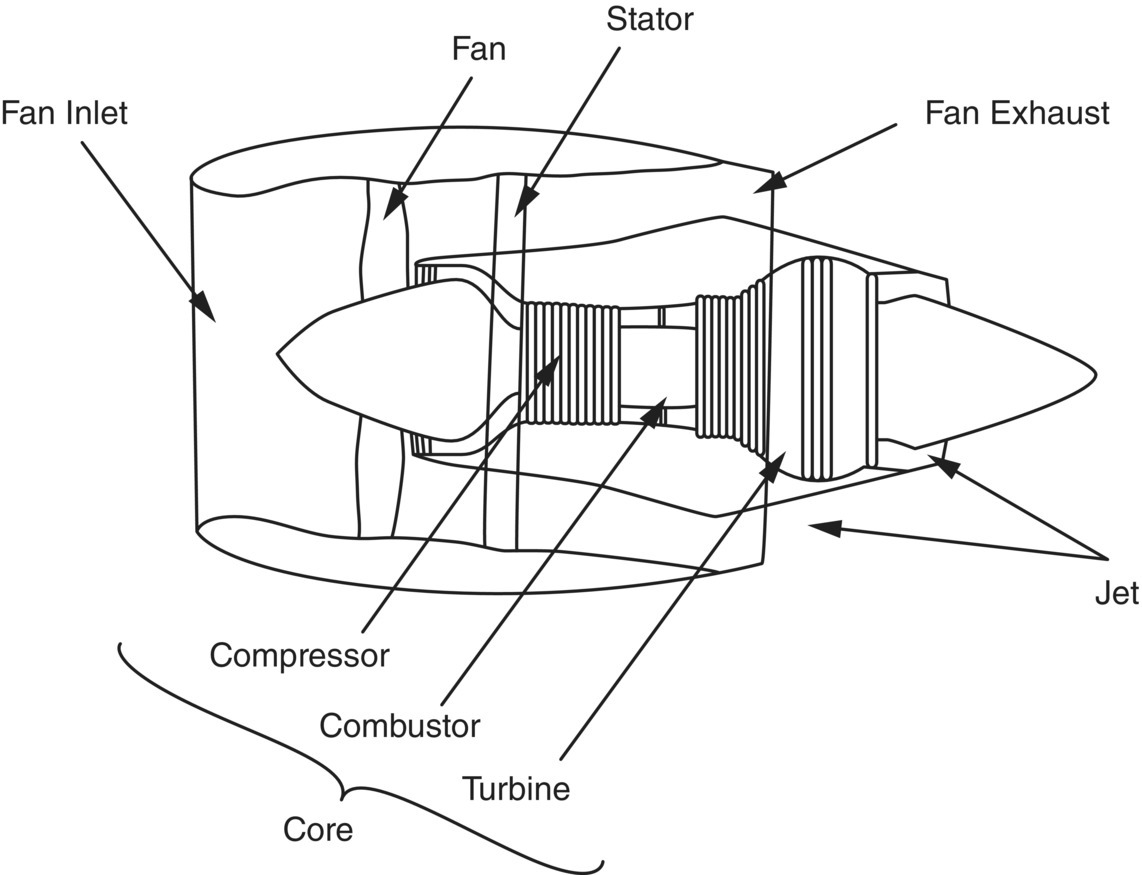
The major noise sources for a modern turbofan engine are discussed in detail in Ref. [4]. Reference [5] is devoted to a review of the theory of aerodynamic noise and in particular jet noise generation. The major noise sources for a modern turbofan engine are shown in Figure 15.1 [4]. The relative sound pressure levels generated by each engine component depend on the engine mechanical design and power setting. During take‐off, the fan and jet noise are both important sources with the exhaust noise usually dominant. During landing approach, the fan noise usually dominates since the engine power setting and thus jet exhaust velocity are reduced. Noise from other components such as the compressor, combustion chamber and turbine is generally less than that from the fan and the jet. The noise radiated from the inlet includes contributions from both the fan and compressor but is primarily dominated by the fan. Downstream radiated noise is dominated by the fan and jet, but there can also be significant contributions from the combustor and turbine, whose contributions are very much dependent on each engine design.
Reliable jet engine noise prediction methods are difficult to develop since they depend on accurate prediction of the unsteady flow field in and around the engine. Methods for reducing jet engine noise include modifying the unsteady flow field, redirecting the sound generated, absorbing the sound using acoustical treatments, and/or combinations of all three.
Leave a Reply