Classification of Motor Vehicle
Motor Vehicles are used for transporting goods or passengers or fulfilling specific functions on land. Motor vehicles can move on the ground, as compared to aircraft and marine craft that operate in air or water.
Based on Type of Roads
- Guided and Non-guided vehicles Guided Motor vehicles move along a fixed guide way; that includes railway vehicles. Non-guided motor vehicles move in any direction. The non-guided motor vehicles are the subject of this book.
- Classification according to Running gear – Single Track motor vehicles and Multi-Track motor vehicles
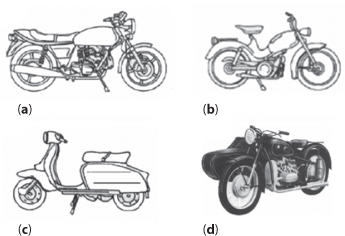
Single Track motor vehicles are motor vehicles with two wheels with or without a sidecar. Examples: Motorcycle – Any two-wheeled vehicle with or without a sidecar.
Moped – Motor cycle with pedals and a petrol engine of low power.
Single-Track Motor Vehicles
Scooter –This is a light, small wheels automotive.
Multi-Track Motor Vehicles -Motor vehicles with three or more wheels.
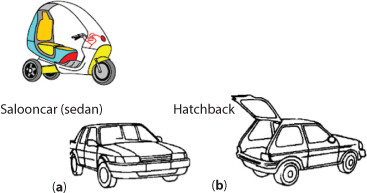
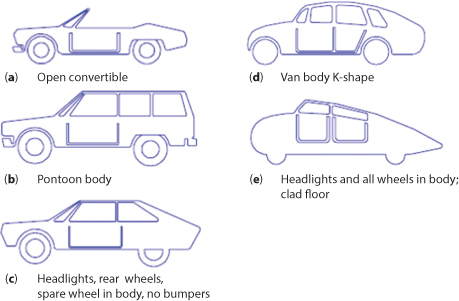
- Salooncar (sedan) –This is a type of motor car in which the space for driver and passengers is cut off from other areas.
- Hatchback car having a large sloping back.
- Pick-up (also pickup) – it is a small truck commonly used by operators.
- Van – covered vehicle, with no side windows, for transporting goods or people.
- Truck (UK Lorry) – large strong motor vehicle for transporting goods, soldiers, etc., by road.
- Tractor fitted with an endless belt passing round the wheels of a tractor enabling it to travel over rough ground.
- Car – Motor vehicle intended for carrying a maximum of 9 passengers with luggage.
1.1. Buses
Buses are used to transport people. The capacity of buses is more than 9 passengers and luggage. Buses fall into one of the following categories, depending upon the intended use.
- Microbus: The capacity of microbuses is approximately 25 passengers.
- City buses (Urban buses): are designed and equipped for driving regularly scheduled in-city and suburban routes. Due to short intervals between stops in local traffic, facilitation of rapid passenger turnover by means of low steps, wide doors and as low a vehicle floor as possible, is particularly important.
- Tour buses (Long-distance coach): are designed to provide a comfortable ride over long distances. Tour buses have large luggage compartments from front to rear below the floor.
Transport Vehicles: Transport vehicles are further classified as follows:
According to the type of body:
- General-purpose cargo trucks: with an open drop-sided body used for carrying bulk and packaged goods.
- Special-purpose trucks: with bodies adapted for a certain kind of work, e.g., dump trucks with tiltable bodies used to carry viscous and bulk materials, or with bodies specially adapted for transporting peat, cement, mixed fodder, grain, cotton, cattle, gasoline, milk, etc.
According to the load capacity:
- Extra-light-duty trucks: up to 0.75 Ton, built on the chassis of passenger cars and used for deliveries of light loads in the communication and communal services and in trade.
- Light-duty vehicles: from 0.75 to 2.5 Ton, that work in trade, at industrial enterprises and in agriculture, hauling light loads. They also serve as cargo taxis.
According to the load capacity:
- Medium-duty trucks: from 2.5 to 5.0 Ton, mostly carrying loads for organizations and enterprises with moderate cargo traffic.
- Heavy-duty trucks: from 5.0 t to 10.0 Ton, used on hard surface roads for carrying building materials, fuel, and products manufactured by large industrial enterprises.
- Extra-heavy-duty vehicles: above 10.0 Ton, for work in ore and coal mines and at big construction projects with a large amount of steady cargo traffic. As a rule, these vehicles are diverted from public highways.
Leave a Reply