The effects of vibration on people’s health and criteria for protection are discussed in Chapter 5. Criteria for human comfort and annoyance, in particular for vibration in buildings, are discussed in this section.
6.17.1 Human Comfort in Buildings
Vibration discomfort depends on many factors including the characteristics of the vibration. Most standards are designed to assess the relative discomfort of different motions and not necessarily to predict the absolute acceptability of vibration. This is because consistent quantitative data concerning human perception of and reaction to vibration is limited and difficult to measure. However, criteria to assess vibration comfort in buildings have been developed just to give guidance to engineers, local authorities and policy makers.
Construction‐site vibrations can have a number of effects including annoyance to residents in neighbors’ buildings. Other major sources of vibration causing discomfort in buildings are nearby road traffic (trucks, busses, subways, rail vehicles, etc.), building service machinery (elevators, air‐conditioning units, pumps, etc.), internal sources (footsteps, washing machines, door slamming, furniture moving, etc.), and blasting. These sources can produce continuous vibration, intermittent vibration, or repeated shocks.
It has been determined that acceptable magnitudes of vibration in some buildings are close to vibration perception thresholds for frequencies in the range 1–80 Hz. For vertical vibration, the human body is most sensitive in the frequency range 4–8 Hz (see Chapter 5). Studies made by Griffin [78] have shown that the approximate absolute rms acceleration threshold for the perception of vibration is 0.01 m/s2 and that the comfortable limit is usually around 0.315 m/s2. However, other variables could also cause annoyance depending on the use of the building in addition to the vibration frequency, direction, and duration.
General assessment of human exposure to whole‐body vibration has been standardized in the international standard ISO 2631 [79] and the British Standard BS 6841 [80]. The specific British standard BS 6472 [81] has been issued for evaluating disturbance to people in buildings. Ranges of vibration magnitudes associated with varying degrees of discomfort are shown in Figure 6.20 [82]. These values are specified in frequency‐weighted rms acceleration (see Chapter 5) measured at the point on the building surface where the vibration enters the human body.
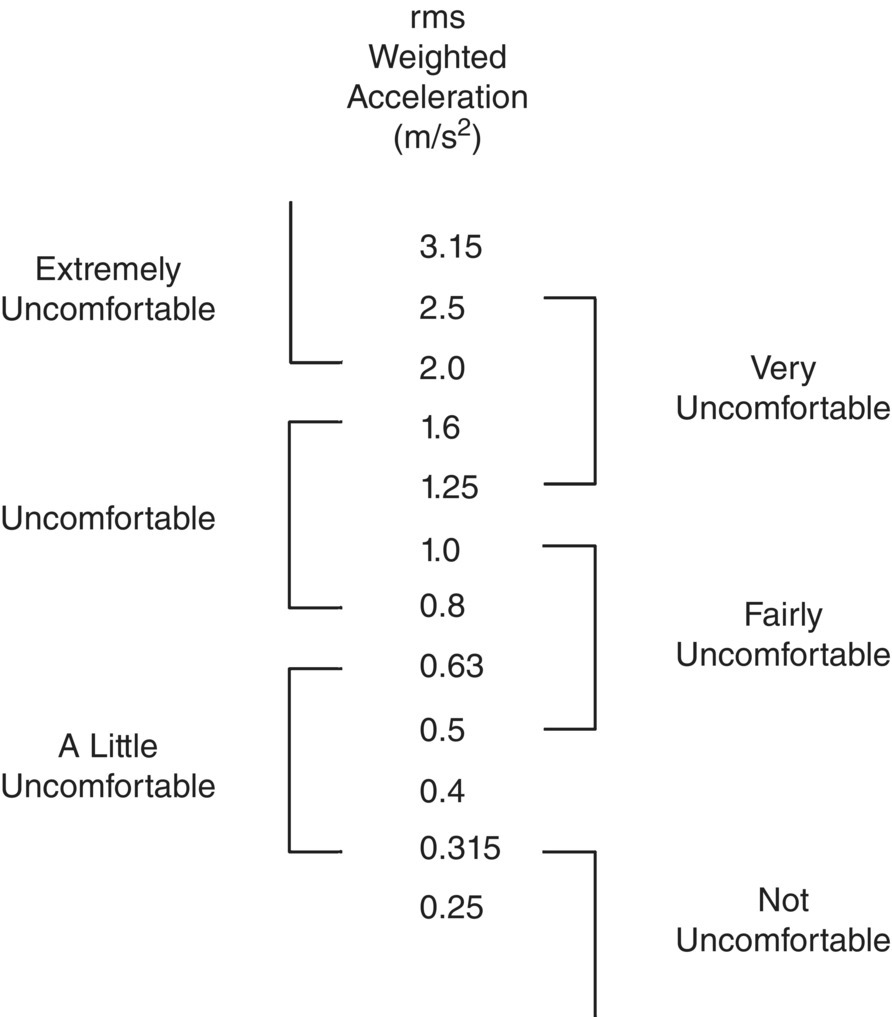
Using the whole‐body vibration dose value (discussed in Section 5.11.2) and the guidance in ISO 2631 Part 2 and BS 6472, it is possible to summarize the acceptability of vibration in different types of buildings. See Table 6.7. Human sensitivity to vibration in buildings is such that a doubling of the vibration dose values of the second column of Table 6.7 will result in the possibility of adverse comments from occupants and a further doubling will mean that adverse comments will become probable.
Table 6.7 Vibration dose values (ms−7/4) at which various degrees of adverse comment may be expected in buildings [82].
| Place | Low Probability of Adverse Comment | Adverse Comment Possible | Adverse Comment Probable |
|---|---|---|---|
| Critical working areas | 0.1 | 0.2 | 0.4 |
| Residential | 0.2–0.4 | 0.4–0.8 | 0.8–1.6 |
| Office | 0.4 | 0.8 | 1.6 |
| Workshops | 0.8 | 1.6 | 3.2 |
EXAMPLE 6.13
There is concern that residents in a building may be disturbed by vibration from three types of event on a nearby construction site. The vibration dose values for each type of event were measured having individual VDVs of 0.06, 0.04, and 0.05 ms−7/4 and they are repeated a number of 4, 20, and 10 events during the day, respectively. Assess the likely effects on the residents of the building.
SOLUTION
First, we need the individual vibration dose values of each event using Eq. (5.8):



The total vibration dose value is then obtained using Eq. (5.8) as

Therefore, since the total VDV is below the lower limit in Table 6.7 for a residential building, there is a low probability of adverse comments from the occupants.
6.17.2 Effect of Vibration on Buildings
Many studies have been carried out to define threshold limits for the occurrence of vibration‐induced damage to buildings. Interestingly, building response to vibration is somewhere between the constant velocity and constant acceleration contours according to several studies. One of the earliest published by Monk [83] in 1971 covers the frequency range 1–100 Hz and vibration displacement amplitudes in the range 1–1000 μm (see Figure 6.21). Generally, vibration will be insufficient to cause cracks in plaster finishes or in walls until it becomes unpleasant or painful. Vibration which is only just perceptible to people is unlikely to cause any damage to buildings unless they are very old or highly stressed. In such cases the damage normally appears first as cracks in old ceilings.
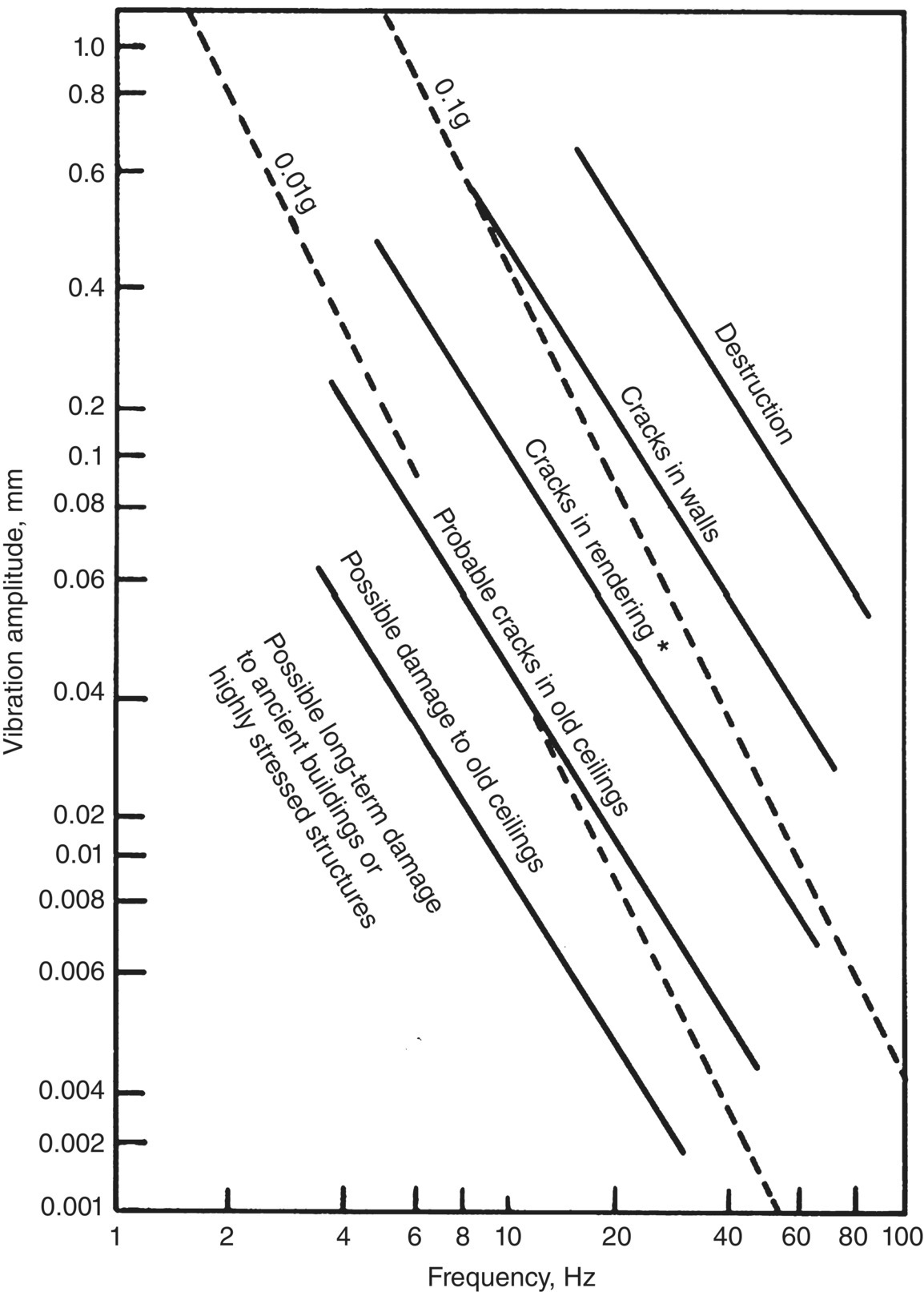
Continuous sources of vibration may produce resonances in buildings. Typical values of building natural frequencies are between 0.1 and 10 Hz for very tall and low buildings, respectively. Individual components of the building such as floors, ceilings, windows, etc. also have their own natural frequencies which can be excited at resonance by a number of vibration sources.
In general, vibration‐induced damage depends on the characteristics of the vibration, the type of source, the type of building, and the type of soil. It has been identified that man‐made sources of ground‐borne vibration are in the frequency range 1–150 Hz while natural sources such as wind and earthquakes have vibration energy at frequencies below 0.1 Hz [84].
Although vibration can be expressed in terms of displacement and acceleration, it is common practice to express limits for vibration on buildings in terms of peak vibration velocity. A guide for measurement of vibrations and evaluation of their effects on buildings has been published as an international standard ISO 4866 [85] and an identical British Standard BS 7385 [86–87]. In these standards, vibration‐induced damage to buildings has been classified into three categories: cosmetic, minor and major. Cosmetic damage is produced in the range from 15 mm/s at 4 Hz to 50 mm/s at frequencies greater than 40 Hz for measurements taken at the base of the building. Empirical evidence suggests that, below 12.5 mm/s peak vibration velocity, no damage is produced to a building.
Some other guidelines have been presented for assessing the effect of vibration and shock from different sources on structures. The interested reader is referred to these documents [88–90] for more information on the subject.
Leave a Reply