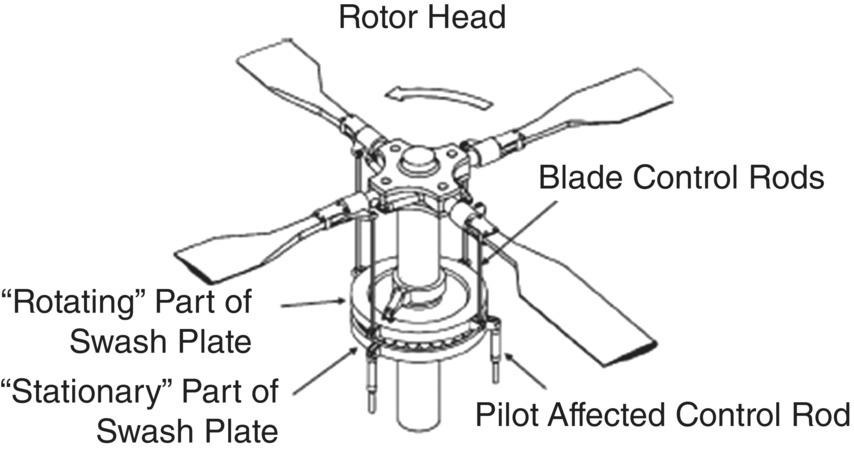
The generation of helicopter rotor noise is very complicated [11]. Sources of helicopter noise include (i) main rotor, (ii) tail rotor, (iii) the engines, and (iv) the drive train components. The dominant noise contributors are the main rotor and the tail rotor. Engine noise is normally less important, although for large helicopters engine noise can be dominant at take‐off. Rotor noise including main rotor and tail rotor noise can be classified as (i) discrete‐frequency rotational noise, (ii) broadband noise, and/or (iii) impulsive noise (also of discrete‐frequency character). The main rotor head kinematics are shown in Figure 15.4 [11].
Helicopter rotor noise is comprised of thickness noise (the noise generated from the periodic volume displacement of the rotating blades) and loading noise (caused by the rotating lift and drag forces). Thickness noise is more important in the low‐frequency range of the rotor–noise spectrum (at the BPF and first few harmonics). It also contains mid‐ and high‐frequency components since it is of an impulsive nature. At low rotational speeds and for low blade loading, the thickness noise line spectrum can be exceeded by the broadband noise components. Broadband noise is a result of turbulent inflow conditions, blade/wake interferences, and blade self‐noise (“airframe noise”).
Of great importance are impulsive‐type noise sources, resulting in the familiar “bang, bang, bang” sound. There are two main kinds: HS impulsive noise and blade–vortex interaction (BVI) impulsive noise. Tail rotor noise has similar characteristics to the main rotor noise. The flow around the tail rotor is the sum of the interacting flows generated by the wakes of the main rotor, the fuselage, the rotor hub, as well as the engine exhaust and empennage flows in addition to its own wake. For most helicopters, the tail rotor noise dominates at moderate speed straight flight conditions and during climb. Practical rotor noise reduction measures include passive reduction of high‐speed impulsive noise, reduction of tail rotor noise, and active reduction of BVI [11]. Lowson has provided an in‐depth review on helicopter noise [12].
Leave a Reply