Hearing Protectors
It is best practice to reduce noise through: (i) the use of passive engineering controls such as use of enclosures, sound‐absorbing materials, barriers, vibration isolators, etc. and then (ii) using administrative measures such as restricting the exposure of personnel by limiting duration, proximity to noise sources, and the like. In cases where it is not practical or economical to reduce noise exposure to sound pressure levels below that cause hearing hazards or annoyance, then hearing protectors should be used [22]. Hearing protection devices (HPDs) can give noise protection of the order of 30–40 dB, depending on frequency, if used properly. Unfortunately, if they are incorrectly or improperly fitted, then the attenuation they can provide is significantly reduced.
There are four main types of HPDs: earplugs, earmuffs, semi-inserts, and helmets. Figure 5.7 shows examples of the four basic kinds of HPDs [36]. Earplugs are generally low‐cost, self‐expanding types that are inserted in the ear canal and must be fitted correctly to achieve the benefit. Custom‐molded earplugs can be made to fit an individual’s ear canals precisely. Some people find earplugs uncomfortable to wear and prefer earmuffs. Earmuffs use a seal around the pinna to protect it and a cup usually containing sound‐absorbing material to isolate the ear further from the environment. If fitted properly, earmuffs can be very effective. Unfortunately, earmuffs can be difficult to seal properly. Hair and glasses can break the seals to the head causing leaks and resulting in a severe degradation of the acoustical attenuation they can provide. In addition, they have the disadvantage that they can become uncomfortable to wear in hot weather. The use of earmuffs simultaneously with earplugs can provide some small additional noise attenuation, but not as much as the two individual HPD attenuations added in decibels.
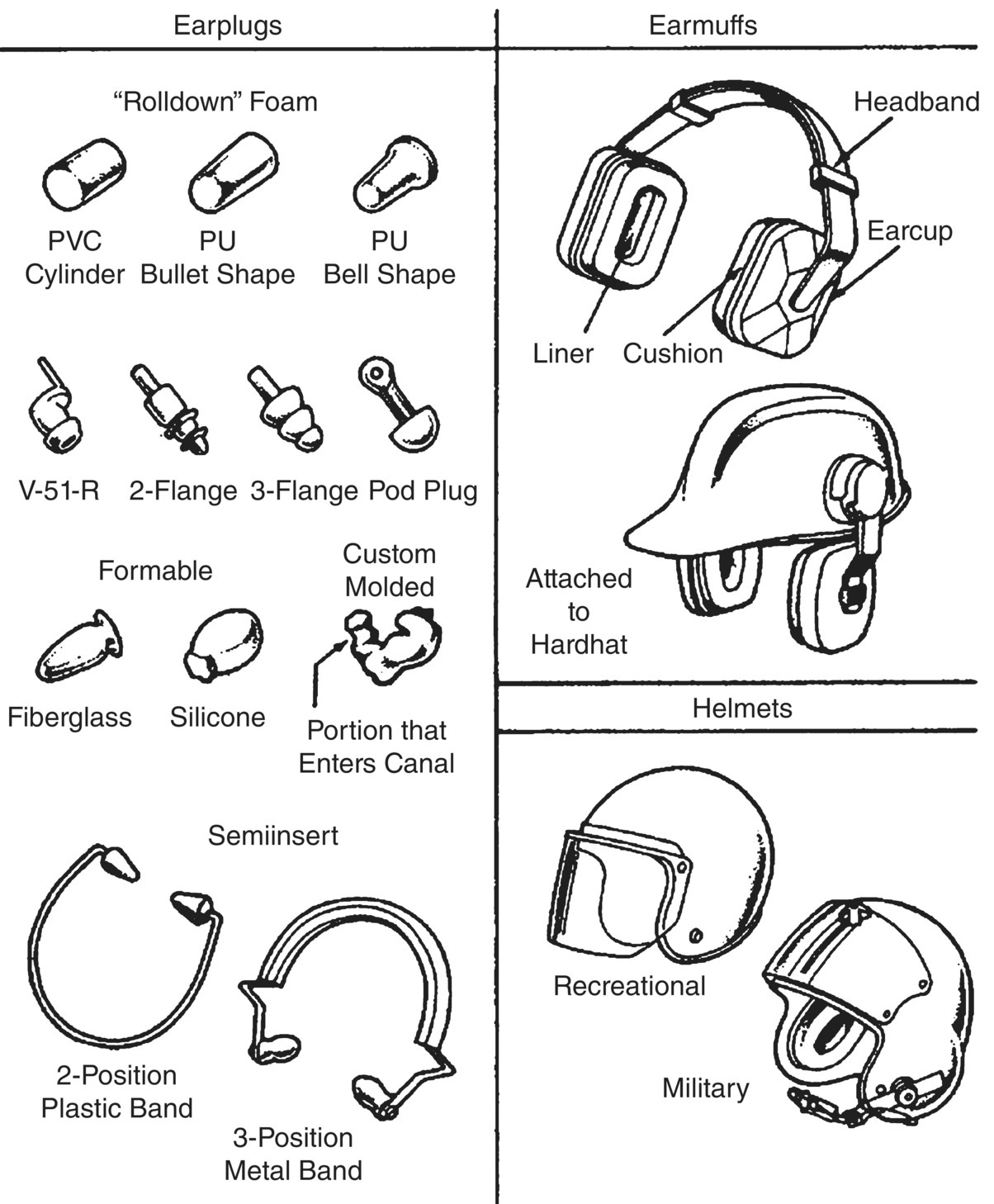
Semi-inserts consist of earplugs are held in place in the ear canals under pressure provided by a metal or plastic band. These are convenient to wear but also have the tendency to provide imperfect sealing of the ear canal. If the plug portion does not extend into the ear canal properly, the semi-insert HPDs provide little hearing protection and can give the user a false sense of security. Helmets usually incorporate semi‐inserts and in principle can provide slightly greater noise attenuation than the other HPD types. Attenuation is provided not only for noise traveling to the middle and inner ear through the ear canal, but also for noise reaching the hearing organ through skull bone conduction. Helmets also provide some crash and impact protection to the head in addition to noise attenuation and are often used in conditions that are hazardous not only for noise but potential head injury from other threats. Unfortunately, the hearing protection they provide is also reduced if the semi-inserts are improperly sealed in the ear canals.
In many occupational noise legislations, ear protectors should not be used as a substitute for effective noise control. The use of ear protectors is considered to be an interim measure and must only be used until engineering methods successfully bring noise levels below specified limits. The reasons why personal ear protection is not a completely satisfactory solution to the industrial noise problem are not hard to find. Perhaps the overriding reason is discomfort. Most types of ear protectors are uncomfortable to wear. They may cause the ears to get hot and sweaty or the tightness of some types of ear protectors can cause pain or headaches.
Another reason is communication difficulties. Many people claim that ear protectors impair communication which to a certain extent is true. However, in continuous intense noise conditions, hearing protectors actually do not reduce intelligibility of speech for people with normal hearing because noise and speech signals are both reduced equally and the speech signal‐to‐noise ratio remains the same. Thus, in continuous noise, the Articulation Index should remain constant (see Section 6.5) and speech intelligibility should be unimpaired. Of course, in intermittent or impulsive noise situations, conversation can normally be carried on in the “quiet” intervals and ear protectors will interfere with communication in such instances.
Another communication‐related disadvantage of ear protectors is the difficulty in hearing warning signals. In continuous noise, hearing protectors may not offer a disadvantage in this regard except for people with high‐frequency hearing loss. Such people, who are often found working in noisy environments, may well have increased difficulty in hearing warning signals and even normal conversation, because ear protectors attenuate high frequencies more and high‐frequency signals will then be more easily masked by low‐frequency noise (see Section 3).
Another disadvantage of the use of hearing protectors is that workers may feel that they can no longer judge the performance of their machines or detect the noise caused by wear or some other malfunction. There may be some truth in this, although it is important for people to learn that they can still hear noise when wearing ear protectors, but simply at a reduced level. A final reason is that some ear protectors such as earplugs can exacerbate diseases of the outer ear such as otitis. However, in these cases the use of earmuffs instead or medications will normally overcome this problem.
There are several standards for determining the noise protection produced by ear protectors [37–41]. Noise protection data should be required to be provided by a manufacturer when hearing protectors are purchased. Both the mean noise protection at each frequency band and the standard deviation of the measurements are normally reported.
The NRR (Noise Reduction Rating) is a single‐number rating method used to describe HPDs noise attenuation. The NRR is intended to be used for calculating the exposure under the HPD by subtracting it from the C‐weighted noise exposure level LC. An alternative use of the NRR is with the A‐weighted noise exposure level, LA, in which the NRR can be applied if 7 dB is first subtracted from its value. Reference [42] contains more detailed discussion on hearing protectors.
EXAMPLE 5.5
A hearing protector has an NRR of 17 dB and it used in a factory where one-octave-band sound pressure levels are given in line two of Table 5.5. Calculate the A‐weighted noise level entering the ear of a worker in this factory.
SOLUTION
First we need the A‐weighted sound pressure level from the one‐octave‐band levels given in Table 5.5. The A‐weighting correction in dB can be taken from Table 4.2 (see Section 4.3.5) and these values are shown in line three of Table 5.5. Line four shows the A‐weighted one‐octave‐band levels. These levels are combined to give


Therefore, the A‐weighted sound pressure level entering at the ear is

Table 5.5 One‐octave‐band factory noise.
| One‐octave‐band center frequency, Hz | |||||||
|---|---|---|---|---|---|---|---|
| 125 | 250 | 500 | 1000 | 2000 | 4000 | 8000 | |
| One‐octave‐band level, dB | 92 | 95 | 94 | 95 | 92 | 85 | 78 |
| A‐weighting correction, dB | −18 | −9 | −3 | 0 | +1.5 | +0.5 | −2 |
| A‐weighted one‐octave‐band levels, dB | |||||||
Leave a Reply