The purpose of governing of steam turbines is to maintain the speed of a turbine sensibly constant, irrespective of the load. The various methods of governing are as follows:
- Throttle governing
- Nozzle control governing
- By-pass governing
- Combination of throttle governing and nozzle control governing
- Combination of throttle governing and by-pass governing
- Throttle governing: The line diagram of throttle governing is shown in Fig. 7.14. The steam flow to the turbine is throttled by a balanced throttle valve actuated by a centrifugal governor. An oil differential relay is incorporated to magnify the small force produced by the governor for a small change of speed to actuate the throttle valve. The throttle valve is moved by a relay piston. A floating differential lever is fixed to its one end and a piston valve is fixed at some intermediate point. The pilot piston valve consists of two piston valves covering ports without any overlap. The piston valves are also operated by lubricating oil supplied by a pump at about 3 to 4 bar. The oil from this chamber is returned by the oil drain.Operation: Let the turbine work at full-rated load at the rated constant speed. If the load is reduced, the energy supplied to the turbine will be in excess and the turbine rotor will accelerate. Thus, the governor sleeve will lift. As the throttle valve position is assumed to be the same momentarily, the pilot piston valve spindle will get lifted, opening the upper port to oil pressure and lower port to oil return. The relay piston will thus close the throttle valve partially. The lowering of the throttle valve spindle will lower the pilot piston spindle and close the ports. As soon as the ports are closed, the relay piston gets stabilised in one position corresponding to the reduced load. The change in the available enthalpy for throttle governing is shown in Fig. 7.15.
- Nozzle control governing: The principle of nozzle control governing is accomplished by uncovering as many steam passages as are necessary to meet the load by poppet valves. An arrangement is shown in Fig. 7.16. The nozzles are divided into groups N1, N2, and N3 under the control valves V1, V2, and V3, respectively. The number of nozzle groups may vary from three to five or more.
- By-pass governing: The principle of by-pass governing is shown in Fig. 7.17. Steam entering the turbine passes through the main throttle valve which is under the control of the speed governor and enters the nozzle box or the steam chest. For loads greater than the economical load, a by-pass valve is opened, allowing steam to pass from the first stage, nozzle box into the steam chest, and so into the nozzles of the fourth stage. The by-pass valve is not opened until the lift of the throttle valve exceeds a certain amount. As the load diminishes, the by-pass valve closes first. The by-pass valve is under the control of speed governor for all loads.
 Figure 7.14 Throttle governing
 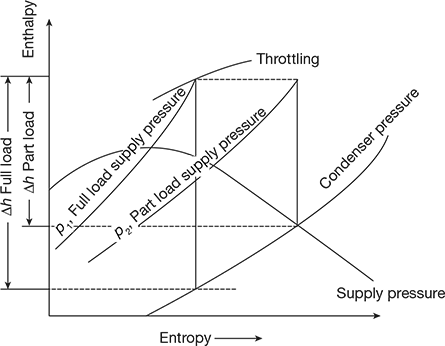 Figure 7.15 T-s diagram for throttling
  Figure 7.16 Nozzle governing
  Figure 7.17 By-pass governing
Leave a Reply