By forced vibration, we mean that the system is vibrating under the influence of continuous (external) forces that do not cease. The total response of a multi‐degree of freedom system due to a force excitation is the sum of a homogeneous solution and a particular solution. The homogenous solution depends upon the system properties while the particular solution is the response due to the particular form of excitation. The homogenous solution is often ignored for a system subjected to a periodic vibration for being of lesser practical importance than the particular solution. For a general form of excitation, a closed‐form solution of a multi‐degree of freedom system can be very difficult to obtain and numerical methods are often used.
The equations of motion of an n‐degree‐of‐freedom undamped linear system excited by simple harmonic forces at some arbitrary angular forcing frequency ω (all excitation terms at the same phase) can be expressed in matrix form as
(2.35) 
where F is an n‐dimensional complex column vector of dynamic amplitude forces. We assume harmonic solutions of the form
(2.36) 
where A is a vector of undetermined amplitudes. Substituting Eq. (2.36) into (2.35) leads to
(2.37) 
A unique solution of Eq. (2.37) exists unless
(2.38) 
which has the same form as Eq. (2.26). Equation (2.38) is satisfied only when the forcing frequency coincides with one of the system’s natural frequencies. In this condition, called resonance, the response of the system grows linearly with time and thus use of the solution Eq. (2.36) is unsuitable. When a solution of Eq. (2.37) exists, the amplitudes can be determined as [13]
(2.39) 
If we consider the two‐degree of freedom system discussed in Example 2.5 but now harmonic force excitations of frequency ω and amplitude F1 and F2 are applied to the masses m1 and m2, respectively (see Figure 2.13), the equations of motion are
(2.40a)
and
(2.40b)
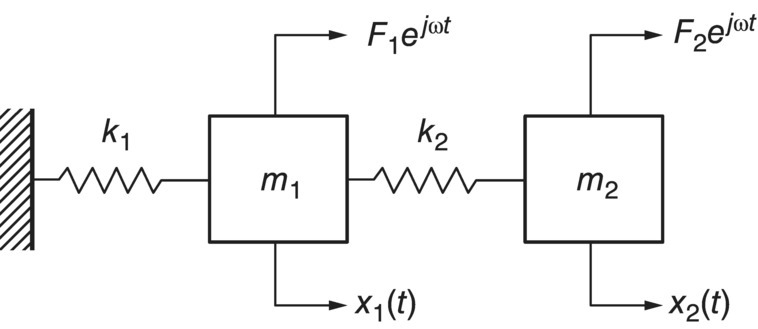
The particular solution is given by Eq. (2.36) as
(2.41)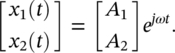
Therefore, Eq. (2.37) becomes
(2.42)
which has to be simultaneously solved to find the displacement amplitudes A1 and A2.
EXAMPLE 2.6
Let consider the two‐degree of freedom system of Example 2.5. Assume that a force F0 ejωt is applied to mass m1 and no force is applied to mass m2. Then, Eq. (2.37) becomes
(2.43) 
SOLUTION
Solving the system of Eq. (2.43) simultaneously, we obtain that
(2.44) 
(2.45) 
and the ratio
(2.46) 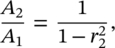
where  and
and  .
.
It is noted from Eq. (2.44) that the steady‐state amplitude of the mass m1 will become zero when r2 = 1, i.e. when the excitation frequency is  . Thus when the stiffness and mass of the secondary mass‐spring system are chosen correctly, the main mass theoretically does not move. At this frequency the secondary mass is exactly 180° out‐of‐phase with the force applied to the primary mass and the mass has an amplitude A2 = −F0/k2. This is the concept of the dynamic vibration absorber (also called neutralizer) used in machinery vibration control applications [11, 13]. The applied force is canceled by an equal and opposite force from the secondary spring. The dynamic vibration absorber was invented in 1909 by Hermann Frahm. This technique works when the excitation is at a fixed frequency at or close to resonance. Since the total system has two natural frequencies (one either side of the excitation frequency), a change in the frequency of the excitation force could excite the modified system at one of these frequencies, making the vibration absorber ineffective.
EXAMPLE
Repeat the problem discussed in Example 2.6 but now assume that a force F0 ejωt is applied to the mass m2 and no force is applied to the mass m1.
SOLUTION
Equation (2.37) becomes now
(2.47) 
which leads to the following results
(2.48) 
(2.49) 
where  and
and  .
.
Leave a Reply