6.13.1 Traffic Noise Index
In an attempt to develop acceptability criteria for traffic noise from roads in residential areas, Griffiths and Langdon [45] produced a unit for rating traffic noise, the traffic noise index (TNI). They measured A‐weighted traffic noise levels at 14 sites in the London area and interviewed 1200 people at these sites in the process. Griffiths and Langdon excluded sites with noise sources other than traffic. They then used regression analysis to fit curves to the data. This indicated that L10 was better at predicting dissatisfaction than L50 or L90, and that TNI was also superior to L10 , L50, and L90.
Use of the TNI has not been widespread. The index attempts to make an allowance for the noise variability since fluctuating noise is commonly assumed to be more annoying than steady noise.
Some doubt has been cast on the conclusions of Griffiths and Langdon, and it has been suggested that the very short sample times (100 seconds in each hour) used may have resulted in underestimates of L10 and overestimates of L90 [46]. TNI is not considered today to be significantly superior to either L10 or Leq and has not been widely used.
Instead of TNI, the British government has adopted the A‐weighted L10, averaged over 18 hours from 06:00 to 24:00 hours, as the noise index to be used to implement planning and remedial measures to reduce the impact on people of road traffic noise [47–49]. In addition, the British government uses a 16‐hour Leq and an 8‐hour Leq for the case of land used for residential development.
6.13.2 Noise Pollution Level
In a later survey, Robinson [50] again concluded that, with fluctuating noise, Leq, the equivalent continuous A‐weighted SPL on an energy basis, was an insufficient descriptor of the annoyance caused by fluctuating noise. He included another term in his noise pollution level (NPL) or LNP.
Robinson examined the available Griffiths and Langdon data. [49] He then examined the aircraft noise experiments of Pearsons [51] and found that LNP predicted very well Pearsons’s data points and the tradeoff between duration and level for individual flyover events. A‐weighted levels were used in LNP with traffic noise, and PNLs (PNdB) were used with aircraft noise. The superiority of LNP over all other forms of NR has not been proved in practice, and it has not been widely used.
6.13.3 Equivalent SPL
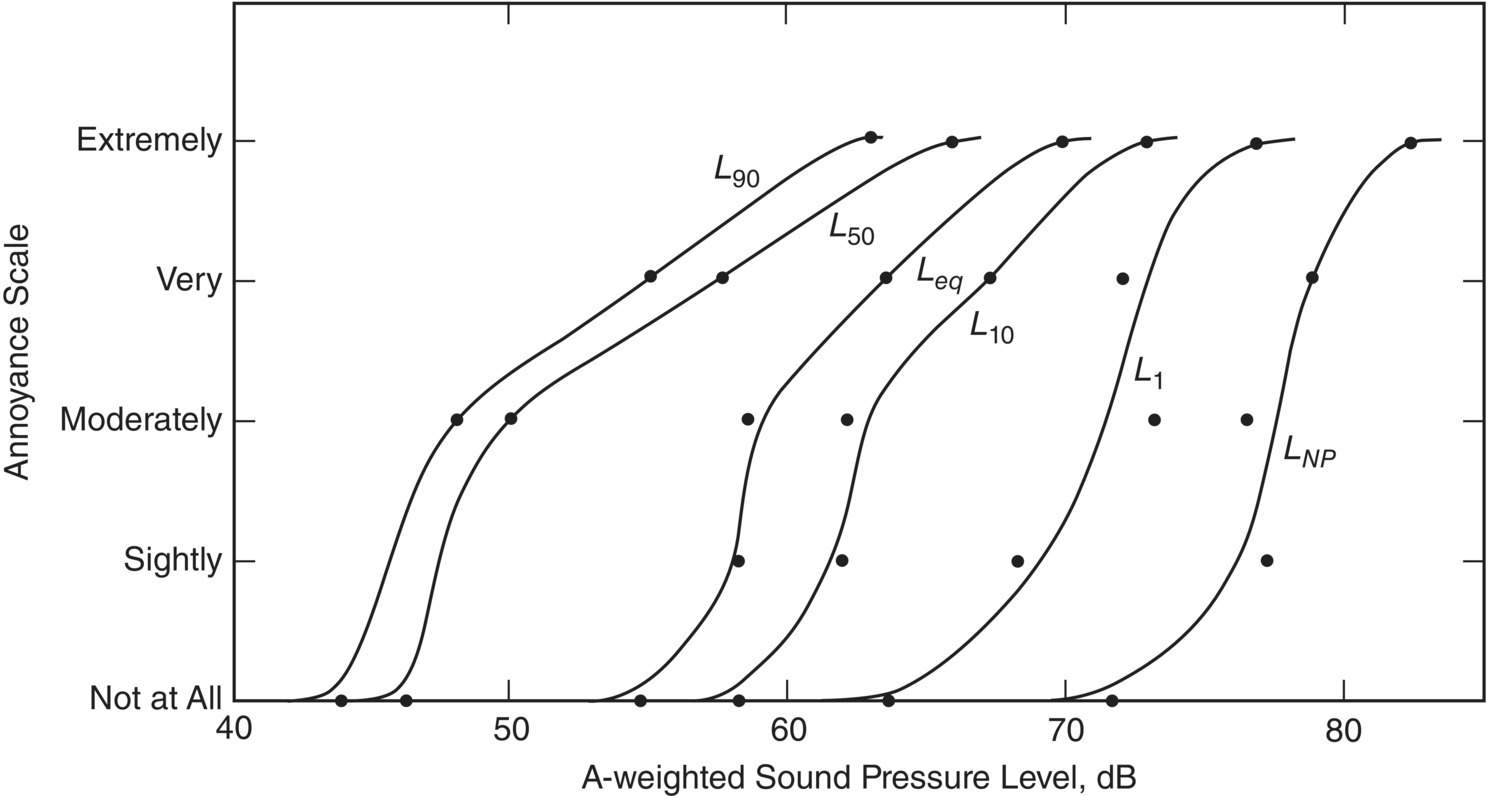
Figure 6.14 shows the annoyance results of Pearsons and coworkers, using six different NRs: L1, L10, L50, L90, Leq, and LNP [52]. As expected for all of the noise measures, annoyance increases with level. The shapes of the curves, however, do vary considerably when the annoyance is less than very annoying. In particular, the L10 and Leq measures exhibit a very steep rise in annoyance from the categories of slightly to moderately annoying for no increase in noise level, presumably one of their drawbacks. However, except for the case of LNP in the extremely annoying category, the standard deviation of Leq for a specified response category is in all cases less than or equal to the standard deviation of the other noise measures. This is an advantage in the use of Leq since there is more confidence in the annoyance scores predicted. There is one clear advantage of Leq over L10, however, in the case of noise containing short‐duration, high‐level single events. If the events do not occur for more than 10% of the time, then L10 will be relatively insensitive to these high‐level events and will tend to represent the “background” noise. In fact, for a noise measure Ln to be useful, the intruding noise events must be present for more than n% of the time. This suggests that L10 would be unsuitable as a measure of aircraft noise annoyance and that it might be a possible source of error in Griffiths and Langdon’s results [45] for low traffic flows.
The A‐weighted equivalent SPL (often now denoted as Leq) has become the measure most commonly used to assess and regulate road traffic (and railroad noise) [29]. In the United States Ldn (a similar measure) is used for road traffic noise assessment.
Leave a Reply