16.5.1 Attenuation Provided by Barriers, Earth Berms, Buildings, and Vegetation
Noise barriers are being used increasingly to protect residential communities from road traffic, rail and rapid transit noise. Chapter 9 of this book and Ref. [16] describes empirical formulas that can be used to predict barrier performance. Barriers are of limited use to protect residential areas from aircraft and airport noise, and construction site noise, with the possible exception of their use to offer protection from the noise caused by the testing of aircraft engines during ground run‐up. Likewise, the mobility and elevation of noise sources of construction equipment used on building sites and highway construction sites often make barriers of limited use. Urban barriers must also be designed to be acceptable aesthetically. The formulas for barrier performance given in Ref. [16] are mostly based on idealized theoretical considerations or experimental studies conducted in the laboratory. Reference [17] describes some of the practical considerations in the use of urban barriers.
The attenuation of a barrier is normally defined in two main ways. The first involves the barrier attenuation, which is defined as the difference between the sound pressure levels measured (or predicted) at a location and the sound pressure level at the same location under free‐field conditions. The second definition involves the reduction in sound pressure level (known as insertion loss) at the receiving location achieved by the insertion of the barrier. The attenuation provided by a barrier is a function of frequency. More exactly it can be related to the difference between the two path lengths from the source to the receiver divided by the wavelength: (i) over the barrier and (ii) straight though the barrier. This quantity is known as the Fresnel number (See Eq. (9.49)), which is also used in optics [16].
The Fresnel number can also be related to the effective nondimensionalized height parameter of the barrier (defined as the ratio of barrier height perpendicular to the incident sound divided by its wavelength). The effective height of the barrier increases with wavelength and so does the barrier attenuation. This means that a barrier of fixed height is more effective in attenuating high‐frequency sound, and stronger shadows are created for high‐frequency sound than low‐frequency sound. A similarity can be observed with the behavior of light since an obstacle produces a stronger shadow for short‐wavelength (high‐frequency) violet light than long‐wavelength (low‐frequency) red light [16].
Theoretically, noise barriers can be shown to provide the same attenuation if placed at the same distance from the source or from the receiver. In practice, however, as common with other passive noise control measures, their placement nearer to the source is usually more effective. This is because receivers, such as the upper regions of high‐rise buildings, can extend in height above a barrier placed near to them, and thus sound is not blocked from reaching them so they are not protected [90]. Also, single or multiple‐road and rail vehicles are normally located close to the ground, and barriers placed close to them block the sound better, which would otherwise be traveling to the multiple elevated receivers.
It is particularly important to ensure that barriers do not have holes or leaks that can degrade their performance and that they are constructed from material with an adequate transmission loss (sound reduction index) to sufficiently attenuate the sound penetrating them and reaching the receivers directly in that manner. Urban barriers are sometimes made to absorb sound on the side facing the source, so as to reduce the sound reflected back to the source. Care must then be made to ensure that the sound‐absorbing material can survive the local environmental conditions and not become degraded too rapidly. Reference [17] describes the use of sound‐absorbing materials with urban barriers. Ref. [16] presents formulas for predicting the attenuation of barriers, while Ref. [17] gives formulas and nomograms for predicting the attenuation of barriers used in urban situations. These formulas are now incorporated in commercial software. The sound attenuation of barriers with complicated shapes such as cantilever, parabolic barriers, or earth berms can now be predicted with boundary element method (BEM) approaches.
Unfortunately, when barriers are used in the field, the atmospheric effects of turbulence or wind and/or temperature gradients above the barriers normally degrade their attenuation and/or insertion loss performance. Reference [17] describes factors that must be considered when barriers are used in practical situations to reduce road and rail traffic noise in the community. Wind is probably the main cause of the degradation of the acoustical performance of barriers. Wind has been found to have two main effects. First, the turbulence in the wind causes the sound waves to be scattered so that some of the sound energy propagates into the shadow zone behind the barrier. Second, wind gradients, which exhibit increasing wind speed with height above a barrier (with wind blowing in the same direction as the sound propagation), can bend the sound downward into the so‐called shadow region of the barrier, thereby decreasing its attenuation. Temperature gradients, in which the temperature increases with height (called temperature inversions), can have a similar effect in bending sound downward into the shadow zone behind a barrier. In practice, the attenuation of an urban barrier does not reach its theoretical value because of such environmental effects, and in real‐use urban barriers normally have an upper attenuation limit of about 20 dB, unless they are of double construction, in which case the upper limit is about 25 dB [17].
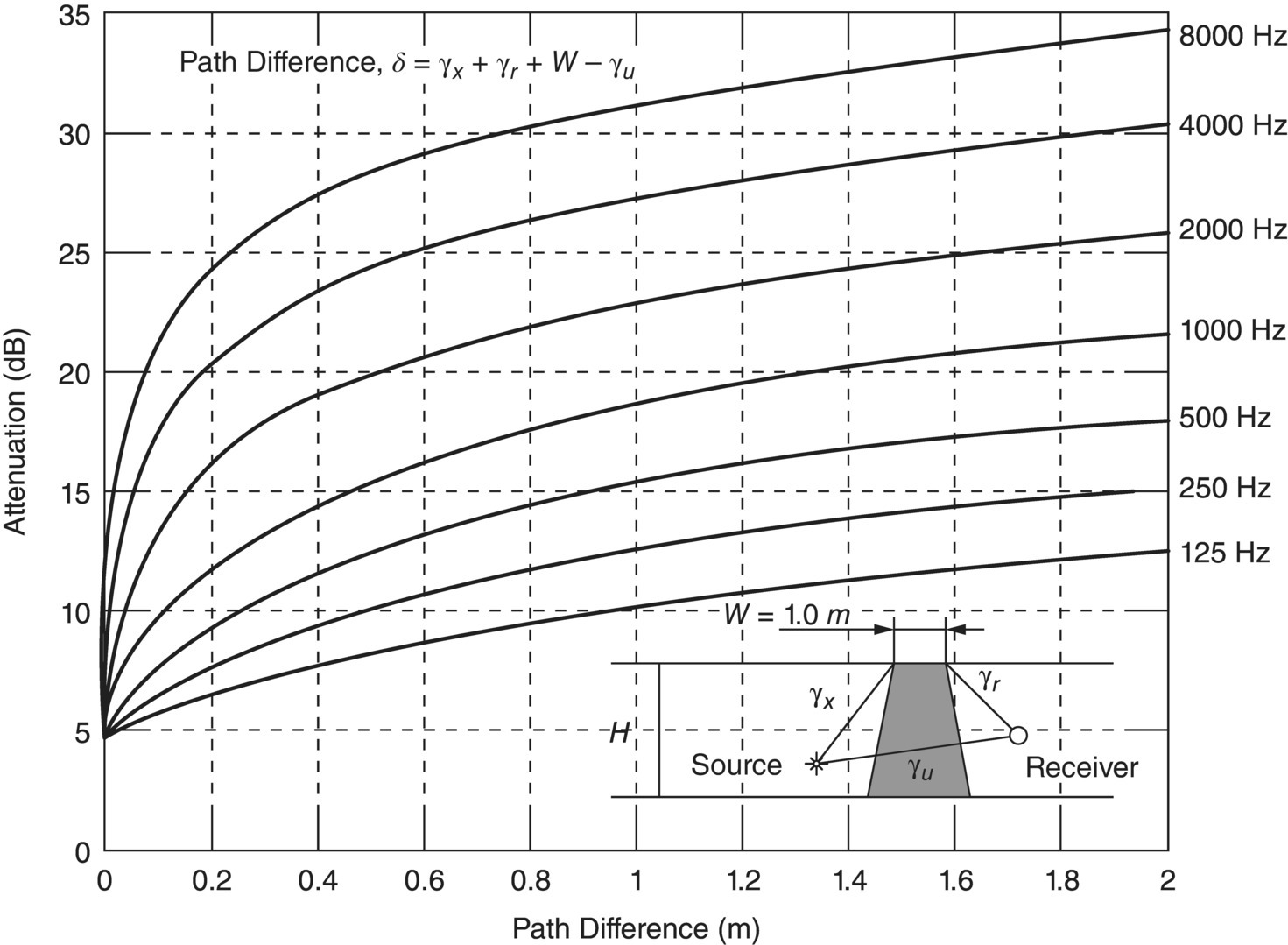
An example of a noise barrier is an earth mound. An earth mound (berm) is a noise barrier constructed of soil, stone, rock, or rubble, often landscaped, running along a highway to protect adjacent land users from noise pollution. The sound attenuation provided by a 1 m wide earth berm as a function of the path difference (see Chapter 9) is shown in Figure 16.8. There is a cost advantage in using earth mounds since they can often be constructed using surplus materials at project sites, provided there is sufficient land area available for their construction. In general, earth mounds represent the lowest cost alternative to construct a noise barrier. An earth mound is an obvious solution to reduce visual impact because it can be made to fit in with the landscape more naturally than any vertical structure, especially as it can support planting which greatly improves its appearance in most rural contexts. In other words, the soft natural outline of an earth mound, in conjunction with planting, is likely to be more attractive to both local residents and to road users [87]. When plants are selected for use in conjunction with a barrier, they should generally be of hardy evergreen species (native plantings are preferable), which require a low level of maintenance. Concerning the acoustical performance of earth mounds, some studies have indicated that earth mounds may provide more sound attenuation than vertical walls of the same height, although experimental and theoretical assessments have yielded mixed results [91].
There is a prevalent popular belief that plantings, shrubs, or rows of big trees produce a significant reduction in road traffic noise. However, noise reductions are irrelevant unless the vegetation is very dense and wide. Although some authors have suggested that vegetation produces beneficial effects in improving public perception of the noise due to visual and psychological relief, other studies have shown the opposite [92]. In addition, care must be exercised with placing plants on barriers, since the scattering they cause can actually reduce a barrier’s attenuation. Further discussion on the noise attenuation provided by trees can be found in Ref. [17].
16.5.2 Base Isolation of Buildings for Control of Ground‐Borne Vibration
Road and rail traffic and some industrial and/or road building operations cause ground vibration of a fairly continuous nature. Railways are usually the sources of most intense ground vibration since they often carry vehicles with relatively heavy loads at high speeds, which results in significant rapidly created forces transmitted to the ground. Although it is possible to reduce the vibration at the source in some cases, there is some limit to the reduction that can be achieved economically.
When new buildings, particularly those of a sensitive nature, such as hospitals, auditoriums, and concert halls are to be constructed near to existing highways and railway lines, suppression of the building vibration and base isolation of the buildings themselves should be considered [40]. Some simple, relatively low‐cost measures are available for reducing building vibration, including (i) increasing the damping in the structure, (ii) stiffening certain regions of the building to move natural frequencies away from forcing frequencies thereby avoiding resonances, and (iii) the installation of floating floors in sensitive parts of the buildings.
In cases where the ground vibration is severe, such as where a building must be constructed near to a railway, it may be necessary to vibration‐isolate the complete building from the ground by means of base isolation [40]. This may be essential only for sensitive buildings. The amount of vibration that is acceptable in a building will depend upon its use and other factors such as the duration and nature of the vibration. The principles of base isolation are similar to those used to protect buildings against earthquakes; however, the lower level of vibration experienced from road, rail, and some industrial sources compared with earthquakes, makes the design criteria somewhat different for each case studied. Each building design will be different and building use, acceptable vibration limits, and other criteria will determine the design chosen. Typical isolation frequencies are in the range of 5–15 Hz.
There are two main types of isolators normally used for base isolation of buildings. These consist of (i) laminated rubber isolators and (ii) helical steel spring isolators. The rubber isolators can either be made from natural rubber or from synthetic rubber. Steel spring isolators usually combine several helical springs in one unit. Rubber isolators normally have higher inherent damping than spring isolators. However, the spring isolators sometimes include additional damping elements to suppress internal coil resonances of the springs at high frequencies, and to limit vibration during the rapid vibration onset or vibration decay caused by passing trains or vehicles. Steel springs are expensive but can be manufactured to have precise stiffness values and a long life. Rubber isolators are usually less expensive but have the drawback that they can be subject to degradation more rapidly than steel springs unless they are protected against any possible hostile environmental conditions, which could cause the degradation. If adequate protection is provided, however, rubber isolators can be made to have sufficient life in terms of both degradation and creep performance.
The design of vibration isolators is described in Refs. [40, 60, 93]. Their performance in buildings is normally measured in terms of the insertion loss they provide, since this quantity describes the benefit obtained from the use of the isolators [39]. Single‐degree‐of‐freedom models are useful to give some approximate indication of the isolator performance, although building vibration is very complicated, and more sophisticated vibration models must be used for better vibration predictions. With continuous excitation, which is almost steady‐state, such as is caused by passing trains, the vibration problem can be treated in the frequency domain. In some cases, where the excitation is more impulsive in nature, such as is caused by some industrial applications, then a time‐domain modeling approach is more convenient. More complicated building base models employ FEM methods. Various software programs are available commercially to create such sophisticated building vibration models. In some cases, simple two‐dimensional numerical models are used to reduce computational demands. Three‐dimensional approaches are more suitable to obtain more accurate building models [40]. Studies on base isolations of buildings continue [94–100].
16.5.3 Noise Control Using Porous Road Surfaces
Paved roads have been in existence for at least 2000 years since Roman times. Obviously such roads created considerable noise by the impacting of wheels on the uneven road surface. In South America, the first allusion to community noise dates back to the end of eighteenth century, when a vice royal decree recommended the use of leather strips on carriage wheels. This resulted from the numerous complaints of inhabitants of the Spanish colonial cities having cobblestone roads [101]. Modern road surfaces are normally composed of asphalt or concrete.
One way to reduce tire/road noise is by the use of porous road pavement surfaces. Such surfaces have the advantage that they not only reduce the tire/road noise at the point of its generation, but they also attenuate it (and vehicle power plant noise) by absorption of sound as it propagates to nearby residential areas. Such surfaces have the further advantage that they drain water well and reduce the splash up behind vehicles during heavy rainfalls. So far there has been greater use of porous road surfaces in Europe, although there is now increasing interest in their use in the USA [13, 102, 103].
The sound absorption of porous road pavement surfaces is affected by several geometrical and other parameters of the road pavements. These include: (i) the thickness d of the porous layer, (ii) the air voids (Va) or “porosity,” (iii) the airflow resistance per unit length, R, (iv) the tortuosity, q, and (v) the coarseness of the aggregate mix (use of small or large aggregate, etc.). For most common dense asphalt mixes, Va is about 5%, while for new porous mixes, the air void content Va varies from about 15–30%. The airflow resistance R is the resistance experienced by air when it passes through open pores in the pavement. The tortuosity or “structural form factor” as it is sometimes known is a measure of the shape of the air void passages (whether they are almost straight or twisted and winding and slowly or rapidly change cross‐section area) and the effect this has on the pavement sound absorption properties (see Chapter 9).
Hamet et al. [104] and others have shown that porous surfaces exhibit one or more regions of high sound absorption in the frequency range of most interest (200–2000 Hz). These high sound absorption regions often peak and can have sound absorption coefficients of almost unity. The thickness of the porous surface has a large effect on the sharpness of the peaks. Generally the thicker the porous surface, the lower is the peak frequency. With thicker porous surfaces, the peaks generally also become broader and the peak absorption is somewhat reduced. The airflow resistance and tortuosity have an influence on these effects too. Hamet et al. measured the absorption of various thickness surfaces from thicknesses of 50–400 mm. They found that their porous surface of 50 mm thickness has a sharp absorption peak of almost unity at about 900 Hz. While their 100 mm porous surface has at first a smoother peak at about 450 Hz and a second sharper peak at about 1350 Hz. Their 150 mm thick surface has peaks at about 300, 900, and 1500 Hz. It is observed that the first peak frequency is proportional to the thickness. Also, it is observed, where the second and third peaks can be seen in the measurements of Hamet et al., that these higher peak frequencies are at almost exactly twice and three times the frequency of the first peak. But the frequencies are only a little more than one half what would be expected from a simple one‐quarter, three‐quarter, and five‐quarter wavelength matching with the thickness. This is presumably because the tortuosity of the air passages makes the distance from the surface to the dense pavement below effectively almost twice as great as the thickness itself.
Von Meier et al. [105, 106] have made theoretical studies of the effect of air void content and flow resistance on the sound absorption coefficient of porous surfaces. They found that both the air void content and flow resistance have a strong effect on the value of the absorption coefficient of the peaks of a 40 mm thick porous surface with a tortuosity value of 5. The air void content leads to higher values of the sound absorption coefficient at both of the peaks predicted for such surfaces; while higher values of air flow resistance also initially lead to higher values of the absorption coefficient at the peaks. After a certain value of air flow resistance per unit length R is reached, however, the peak absorption values start to decline. Additional discussion on porous road surfaces can be found in Ref. [13].
Leave a Reply