It is seen for the microphone (or accelerometer) shown in Figure 7.3 that the dynamic range is about 100 dB. Most good‐quality microphones have a dynamic range of about 100–120 dB (interestingly enough about the same as the human ear) [2]. As the microphone diaphragm diameter (or accelerometer mass) is increased, the transducer sensitivity is normally increased as well so that electrical noise is less of a problem and the lower signal amplitude limit for measurements is decreased. In the case of a microphone, however, a larger diaphragm diameter usually results in a larger deflection for a given sound pressure and a reduced upper sound pressure level limit because of nonlinearity problems. Thus between the upper and lower amplitude limits, the microphone has a usable range of operation.
Small‐diameter microphones are not very sensitive but can be used for high‐amplitude sound pressures without distortion; their electronic noise floor is quite high, however. (Different types are discussed briefly in this chapter. The fundamentals of the operation of the main types of microphone are described in more detail in Ref. [2].) Large diameter microphones are normally more sensitive and can be used for lower‐level noise than small‐diameter microphones. Their noise floor is lower, but larger‐diameter microphones experience more diffraction problems at low frequencies than small‐diameter microphones [5]. Figure 7.4 shows the inherent noise floor plotted against upper limiting frequency for four microphone diameters [6]. Because of the dynamic range problems, the small‐diameter microphones cannot be used for very “quiet” sounds, and the large‐diameter microphones cannot be used for intense noise.
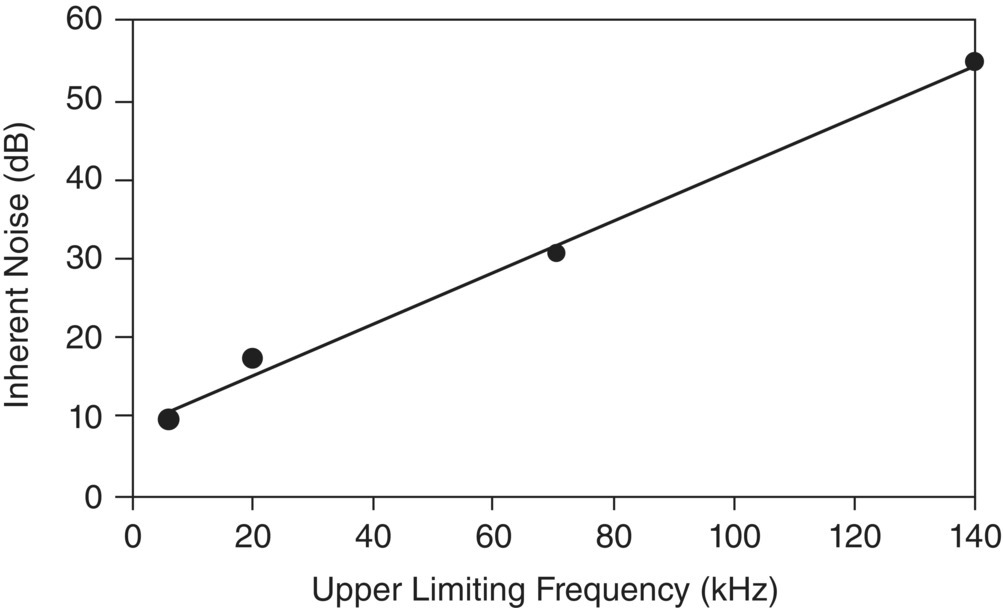
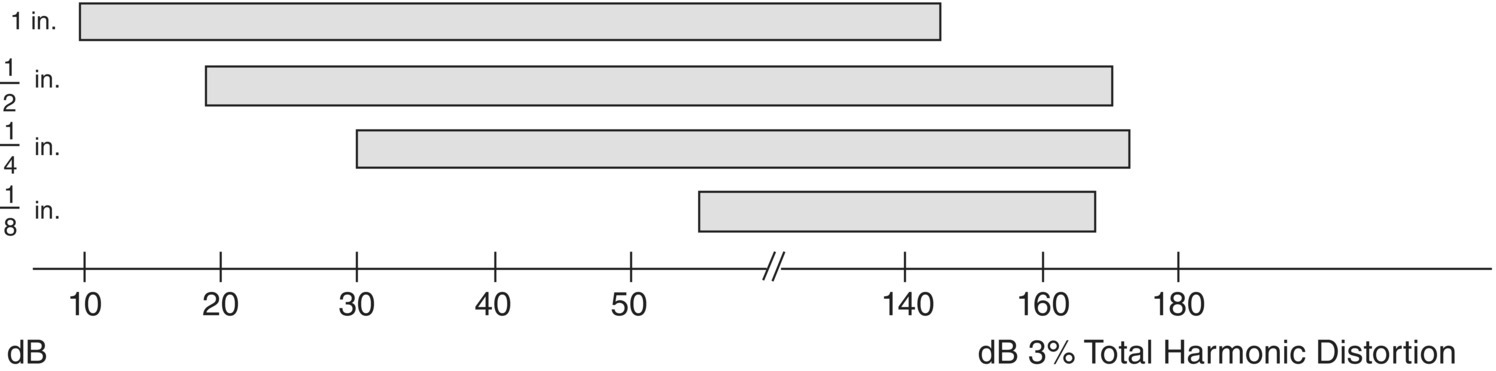
Figure 7.5 shows the dynamic range for four commercially available microphones. The lower level limit is given in terms of the A‐weighted sound pressure level of the internal noise floor of the microphone and associated preamplifier. The upper level limit is set by the sound pressure level at which 3% dynamic distortion occurs. It is observed that the 1‐in. and 1/2‐in. diameter microphones have the greatest dynamic ranges of about 150 dB. The 1/4‐in. microphone has a dynamic range of about 140 dB, while the 1/8‐in. diameter microphone has a dynamic range of only about 100 dB [6].
Leave a Reply