In general, a directivity factor Qθ,ϕ may be defined as the ratio of the radial intensity 〈Iθ, ϕ〉t (at angles θ and ϕ and distance r from the source) to the radial intensity 〈Is〉t at the same distance r radiated from an omnidirectional source of the same total sound power (Figure 3.12). Thus
(3.53)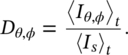
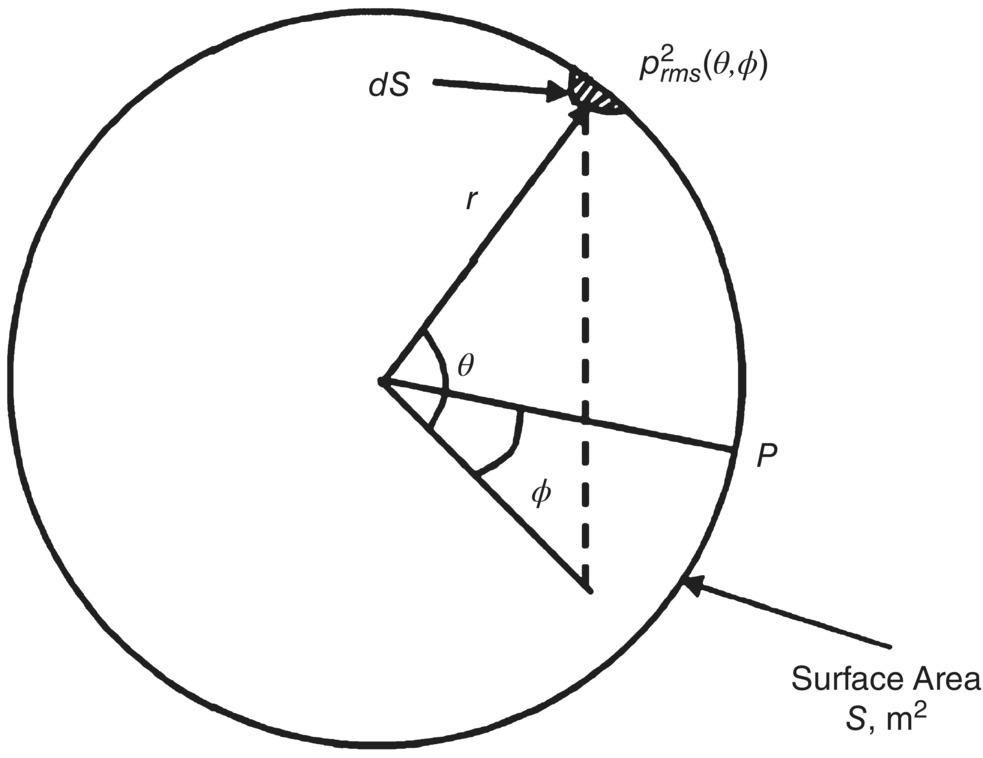
For a directional source, the mean square sound pressure measured at distance r and angles θ and ϕ is p2rms (θ,ϕ).
In the far field of this source (r ≫ λ), then
(3.54)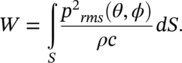
But if the source were omnidirectional of the same power W, then
(3.55)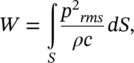
where p2rms is a constant, independent of angles θ and ϕ.
We may therefore write:
(3.56)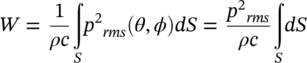
and
(3.57)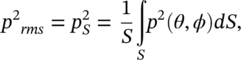
where  is the space‐averaged mean‐square sound pressure.
We define the directivity factor Q as
(3.58)
the ratio of the mean‐square sound pressure at distance r to the space‐averaged mean‐square pressure at r, or equivalently the directivity Q may be defined as the ratio of the mean‐square sound pressure at r divided by the mean‐square sound pressure at r for an omnidirectional sound source of the same sound power W, watts.
Leave a Reply