It has been observed from the experiments that the products of partial oxidation are the main cause of odour in diesel exhaust. This partial oxidation may due to a very lean mixture during idling or due to wall-quenching effect. The effect of fuel-air ratio and odour is shown in Fig. 11.25.
The members of the aldehyde family are considered responsible for the pungent odours of diesel exhaust. The aldehydes in the exhaust are found at maximum 30 ppm but it is observed that even 1 ppm can cause irritation to the nose and eyes. There is no standard method developed yet for measuring the odour. However, several odour producing components such as nepthaldehyde, n-butylbenzene, and so on, are given standard rating and trained personnel can give odour ratings for the diesel exhaust sample by comparison.
The factors which affect the odour formation in the diesel engine are as follows:
- Fuel-air Ratio: It is already mentioned that lean mixtures produce odours.
- Mode of engine operation: The mode of operation of the engine affects the exhaust odour significantly. Maximum odour occurs when the engine is accelerated from idling.
- Engine type: The odour intensity does not change with the type of engine—two-stroke or four-stroke engine.
It is also claimed by a few researchers that the intensity of odour is reduced by additive compounds.
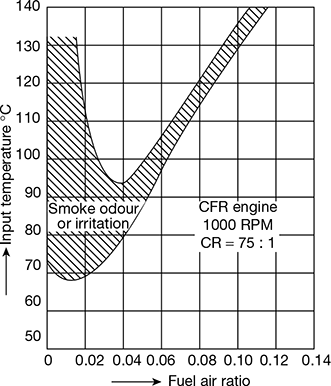
Figure 11.25 Effect of fuel air ratio on odour in diesel exhaust
Leave a Reply