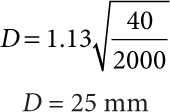
Inside diameter of pipe D = 1.13√Q/V
Thickness of pipe 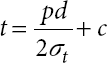
Let assume that Q = 40 m3/min V = 2000 m3/min
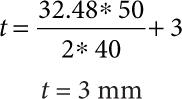
From the weight of the car and diameter of cylinder. We got pressure of 324.8Kpa.
From Table 8.2, we find for steel pipe c=3mm there for thickness of the pipe and σt = 40 Mpa
Design of Spring
Mechanical springs are used in machine to exert force to provide flexibility and to store or absorb energy and I select the helical compressive spring. These are:
- Ease in manufacturing and reliability
- Wide range and constant spring rate
Material selection
We select music wire that has
- Toughness and tensile strength
- Higher stress under cyclic loading
For the material, shear modulus, G = 81.7Gpa
Tension modulus E = 200Gpa
Gage no = 16
Diameter of wire = 2mm
Design shear stress= 895Mpa
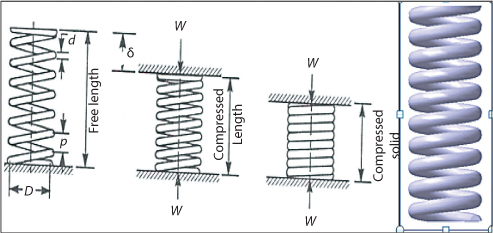
Table 4.4 Number of active coils specification.
| Squared & ground end | Planed end | Ground end | |
| Na | N-2 | N | N-1 |
To start the design analysis the above standard
And initial specifications are:-
Outside diameter, DO= 12mm
Nt = total Number of coil =12
Rob oust linearity = 0.15
Where, Nt = coil numbers
Na = active coil numbers
Ls = spring solid length
Lo = spring free length
The ends are square and ground ended because springs with this end are frequently mounted on a bottom-type seat or on a socket with a depth equal to the height of just a few coil for the purpose of locating the spring.
STEP ONE:
Mean diameter, Dm = Do–Dw = 12mm–2mm = 10mm
Internal diameter, Di = Dm–Dw = 10mm–2mm = 8mm
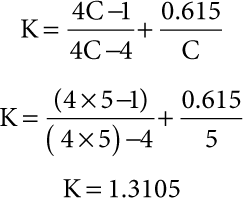
Spring index, C = Dm/Dw, = 100mm/2mm = 5
Which is safe with typical machinery spring having C value from 5-12
Wahl factor,
STEP TWO:
Stress in spring at F = Fo
Where Fo = operating spring force (calculated from given handle force).

As spring is compressed it gets twisted and thus the shear stress may be expressed as:

The modified stress equation is given by Wahl as:
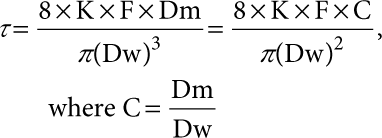
So all the factors are found from the above calculation

STEP THREE
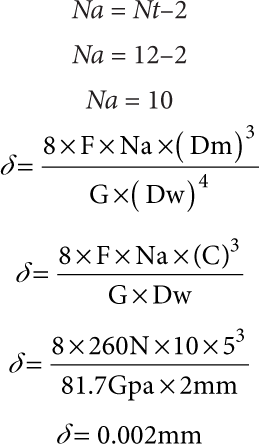
Deflection at operating force (fo).
Θ = TL/GJ where θ= angle of twist in radians
T= Torque
L= Wire length
G= Elasticity modulus of the material in shear
J= Wire moment of inertia
Again, for convenience, we will use a different form of the equation in order to calculatethe linear deflection of the spring from the typical design variables of the spring. The resulting equation is,
STEP FOUR
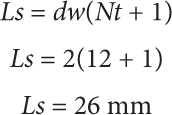
Solid length is the shortest possible length that the spring can have as it is not fully compressed to the solid length during operation.
STEP FIVE
Design stress from the average stress service for ASTM- (music wire) for:-
Dw = 2 & τ = 895 Mpa & operating stress τo = 870 Mpa from the step the design is safe.
STEP SIX
BUCKLING –If Lo > 2.63 DM/α the spring will buckle at operating deflection.
So, to evaluate buckling
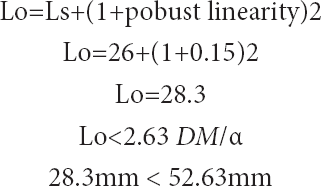
Therefore the free length of 28.3 is less than 52.63 and buckling is unlikely.
Leave a Reply