The definitions of muffler performance in most common use will be given here [1, 5–8]. It should be noted, however, that some authors use different nomenclature and confusion can sometimes arise.
- Insertion Loss (IL). This is the difference in the sound pressure level (SPL) measured at one point in space with and without the muffler inserted between that point and the source [1, 5–8]. IL is a convenient quantity to measure and its use is favored by manufacturers.
- Transmission Loss (TL). This is defined as 10 log10 of the ratio of the sound power incident on the muffler to the sound power transmitted. This is the quantity which is most easily predicted theoretically, and its use is favored by those engaged in research.
- Noise Reduction (NR). This is the difference in SPLs measured upstream and downstream of the muffler.
- Attenuation. This is the decrease in propagating sound power between two points in an acoustical system. This quantity is often used in describing absorption in lined ducts where the decrease in SPL per unit length is measured [7, 8].
The first three definitions are used frequently in work on mufflers for automobile engines and they are illustrated in Figure 10.1. It is of interest to note that these definitions are also used with similar meanings to describe sound transmission through air‐conditioning ducts, walls of buildings, aircraft cabins, or machine enclosures.
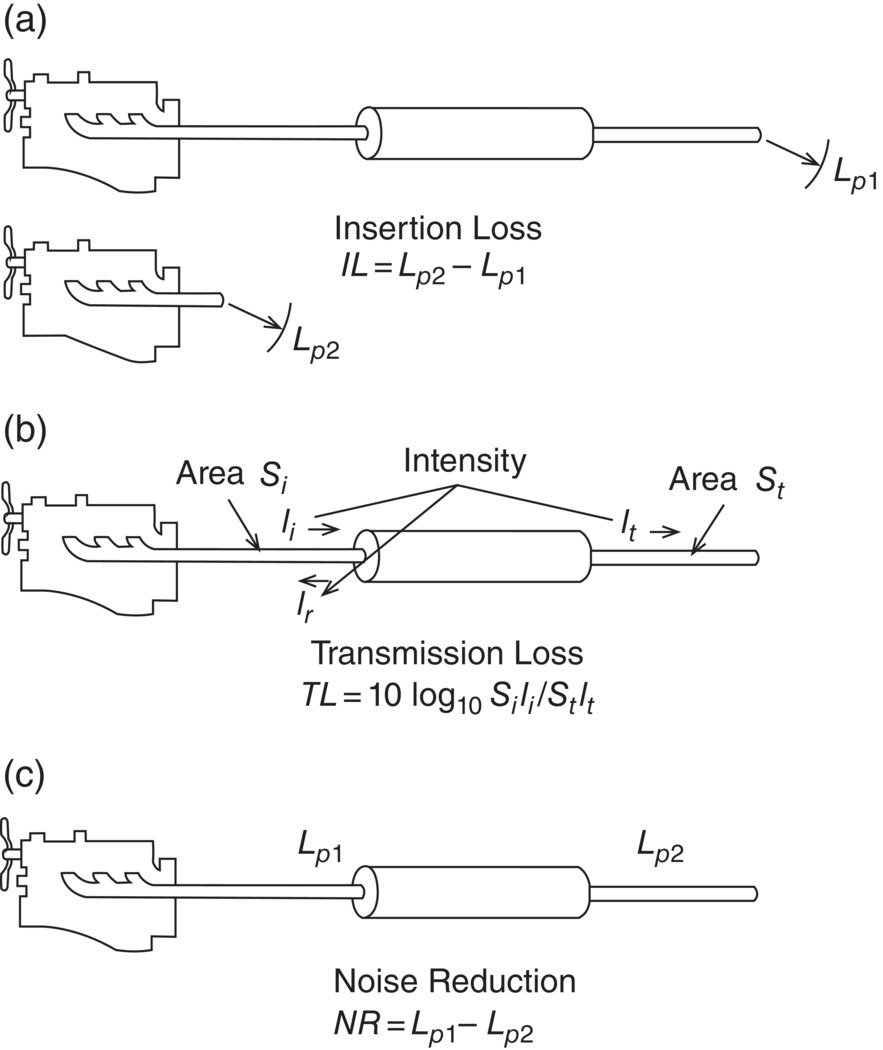
In general, IL, TL, and NR are not simply related, since, except for the TL, they depend either on the termination impedance or on the internal impedance of the source (radiation impedance of the tail pipe). However, if the source and termination impedances are equal to ρc/S (i.e. the source and the termination are non‐reflecting), then,

and usually,

Leave a Reply