Noise dose (D) is a measure of the exposure to noise to which a person is subjected. It is defined in terms of the A‐weighted sound pressure level eight‐hour limit (PEL) that represents a 100% dose. For a given duration of the exposure to noise at the constant A‐weighted sound pressure level (C) in hours, and the reference duration Tr in hours permitted for exposure to noise at the steady sound level, the dose in percent may be calculated as
(5.1)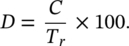
When the daily noise exposure is composed of two or more periods of noise exposure at different levels, their combined effect should be considered, rather than the individual effect of each. Then if D in the equation
(5.2)
exceeds 100%, then, the mixed exposure should be considered to exceed the limit value. Cn indicates the actual total time of exposure at a specified noise level and Tn indicates the total time allowed for exposure at that level. The permissible duration T in hours at any level is calculated as
(5.3)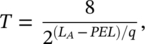
where LA is the A‐weighted sound pressure level of the noise to which the person is exposed. Note that OSHA establishes a threshold (or cutoff) A‐weighted level of 80 dB and exposures that are below this level should not be included in calculating the total dose. NIOSH uses a threshold level of 75 dB.
EXAMPLE 5.1
Suppose that an unprotected worker is subject to the following four exposure durations and corresponding A‐weighted sound pressure levels during an 8‐hour workday: 6 hours at 92 dB, 1 hour and 24 minutes at 98 dB, 30 minutes at 107 dB, and 6 minutes at 115 dB. Determine the total daily noise dose according to OSHA regulations.
SOLUTION
Using Eq. (5.3) with PEL = 90 dB and q = 5 dB, the permissible time of exposure at each level is calculated. Therefore,
- 6 hours at 92 dB, then T1 = 6.06 hours
- 1 hour and 24 minutes (1.4 hours) at 98 dB, then T2 = 2.64 hours
- 30 minutes (0.5 hours) at 107 dB, then T3 = 0.76 hours
- 6 minutes (0.1 hours) at 115 dB, then T4 = 0.25 hours.
Now, the total daily noise dose is calculated using Eq. (5.2) as

Therefore, some corrective action should be taken since the total noise dose considerably exceeds 100%.
EXAMPLE 5.2
A man works in a large five‐star hotel. During a typical working day he spends a total of 2 hours supervising in the kitchen where the average A‐weighted noise level is 88 dB. For another 4 hours he carries out administrative tasks in an office where the A‐weighted sound pressure level is 77 dB and another 1 hour in the restaurant where the noise level is 66 dB. What is the total noise dose according to both OSHA and NIOSH criteria?
SOLUTION
- We have to combine the three partial exposures by finding the noise dose for each task. We obtain the permissible time of exposure at each A‐weighted level according to OSHA using Eq. (5.3):
- 88 dB to 2 hours, T1 = 10.56 hours
- 77 dB to 4 hours and 66 dB to 1 hour, are not included since the levels are below the OSHA threshold of 80 dB. Therefore using Eq. (5.2)

- In the same way, we obtain the permissible time of exposure at each level according to NIOSH:
- 88 dB to 2 hours, T1 = 4 hours
- 77 dB to 4 hours, T2 = 50.8 hours
- 66 dB to 1 hour, is below the NIOSH threshold of 75 dB and therefore is not included in calculating the total dose. Then
 From this example we can notice that employees who typically go into high noise level areas for short durations and then return to quiet areas during their work day may exhibit significantly higher daily noise exposures using the NIOSH criteria.
EXAMPLE 5.3
A driller supervisor in a copper mine works 12 hours shifts. A personal dosimeter registers a noise dose of 70% in 7 hours. What would be the total noise dose if during this time the worker was exposed to a representative sample of the daily noise?
SOLUTION
Considering that the worker was exposed to a representative sample of the daily noise, we can obtain the noise dose per hour directly as 70%/7 hours = 10% per hour. Thus, the total noise dose in a 12 hours shift is 12 × 10% = 120%, so the worker is overexposed.
Table 5.3 Time‐Weighted Average (TWA ) noise level limits as a function of exposure duration.
| Duration of Exposure [h/day] | A‐Weighted Sound Pressure Level (dB) | ||
|---|---|---|---|
| ACGIH | NIOSH | OSHA | |
| 16 | 82 | 82 | 85 |
| 8 | 85 | 85 | 90 |
| 4 | 88 | 88 | 95 |
| 2 | 91 | 91 | 100 |
| 1 | 94 | 94 | 105 |
| ½ | 97 | 97 | 110 |
| ¼ | 100 | 100 | 115a,b |
| ⅛ | 103c | 103 | — |
a No exposure to continuous or intermittent A‐weighted sound pressure level in excess of 115 dB.
b Exposure to impulsive or impact noise should not exceed a peak sound pressure level of 140 dB.
c No exposure to continuous, intermittent, or impact noise in excess of a C‐weighted peak sound pressure level of 140 dB
OSHA regulations specify a single value called the time‐weighted average sound pressure level (TWA ). TWA is that level which, if constant over an eight‐hour period of exposure, would result in the same 5‐dB‐exchange‐rate noise dose as is measured. It can be calculated by
(5.4)
Note that TWA is a concept similar to a normalized eight‐hour average sound level (Leq,8h) or the noise exposure level defined in some international occupational noise regulations. In particular, for a PEL = 85 dB and q = 3 dB, the noise exposure level recommended in Europe (LEX) is defined as the TWA of the daily noise exposure levels for a nominal week of five 8‐hour working days. It is calculated by
(5.5)
Table 5.3 shows the time-weighted average (TWA) noise level limits promulgated by the ACGIH (American Conference of Governmental Industrial Hygienists), NIOSH, and OSHA.
It is possible to make a dosimeter (see Chapter 7) to measure the daily noise dose of a person at work, but since the noise exposures using the OSHA criteria are not added on an energy basis (halving of exposure time for a 5 dB increase, not 3 dB), it is very difficult to make an instrument to do this accurately and also incorporate impulsive noise energy correctly. Dosimeters are easier to make with a 3‐dB exchange rate so they incorporate impact noise correctly. In addition, for other exchange rates there is no unique relationship between noise dose and equivalent continuous sound pressure level [35].
EXAMPLE 5.4
A worker in a pulp mill without using hearing protection has the noise exposure record shown in Table 5.4. Calculate the resulting daily TWA and LEX.
SOLUTION
- We notice that the last two hours of exposure are below the thresholds defined by OSHA and NIOSH. Therefore, we calculate the total A‐weighted noise dose according to OSHA as


- The corresponding total A‐weighted noise dose using a PEL = 85 dB and 3‐dB exchange rate is


- It is expected a LEX value to be a little higher than the TWA value if the noise levels vary during the noise exposure period.
Table 5.4 Worker’s A‐weighted noise level exposure record.
| Level, dB | Exposure, hours |
|---|---|
| 95 | 1 |
| 85 | 1 |
| 90 | 1 |
| 85 | 2 |
| 80 | 1 |
| 70 | 2 |
Leave a Reply