The thermodynamic analysis of the gas cycle shows that the efficiency of the cycle depends on the range of maximum temperature of the gas. If maximum temperature is increased, efficiency of the cycle is also increased. Any increase in the maximum temperature of gas results in an increase in the blade temperature, thereby inducing more thermal stresses in the blade material. Thus, this limits the capacity of gas temperature when blades are cooled properly.
1 Advantages of Cooling
- Specific thrust of jet engine increases by 32% for gas temperature increase from 800°C to 1100°C at the expense of 7% specific fuel consumption.
- If the maximum temperature is increased to 1600°C in place of present practice of 900°C, the specific fuel consumption will be increased by 50% and there is an increase in specific power output by 200%.
2 Different Methods of Blade Cooling
- Internal air cooling: It is done by supplying cold air through hollow blade. It employs an internal baffle or deflector to direct the flow over the hotter portions on the internal surface (Fig. 16.37).
- Film cooling: It involves supplying of thin film of cold compressed air through a narrow slit on the blade’s surface to form a cold boundary layer over the blades (Fig. 16.38).
- Water cooling: Circulation of water is maintained through a section of the blade from the root towards the tip.
- Rim cooling: The rim is cooled by circulating the cooling fluid and thus the blade temperature is reduced by conduction.
Figure 16.39 shows the distribution of temperature over the blade height.
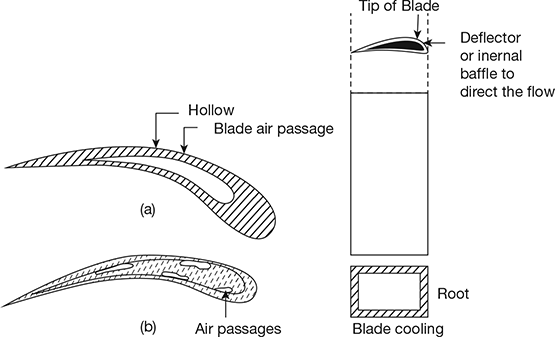
Figure 16.37 Internal cooling of blade
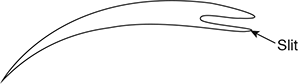
Figure 16.38 Air film cooling of blade
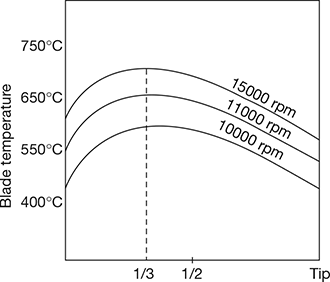
Figure 16.39 Distribution of temperature over blade height
Leave a Reply