A tire provides a cushion between the vehicle and the road, reducing shocks. This effect is provided by compressed air present in the tire. Radial ply tires are best for use.
Tire Tread Designs
Tires generally fall into one of the following categories:
- Directional
- Non-directional
- Symmetric and Asymmetric.
Cross-Ply Tires
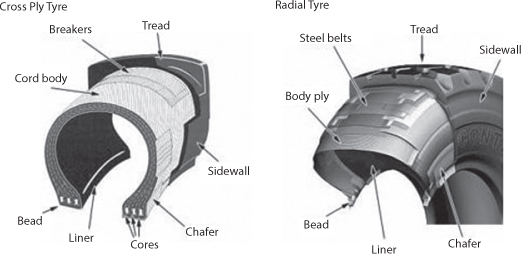
In developed countries, cross-ply tires are no longer in use for commercial applications as original or replacement tires. In the present scenario, cross-ply tires are used only as spare tires for automobiles for temporary purposes, in motor cycles, race cars and agricultural vehicles. The cross-ply tire has a supporting framework which consists of at least 2 layers of rubberized fibers which have a bias angle of 20–40°. Based on the strength requirements, even steel cords can be employed in the construction. At the feet of the tire, the layers are wrapped around the tire core on either sides with the folded end of the plies forming the bead. The bead must transfer braking moment and provide permanent seat to the tire. Protective moldings are designed on the sides to prevent the damage from contact with curbstones.
Radial Ply Tires
Radial ply tires have much more flexible sidewalls due to their construction. They use two or more layers of casing plies, with the cord loops running radially from bead to bead.
Leave a Reply