Compressors can be considered to be pumps for gases. Although there are some differences in construction details between compressors and pumps, their principles of operation, however, are essentially the same (see Section 11.3.4). Since gases normally have much lower densities than liquids, it is possible to operate compressors at much higher speeds than pumps. However, gases have lower viscosities than most liquids and so leakage with compressors is more of a problem than with pumps. Thus, this requires tighter manufacturing tolerances in the moving parts of compressors. Due to the low viscosity of gases and their compression, the temperature of the working medium and of the machine itself increases during compression. As a consequence, when the pressure ratio from after to before compression is more than about five, additional cooling is needed for the compressor and lubrication system. This makes compressors more complicated, as regards maintenance and servicing, than pumps used for liquids. In general compressors are more expensive to operate than pumps.
Compressors are used for many different applications, and there are a large number of quite different designs. Rather like pumps, there are two basic types of compressor: (i) positive‐displacement compressors including reciprocating piston and rotary types and (ii) dynamic compressors including axial and centrifugal types. Like pumps, there are a few special‐effect compressor types as well.
Positive‐displacement compressors operate by increasing the pressure of the gas by reducing its volume in a compression chamber through work applied to the compressor mechanism. Very large numbers of small positive‐displacement compressors have been mass produced around the world for use in household refrigerators and domestic and automobile air‐conditioning systems. Considerable efforts, which are driven in part by market forces, have been expended to produce quieter small positive‐displacement compressors. Positive‐displacement compressors can be characterized by the location of the motor: (i) External‐drive (open‐type) compressors have a shaft or other moving part extending through the casing and are driven by an external power source, thus requiring a shaft seal or equivalent rubbing contact between fixed and moving parts; (ii) hermetic compressors have the compressor and motor enclosed in the same housing shell without an external shaft or shaft seal and the motor operates in the compressed gas; and (iii) semi‐hermetic refrigerant compressors have the compressor directly coupled to an electric motor and contained within a gas‐tight bolted casing. Positive‐displacement compressor mechanisms can be further subdivided into (i) reciprocating types: piston, diaphragm, or membrane, and (ii) rotary types: rolling piston, rotary vane, single‐screw, twin‐screw, scroll and, throchoidal (lobe). Figure 11.18 shows the principles of operation of several positive‐displacement compressors.
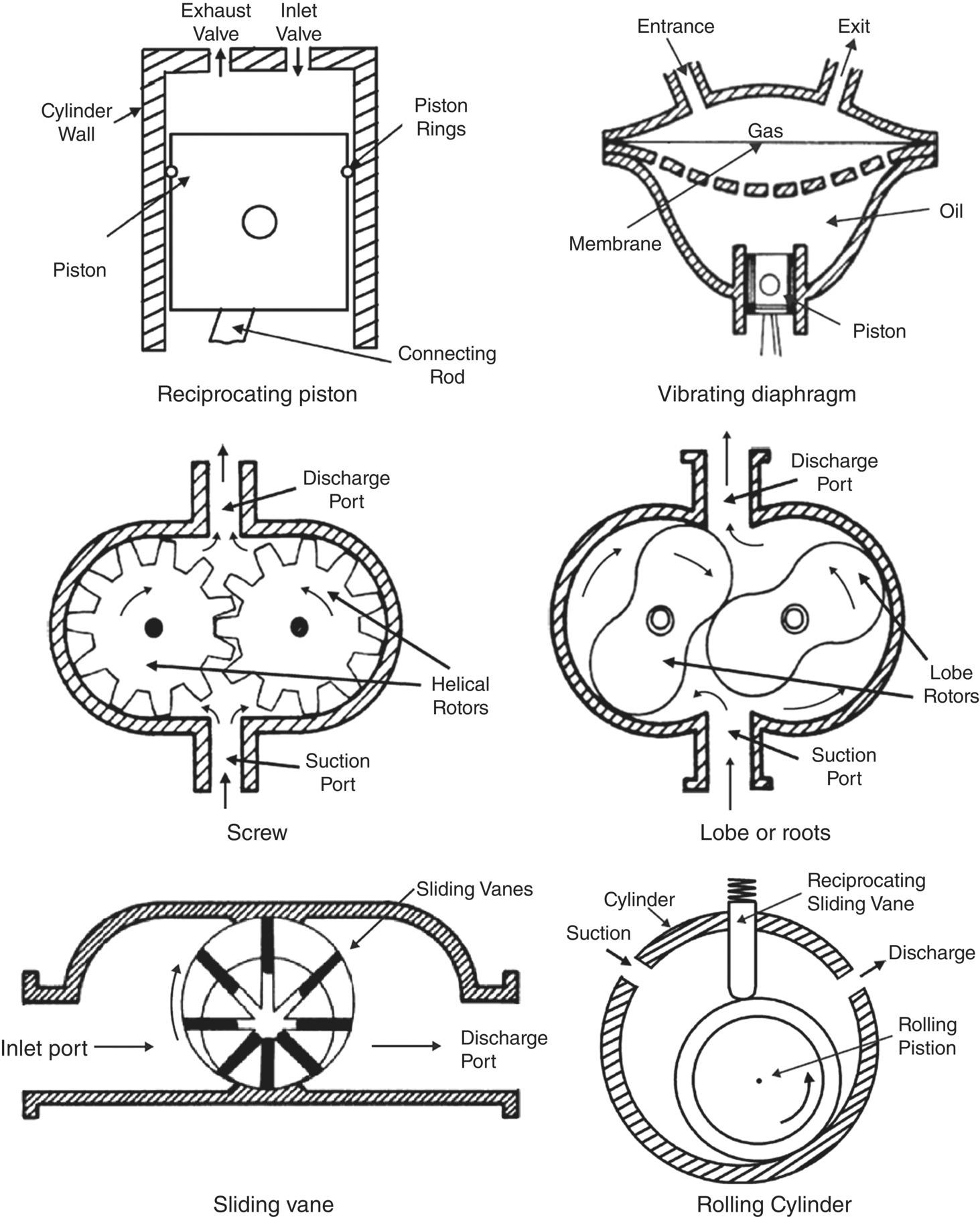
Dynamic compressors, on the other hand, work on the principle of using bladed impellors on continuously flowing gas to increase its kinetic energy, which is eventually converted into potential energy and gas of higher pressure. They can be made to be of low weight and generally have higher efficiencies than positive‐displacement types. Their operational principles are very similar to fans (see Section 11.2.3).
Centrifugal compressors are widely used in large buildings, offices, factories, and industrial plants that require large central air‐conditioning and cooling systems [72, 73]. Such centrifugal compressors eliminate the need for valves. The number of parts with sliding contact and close clearances are reduced, compared with positive‐displacement types. Thus, maintenance costs are reduced, although operating costs may be increased due to their somewhat lower efficiency than comparable positive‐displacement compressors. They are smaller and lighter in weight, and generally have lower original equipment and installation costs than equivalent reciprocating types. The noise and vibration characteristics are quite different, however, due to the higher speed and the lack of out‐of‐balance machine parts. The main components of a centrifugal compressor include (i) an inlet guide vane, (ii) an impellor, (iii) a diffuser, and (iv) a volute.
Axial and centrifugal compressors are competitive for volume flow rates from about 25 to 90 m3/s, but when volume flow rates higher than about 60 m3/s are needed, axial‐flow compressors are normally used instead of centrifugal‐flow machines [72]. This is because they are more efficient, smaller in size and weight, and require lower installation costs. They have several disadvantages, however, including generally more complex control systems, a narrower range of available flow rates, and surge and ingestion protection requirements. They also produce higher noise levels than centrifugal types, thus requiring more extensive acoustical treatment. Currently, axial compressors have their greatest use in aircraft and air transportation systems.
The ejector compressor is the simplest form of dynamic compressor [73]. It has no moving parts and is thus low cost. It is inexpensive, but has a low efficiency, however, and thus sees use mostly for vacuum applications. It requires a high‐pressure source and transfers the momentum of the high‐pressure jet stream to the low‐pressure process gas.
The noise generated by the piston type of compressors depends upon several factors, the most important being the reciprocating frequency and integer multiples, number of pistons, valve dynamics, and acoustical and structural resonances. The noise produced by the rotary types depends upon rotational frequency and multiples, numbers of rotating elements, flow capacity, and other flow factors. The noise generated by centrifugal and axial compressors also depends upon rotational frequency and the number of rotating compressor blade elements. Flow speed and volume flow rate, however, are also important factors. Such dynamic compressors are used in aircraft jet engines and large commercial electricity generating plants.
A number of empirical equations have been presented to estimate the overall sound power levels of different types of compressors. For large centrifugal compressors (greater than 75 kW), the overall sound power level generated within the exit piping can be estimated from [70]
(11.12)
where WR is the power of the driver motor in kW, and U is the impeller tip speed in m/s. Equation (11.12) is valid for 30 < U < 230. The impeller tip speed U = πD × N/60, where D is the diameter in metres of the impeller and N is the impeller rotary speed in rpm. The frequency in hertz at which the maximum noise level is produced is
(11.13)
The one‐octave band sound power levels can be determined by subtracting 4.5 dB from the level calculated by Eq. (11.12) for the one‐octave band containing fp. Then, the spectrum rolls off at the rate of 3 dB per octave above and below the one‐octave band of maximum noise level.
A similar procedure can be used to estimate the overall sound power level within the exit piping of a reciprocating compressor using
(11.14)
but now fp = Nc × N/60, where Nc is the number of cylinders of the compressor.
The overall sound power radiated by the compressor casing and exit pipe walls can be roughly determined by subtracting the transmission loss provided by the casing and exit piping from the values determined from Eqs. (11.12)–(11.14).
EXAMPLE 11.8
Estimate the overall sound power level of a 120 kW centrifugal compressor with impeller diameter of 1 m and operating at 2400 rpm.
SOLUTION
The impeller tip speed is U = π(2400)/60 = 125.7 m/s. Then, use of Eq. (11.13) yields fp = 4.1 × 125.7 = 515 Hz. Therefore, we must subtract 4.5 dB at the 500 Hz one‐octave band in which the frequency fp falls. Now using Eq. (11.12), Lw = 20 × log(120) + 50 × log(125.7) − 46 ≈ 100.5 dB. Thus, the sound power level at the 500 Hz one‐octave band would be 100.5 − 4.5 = 96 dB. The levels in higher and lower one‐octave bands decrease by 3 dB per octave. Then, the sound power levels in nine one‐octave bands from 31.5 to 8000 Hz are: 84, 87, 90, 93, 96, 93, 90, 87, and 84 dB, respectively. The overall sound power level is obtained by logarithmically adding the previous one‐octave band levels. Then,

An alternative equation to calculate the overall external sound power levels directly for rotary, reciprocating, and centrifugal compressors is [70]
(11.15)
where A is a constant that depends upon the type of compressor (see Table 11.5). The one‐octave band sound power levels can be determined by subtracting the adjustments listed in Table 11.5 from the overall values of Eq. (11.15).
Table 11.5 One-octave band level adjustments (dB) for exterior noise levels radiated by compressors [70].
| One-octave band frequency (Hz) | |||||||||
|---|---|---|---|---|---|---|---|---|---|
| Type of compressor | 31.5 | 63 | 125 | 250 | 500 | 1000 | 2000 | 4000 | 8000 |
| Rotary and reciprocating (including partially muffled inlets); A = 90 | 11 | 15 | 10 | 11 | 13 | 10 | 5 | 8 | 15 |
| Centrifugal (casing noise excluding air inlet noise); A = 79 | 10 | 10 | 11 | 13 | 13 | 11 | 7 | 8 | 12 |
| Centrifugal (unmuffled air inlet noise excluding casing noise); A = 80 | 18 | 16 | 14 | 10 | 8 | 6 | 5 | 10 | 16 |
EXAMPLE 11.9
Estimate the exterior casing sound power level spectrum for a 100 kW centrifugal compressor.
SOLUTION
Use of Eq. (11.15) with A = 79 yields Lw = 79 + 10 × log(100) = 99 dB. Now we subtract the values given in the second row of Table 11.5 from 99 dB for each one‐octave band. Then, the sound power levels in the nine one‐octave bands from 31.5 to 8000 Hz are: 89, 89, 88, 86, 86, 88, 92, 91, and 87 dB, respectively.
For noise control it is normal to classify noise problems in terms of the source–path–receiver framework (See Figure 9.1). In the case of compressors, it is not always so easy to make a distinct division between sources and paths. With positive‐displacement compressors, the main noise source is the time‐varying pressure pulsation created between the suction (inlet) and discharge manifolds of the compressor. This fluctuating pressure forces the compressor casing and any connecting structures into vibration, which consequently results in sound radiation. Many compressors have housing shell structures, and it is normal to vibration‐isolate the compressor casing from the compressor shell housing, which itself may or may not be completely hermetically sealed. Suction and discharge piping must be provided, and care must be taken to reduce vibration transmission paths from the casing to the shell housing through this piping. It is not possible to completely eliminate the vibration transmission through the compressor vibration isolation system, and the piping and the gas between the casing and housing also provides another path for sound energy transmission to the shell. Reference [72] describes some design, operational noise, and vibration features of several categories of dynamic compressors in use and also gives some examples of how noise and vibration problems have been overcome in practice.
Leave a Reply