If the entire pressure drop from boiler pressure to condenser pressure is carried out in a single stage nozzle, the velocity of steam entering the turbine blades will be very high and consequently, the turbine speed will be very high. Such high speed turbine rotors are not useful for practical purposes and a reduction gearing is necessary between the turbine and the generator driven by the turbine. There is also a danger of structural failure of the blades due to excessive centrifugal stresses. Further, the velocity of steam at the exit of the turbine is also high when a single stage of blades is used. This gives rise to considerable loss of kinetic energy, reducing the efficiency of the unit. This loss of kinetic energy is termed as ‘carry over losses’ or ‘leaving losses’.
Compounding is a method employed for reducing the rotational speed of the impulse turbine to practical limits by using more than one stage. There are three methods of compounding impulse turbines as follows:
- Velocity compounding
- Pressure compounding
- Pressure and velocity compounding
- Velocity Compounding: This system consists of a nozzle or a set of nozzles and a wheel fitted with two or more rows of blades as shown in Fig. 7.3. It has two rings of moving blades and two rows of fixed or guide blades placed. Steam entering the nozzle expands from the initial pressure to the exhaust pressure. On passing through the first row of moving blades, the steam gives only a part of kinetic energy and issues from this row of blades with a fairly high velocity. It then enters the guide blade and the moving blade. There is a slight drop in velocity in the guide blade due to friction. While passing through the second row of moving blades, the steam suffers a change in momentum and gives a part of kinetic energy to rotor. The steam leaving from the second row of moving blades is redirected to the second row of guide blades. By doing work on the third row of moving blades, the steam finally leaves the wheel in more or less axial direction with a certain residual velocity, about 2% of the initial velocity of steam at nozzle exit. Thus, the whole of velocity is not utilised on one row of moving blades but in a number of stages, as in a Curtis turbine.
 Figure 7.3 Velocity-compounded impulse turbine
 - Pressure Compounding: This arrangement consists of allowing the expansion of steam in a number of steps by having a number of simple impulse turbines in the series on the same shaft, as shown in Fig. 7.4. The exhaust steam from one turbine enters the nozzles of succeeding turbines. Each of the simple impulse turbines is called a ‘stage’ of the turbine comprising its sets of nozzles and blades. This is equivalent to splitting up the whole pressure drop into a series of smaller pressure drops, hence, the term ‘pressure compounding’.The pressure compounding causes a smaller transformation of heat energy into kinetic energy to take place in each stage than in a simple impulse turbine. Hence, the steam velocity is much lower, with the result that the blade velocity and rotational speed may be lowered. The leaving loss is only 1–2% of the total available energy. Rateau turbine is a pressure compounded turbine.
- Pressure and Velocity Compounding: It is a combination of pressure compounding and velocity compounding. The total pressure drop of steam is divided into stages and the velocity of each stage is compounded. This allows a bigger pressure drop in each stage and hence, less stages are necessary which require a shorter turbine for a given pressure drop. Such a turbine is shown in Fig. 7.5. The diameter of such a turbine increases in each stage in order to accommodate for a larger volume of steam at the lower pressure. The pressure is constant in each stage.
 Figure 7.4 Pressure compounded impulse turbine
 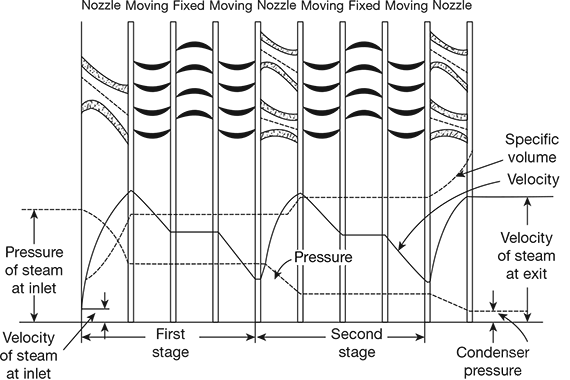 Figure 7.5 Pressure- and velocity-compounded impulse turbine
Leave a Reply