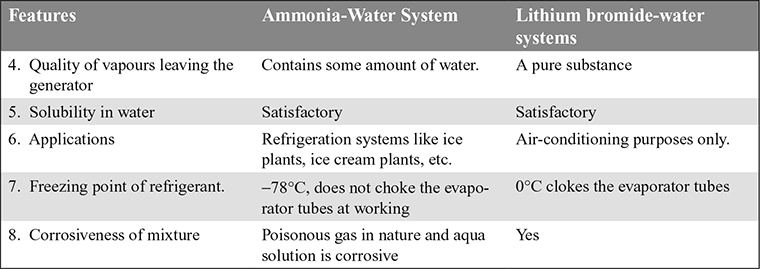
The comparison of ammonia-water and lithium bromide-water systems are given m Table 19.2
Table 19.2 Comparison of ammonia-water and lithium bromide-water systems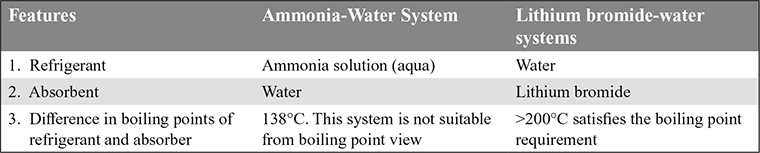
Exercises
19.1. The evaporator and condenser temperatures in an NH3 refrigeration system are –10°C and 40°C respectively. Determine per TR basis: (a) mass flow rate; (b) compressor work, (e) condenser heat rejection; (d) C.O.P.; and (e) refrigerating efficiency. Use only the propertiesof NH3 given below:

For superheated NH3 at 15.55 bar, the following values may be taken

[Ans. 0.198 kg/min: 0.82 kW; −4. 32 kW; 4.27; 81.2%]
19.2. In a vapour compression refrigeration system using R-12, the evaporator pressure is 1.4 bar and the condenser pressure is 8 bar. The refrigerant leaves the condenser sub-cooled to 30°C. The vapour leaving the evaporator is dry and saturated. The compression process is isentropic. The amount of heat rejected in the condenser is 13.42 MJ/min. Determine: (a) refrigerating effect in kJ/kg; (b) refrigerating load in TR; (c) compressor input in kW; and (d) COP.
[Ans. 114 k//kg; 49 TR: 51.4 kW; 3.35]
19.3. A vapour compression refrigerator works between the temperature limits of −20°C and 25°C. The refrigerant leaves the compressor in dry saturated condition. If the liquid refrigerant is undercooled to 20°C before entering the throttle valve determine:
- work required to drive the compressor ;
- refrigerating effect produced per kg of the refrigerant; and
- theoretical COP.
Assume specific heat of the refrigerant as 4.8. The properties of the refrigerant are

[Ans. 189.7 kJ/kg; 990.2 kJ/kg; 5.01]
19.4. A food storage chamber requires a refrigeration system of 12 TR capacity with an evaporator temperature of −8°C and condenser temperature of 30°C. The refrigerant R-12 is sub-cooled by 5°C before entering the throttle valve, and the vapour is superheated by 6°C before entering the compressor. If the liquid and vapour specific heats are 1.235 and 0.733 kJ/kg.K respectively, find: (a) refrigerating effect per kg; (b) mass of refrigerant circulated per minute; and (c) coefficient of performance.
The relevant properties of the refrigerant R-12 are given below:

[Ans. 130.05 kJ/kg; 19.4 kg; 6.2]
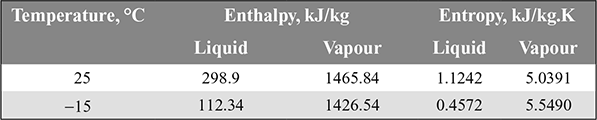
19.5. An ammonia refrigerator produces 30 tonnes of ice form and at 0°C in 24 hours. The temperature range of the compressor is from 25°C to −15°C. The vapour is dry saturated at the end of compression and an expansion valve is used. Assume a coefficient of performance to be 60% of the theoretical value. Calculate the power required to drive the compressor. Latent heat of ice = 335 kJ/kg. Properties of ammonia are.
[Ans. 33.24 kW]
19.6. A freezer of 20 TR capacity has evaporator and condenser temperature of −30°C and 25°C respectively. The refrigerant R-12 is sub-cooled by 4°C before it enters the expansion valve and is superheated by 5°C before leaving the evaporator. The compression is isentropic and the valve throttling and clearance are to be neglected. If a six cylinder, single acting compressor with stroke equal to bore running at 1000 rpm is used, determine (a) COP, of the refrigerating system, (b) mass of refrigerant to be circulated per min, (c) theoretical piston displacement per minute, and (d) theoretical bore and stroke of the compressor. The specific heat of liquid R-12 is 1.235kJ/kg K and of vapour R-12 is 0.733 kJ/kg.K. The properties of R-12 are given below:

[Ans. 3.64; 34.12 kg/min; 5.56 m/min; 0.106 m]
19.7. A refrigeration plant of 8 TR capacity has its evaporation temperature of − 8°C and condenser temperature of 30°C. The refrigerant is sub-cooled by 5°C before entering into the expansion valve and vapour is superheated by 6°C before leaving the refrigerator. The suction pressure drop is 0.2 bar in the suction valve and discharge pressure drop is 0.1 bar in the discharge valve.
If the refrigerant used is R-12, find out the COP, of the plant and theoretical power required for the compressor. Assume compression is isentropic. Use p-h chart for calculation.
19.8. An ammonia refrigerator works between − 6.7°C and 26.7°C, the vapour being dry it the end of isentropic compression. There is no under cooling of liquid ammonia and the liquid is expanded through a throttle valve after leaving the condenser. Sketch the cycle on the T-s and p-h diagram and calculate the refrigeration effect per kg ammonia and the theoretical coefficient of performance of the unit with the help of the properties given below:

[Ans. 1028.3 kJ/kg, 7.2]
19.9. An ammonia refrigerating machine fitted with an expansion valve works between the temperature limits of −10°C and 30°C. The vapour is 95%, dry at the end of isentropic compression and the fluid leaving the condenser is at 30°C If the actual coefficient of performance is 60% of the theoretical, find the ice produced per kW hour at 0°C from water at 10°C. The latent heat of tee is 335 kJ/kg. The ammonia has the following properties:

[Ans. 33.24 kg/kWh]
19.10. A R-12 refrigerating machine works on vapour-compression cycle. The temperature of refrigerant in the evaporator is − 20°C. The vapour is dry saturated when it enters the compressor and leaves it in a superheated condition. The condenser temperature is 30°C. Assuming specific heat at constant pressure for R-12 in the superheated condition as 1,884 kJ/kg.K, determine:
- condition of vapour at the entrance to the condenser:
- condition of vapour at the entrance to the evaporator; and
- theoretical COP of the machine. The properties of R-12 are:

[Ans. 33.8°C;29% dry; 4.07]
19.11. A CO2 refrigerating plant fitted with an expansion valve, works between the pressure limits of 54.81 bar and 20.93 bar. The vapour is compressed isentropically and leaves the compressor cylinder at 32°C. The condensation takes place at 18°C in the condenser and there is no undercooling of the liquid. Determine the theoretical coefficient of performance of the plant. The properties of CO2 are:

[Ans. 4.92]
19.12. A single stage NH3 refrigeration system has cooling capacity of 500 kW. The evaporator and condenser temperatures are −10°C and 30°C respectively. Assuming saturation cycle, determine: (a) mass flow rate of refrigerant; (b) adiabatic discharge temperature, (c) compressor work in kW; (d) condenser heat rejection, (e) COP; and (f) compressor swept volume in m3/min, if volumetric efficiency is 70%.
The following values may be taken:
| hg (−10°C) = 1431.6 kJ/kg; | hf (30°C) = 322.8 k.J/kg; |
| vg (−10°C) = 0.4185 m3/kg; | sg = (−10°C) = 5.4717 kJ/kg.K |
The properties of superheated NH3 at condenser pressure of 1 1.66 bar (30°C) are as follows:
At 85°C, h = 1621.8 kJ/kg; s = 5.5484 kJ/kg.K.
At 90°C, h = 1634.5 kJ/kg;
s = 5.4838 kJ/kg.K;
[Ans. 0.45 kg/s; 88.3°C; 89.5 kW; 590 kW; 5.585; 16.2 m3/min]
19.13. A 15 TR Freon 22 vapour compression system operates between a condenser temperature of 40°C and an evaporator temperature of 5°C.
- Determine the compressor discharge temperature:
- Using the p-h diagram for Freon 22.
- Using saturation properties of Freon 22 and assuming the specific heat of its vapour as 0.8 kJ/kg.K.
- Using superheat tables for Freon 22.
- Calculate the theoretical piston displacement and power consumption of the compressor per ton of refrigeration.
19.14. A simple saturation ammonia compression system has a high pressure of 1.35 MN/m2 and a low pressure of 0.19 MN/m2. Find per 400,000 kJ/h of refrigerating capacity, the power consumption of the compressor and COP of the cycle.
19.15.
- A Freon 22 refrigerating machine operates between a condenser temperature of 40°C and an evaporator temperature of 5°C. Calculate the increase (per cent) in the theoretical piston displacement and the power consumption of the cycle:
- If the evaporator temperature is reduced to 0°C,
- If the condenser temperature is increased to 45°C.
- Why is the performance of a vapour compression machine more sensitive to change in evaporator temperature than to an equal change in the condenser temperature?
19.16. In a vapour compression cycle saturated liquid Refrigerant 22 leaving the condenser at 40°C is required to expand to the evaporator temperature of 0°C in a cold storage plant.
- Determine the percentage saving in network of the cycle per kg of the refrigerantif an isentropic expander could be used to expand the refrigerant in place of thethrottling device.
- Also determine the percentage increase in refrigerating effect per kg of refrigerant as a result of use of the expander. Assume that compression is isentropic from saturated vapour state at 0°C to the condenser pressure.
Leave a Reply