- Insufficient brake.
- Brake applies too slowly.
- Brake releases too slowly.
- Brakes do not apply.
- Brake not released.
- Brake grab or erratic brake.
- Air pressure rises above normal.
- Excessive oil or water in the brake system.
Cause of the Problem
- Low air pressure in the brake system.
- Restricted tubing.
- Improper functioning drum/shoe.
- Excessive system leakage.
- Defective governor.
- Compressor passing excessive oil.
- Restricted discharge line.
- Improper alignment
Air Brake System Troubleshooting
- Dirt is the main cause of premature failure of air valves. So it is safe to blow out the airlines and make sure that it is free of dirt.
- Whenever the pipe dope is employed on fittings, use it sparingly. This can also lead to failure.
- It is not advisable to give overtight when installing fittings into a remanufactured valve since it may cause cracking on the valve surface.
- Make sure that the delivery lines are disconnected from the valve prior to replacing a valve that has air leaking from its exhaust port.
Leakage in Pneumatic Brake System
A graduated Flow Control Valve (FCV) is mounted to get a firm control over the degree of leak in the system. Four turns made on the FCV dial open the valve fully. The main delivery of the treadle valve is connected to one of the brake chambers (front) for all running conditions as depicted in Figure 5.7.
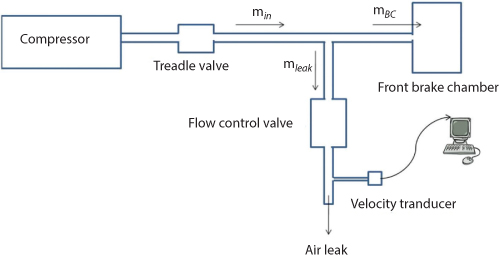
To measure the mass flow rates of the air leaking out from the system, a velocity transducer manufactured by All Sensors Corporation was installed. The sensor was interfaced using the DAQ card and the voltage outputs were recorded during the test runs. The voltage outputs from the sensor were then converted to dynamic pressure using the calibration curve of the sensor. This pressure data was then converted to velocity and in turn to mass flow rate.
Leave a Reply