In the Rankine cycle, the heat rejected is considered to be of no value. However, this heat can be supplied by steam, for the heating of buildings, and heating required by many industrial processes. Thus, the functions of power generation and heating can often be combined effectively. This combination is often called cogeneration.
In such a cycle, the process heater replaces the condenser of an ordinary Rankine cycle. The pressure of the exhaust from the turbine is the saturation pressure corresponding to the temperature desired in the process heater. Such a turbine is called back pressure turbine. The cycle for a single plant carrying varying heat and power loads is shown in Fig. 4.25.
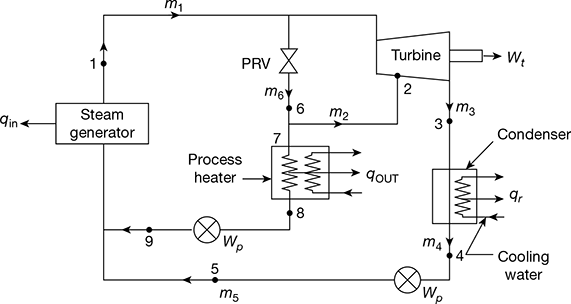
Figure 4.25 Combined power and heating cycle
When the power load is zero, all the steam passes through the pressure reducing valve (PRV) and none through the turbine. When heating load is zero, the steam expands through the turbine and flows into the condenser. In order to meet heating and power loads, the steam flow distribution is determined as follows:
The steam is extracted from the turbine at point 2 where the pressure is held constant by an automatic valve arrangement. The flow rate in the extraction line is computed from energy balance on the heating system as:
The power produced by this steam flowing through the turbine from the extraction point is,
W = m2 (h1 − h2)
Now h1 = h6 and h2 = h1 − w, so that h6 > h2.
The steam distribution to compute m2, m3 and m6 must satisfy the First Law of Thermodynamics for power required.


Leave a Reply