Gas turbines may be classified as follows:
- Constant pressure combustion (or continuous combustion) gas turbine
- Open cycle constant pressure gas turbine
- Closed cycle constant pressure gas turbine
- Constant volume combustion (or explosion) gas turbine
1 Constant Pressure Combustion Gas Turbine
In this type, the fuel is burned at constant pressure and the cycle used is the Joule cycle. The turbine belongs to the reaction type using oil fuel and is fitted with an axial flow rotary air compressor which is coupled to the rotor shaft. The heat is supplied to the working fluid at constant pressure.
The open and closed cycle gas turbines are shown in Figs 16.1(a) and 16.1(b), respectively. A simple open cycle constant pressure gas turbine consists of a compressor, combustion chamber, and turbine. The air is taken from the atmosphere by the compressor and is compressed to the combustion pressure of 1 to 4 atm. It is then forced into the combustion chamber. A part of this air is used as combustion air for the oil which enters the burner, and the remainder is forced through the annular space between the wall of the combustion chamber and the burner jacket. The air receives heat from the burner jacket and also mixes with the products of combustion chamber and the burner jacket. This raises the temperature and volume of the air. The use of a very large quantity of air in excess of the combustion air prevents the temperature of the mixture from reaching values which are too high for the metal of the rotor blades. It also prevents the burner from becoming too hot.
The high pressure and high temperature gases now enter the turbine and flow through the blade rings, where they continuously expand, and the pressure energy is converted into kinetic energy, which in turn is absorbed by the rotor. On leaving the turbine, the spent gases pass away to the exhaust. The speed of the turbine is generated by controlling the fuel oil supply and the safety valve which by-passes some of the mixture. If the pressure becomes too high, the net power developed by the turbine is utilised in driving the generator but a considerable amount of the total power produced by the rotor is absorbed in driving the compressor. The turbine is started by the electric starter motor.
In the closed cycle constant pressure gas turbine, the compressed fluid coming out from the compressor is heated in the heater by an external source at constant pressure and the high pressure and temperature fluid develop the work while passing through the turbine. The fluid coming out from the turbine is cooled to its original temperature in the cooler using an external cooling source before passing into the compressor. Thus, the working fluid is continuously circulated in the closed cycle. Such a turbine has now become obsolete.
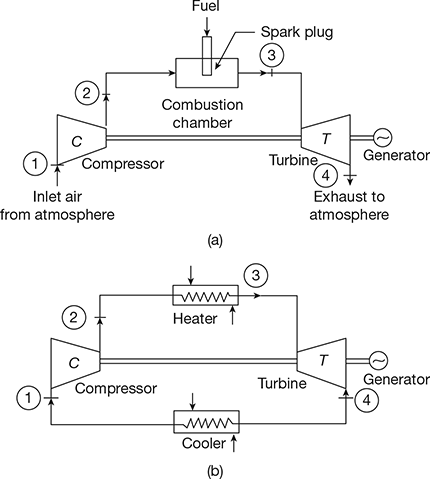
Figure 16.1 Constant pressure combustion gas turbine: (a) Open cycle turbine, (b) Closed cycle turbine
2 Constant Volume Combustion Gas Turbine
The constant volume combustion gas turbine is shown in Fig. 16.2. Air is taken from the atmosphere and is compressed by an axial flow compressor driven by a separate steam turbine. The compressed air coming out of the compressor at about 3 bar is passed to the constant volume combustion chamber. The fuel is injected into the combustion chamber in the current of air by a separate fuel pump. The air-fuel mixture formed in the combustion chamber is then ignited by means of a spark plug. The combustion takes place at constant volume in the combustion chamber and the pressure inside the chamber increases to nearly 12 bar. The high pressure and temperature gases are fed to the gas turbine through the water-cooled nozzle. The gases passed through the turbine develop the useful work. The exhaust gases are fed to the steam boiler to generate steam for the steam turbine driving the compressor.
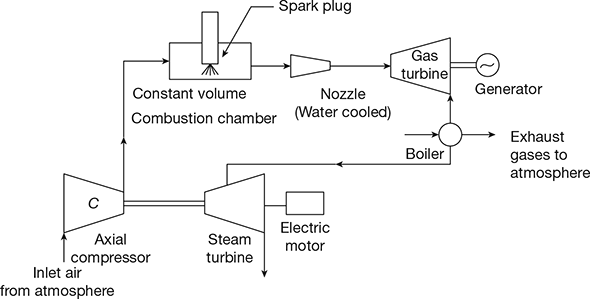
Figure 16.2 Constant volume combustion gas turbine
The major disadvantage of this turbine is the intermittent combustion which impairs its smooth functioning. The absolute necessity of a separate steam turbine to recover the heat from exhaust gases further discourages its use in practice.
Leave a Reply