Many different types of sound fields are encountered in practice. The sound field near to a simple point sound source has certain well‐known characteristics. However, sound fields generated by many simultaneously operating independent sources have much more complicated characteristics. A reverberant sound field, which is created when sources operate in spaces with hard wall surfaces, has even more complicated properties, and so on.
8.4.1 Active and Reactive Intensity
We have seen that the sound pressure and the particle velocity are in phase in a plane propagating wave. This is also the case in a free field, sufficiently far from any source that generates the sound field. Conversely, one of the characteristics of the sound field near a source is that the sound pressure and the particle velocity are partly out of phase (in quadrature). To describe such phenomena, one may introduce the concept of active and reactive sound fields.
In a simple harmonic sound field, the particle velocity may, without loss of generality, be divided into two components: one component in phase with the sound pressure and the other component out of phase with the sound pressure.
The instantaneous active intensity is the product of the sound pressure and the in‐phase component of the particle velocity. This quantity fluctuates at twice the frequency of the sound wave and has a nonzero time average. The time‐averaged quantity is the component that is generally referred to simply as sound intensity. The (active) sound intensity is associated with net flow of sound energy and has a direction normal to the wavefronts [24–27].
The instantaneous reactive intensity is the product of the sound pressure and the out‐of‐phase component of the particle velocity. This quantity fluctuates at twice the frequency of the sound wave and has a time average equal to zero at any point in a sound field [24–27].
8.4.2 Plane Progressive Waves
Consider first the situation in a plane progressive simple harmonic wave traveling in the positive x‐direction. The sound pressure p(x,t) may be written:
(8.12)
and since sound pressure and particle velocity are in phase
(8.13)
But from Eq. (8.8) in a sinusoidal progressive plane wave, p/u = P/U = ρc.
The total mechanical energy per unit volume is known as the sound energy density and can be written
(8.14)
The potential energy density takes the form
(8.15)
and the kinetic energy density is given by
(8.16)
where P is the sound pressure amplitude, U is the particle velocity amplitude, and k is the wavenumber ω/c. Thus from Eq. (8.8) summing Eqs. (8.15) and (8.16), and using Eq. (8.8), the total instantaneous energy density is
(8.17)
and the time‐average of the total energy density, 〈etot (x,t)〉
(8.18)
which is seen to be independent of x.
The time‐average total energy density is given by ½ P2/ρc2 for all values of x and t. The instantaneous intensity is (from Eqs. (8.12) and (8.13)) given by
(8.19)
The time average intensity is given by ½ P2/ρc for all values of x and t. Thus
(8.20)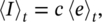
where 〈e〉t is the time‐average of the total instantaneous energy density e(t). The result in Eq. (8.20) can also be obtained by considering the sound energy in a progressive wave without reflections in a tube. All of the sound energy in a column of fluid 1 m long in the tube must flow through the cross‐section area dS in unit time. Thus etot (x,t) cdS = I dS, which on rearranging gives Eq. (8.20).
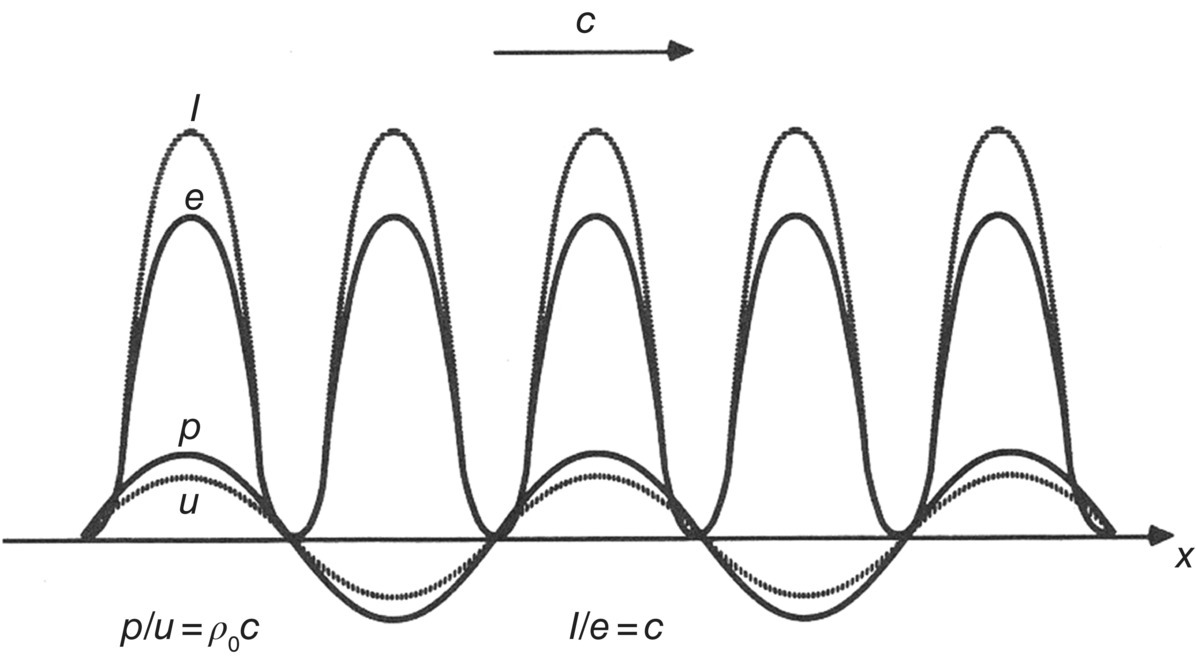
The instantaneous distribution of the sound pressure, particle velocity, sound intensity and energy density e (x,t) are shown at one instant of time in Figure 8.5. It is seen that the energy is concentrated in specific regions where the pressure and particle velocity are maximum and travels in the positive x‐direction at the wave speed, c.
8.4.3 Standing Waves
Consider now the case of a pure tone standing wave with angular frequency ω = 2πf. The sound pressure takes the form
(8.21)
The instantaneous distribution of the total energy density (kinetic plus potential) is given by
(8.22)
and the instantaneous sound intensity distribution is given by
(8.23)
In this case, the time average sound intensity is seen to be zero for all positions in the sound field in the tube. The instantaneous sound intensity represents an oscillatory flow of sound energy back and forth between regions of high potential energy and kinetic energy. The fluctuations of 2ω = 4πf are at twice the angular frequency of the sound wave, ω. See Figure 8.6.
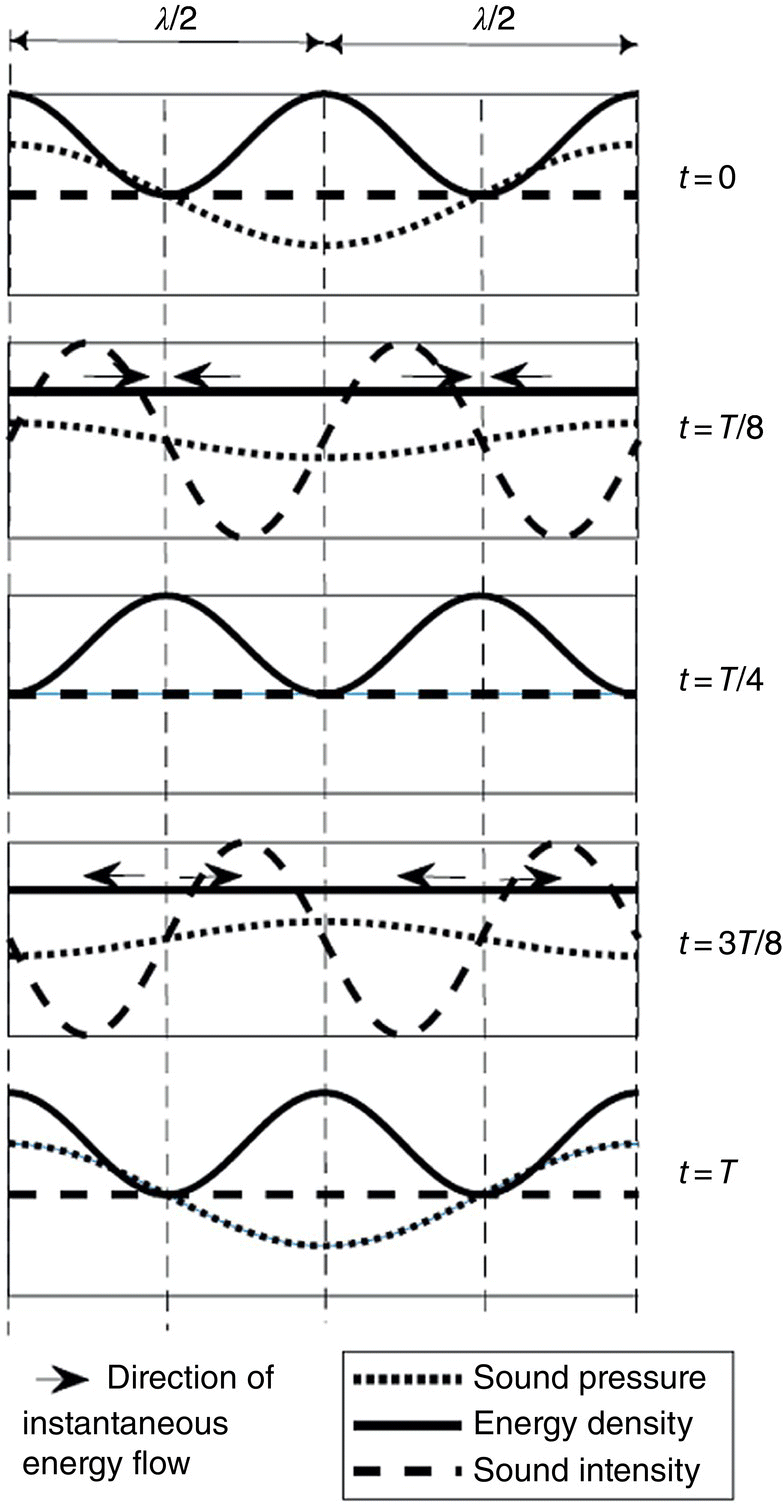
Figure 8.6 illustrates this behavior for one sound energy oscillation, which is equivalent to one half of the period of the sound pressure and particle velocity. The plot shows the standing wave where the wavelength λ is equal to the tube length ℓ and thus k = λ/ℓ.
Very near a sound source, the reactive field is usually stronger than the active field. However, in the absence of reflections, the reactive field diminishes rapidly with increasing distance from sources. Therefore, at a moderate distance from sources, the sound field is dominated by the active field. The extent of the reactive field depends on the frequency and on the dimensions and the radiation characteristics of the sound source; however, in practice, the reactive field may be assumed to be negligible at a distance greater than, say, 0.6 m from the source, provided the reflected sound field is small [27].
8.4.4 Vibrating Piston in a Tube
Consider a sound field created by a vibrating piston [27]. Plane sound waves are traveling along a hard‐walled tube, as illustrated in Figure 8.7, when only a single frequency is present.
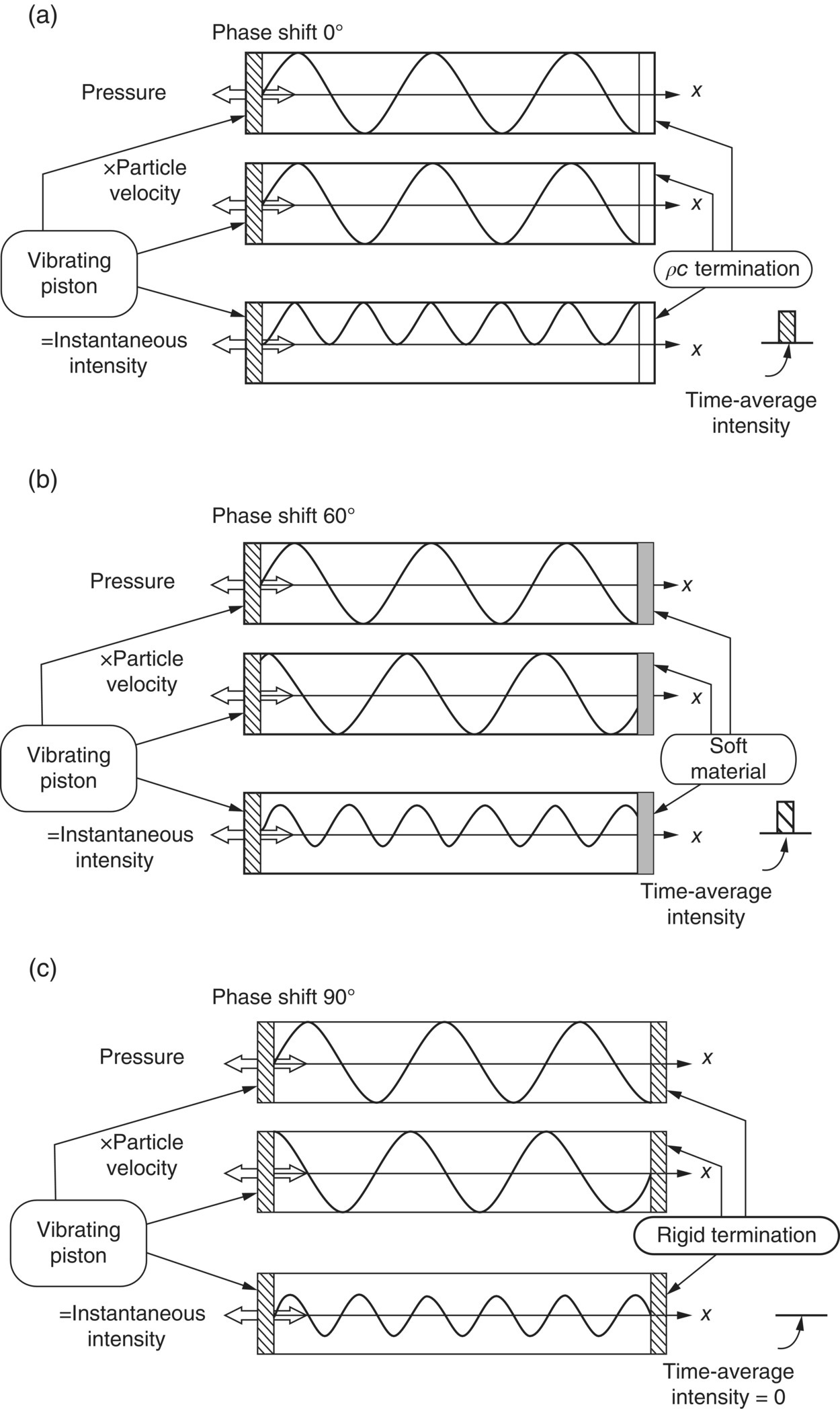
In Figure 8.7a the tube is terminated at the right end with a perfect absorber; therefore, there is no reflection of sound at the termination of the tube. Under these conditions the pressure and the particle velocity are in phase at every position in the tube, and the spatial distribution of the pressure is in phase with the spatial distribution of the particle velocity, as shown in the figure at two instants of time by the continuous and broken lines. The instantaneous intensity is always positive in the direction toward the termination and is given from Eq. (8.1) by:

(8.24)
In Figure 8.7b the tube is terminated with material that is partly absorptive. There will be partial reflection at the termination in this example, so that a weaker wave returns from right to left. The two opposite traveling waves add together, giving the pressure distribution shown at two different instants of time. In this case the spatial distribution of the particle velocity is somewhat out of phase with the spatial distribution of the pressure. The two waves interact to give an active intensity that is less than shown in Figure 8.7a. There is also a reactive component that flows back and forth in the positive then negative direction (to and from locations of high sound pressure and thus potential energy to regions of high particle velocity and thus kinetic energy). The time average of this reactive component is zero at any point in the tube.
In Figure 8.7c the tube is terminated with an infinitely hard material. Therefore, the waves are perfectly reflected at the termination, and the reflected waves traveling back to the left have the same amplitude as the incident waves traveling to the right. The incident and reflected waves combine to give a standing wave pattern. In this sound field the pressure and the particle velocity are in quadrature at all positions; therefore, the time average of the intensity is zero at any point (i.e. the sound field is completely reactive). The spatial distribution of the pressure is 90° out of phase with the spatial distribution of the particle velocity. The magnitude of the reactive intensity varies with the position: at some locations it is maximum, and at other locations it is zero.
In the general case, where the sound field cannot be assumed to be simple harmonic, one cannot make an instantaneous separation of the particle velocity into components in phase and in quadrature with the pressure; under some conditions the particle velocity is not fully correlated with the sound pressure [27–29].
Leave a Reply