There are two main types of bearings: (i) rolling contact and (ii) sliding contact [6, 7]. Rolling contact bearings are more commonly used, but sliding contact bearings are usually quieter than rolling contact bearings, if properly manufactured, installed, and maintained. Proper lubrication is essential for both rolling and sliding contact bearings. Reference [26] presents a detailed review of the noise of bearings.
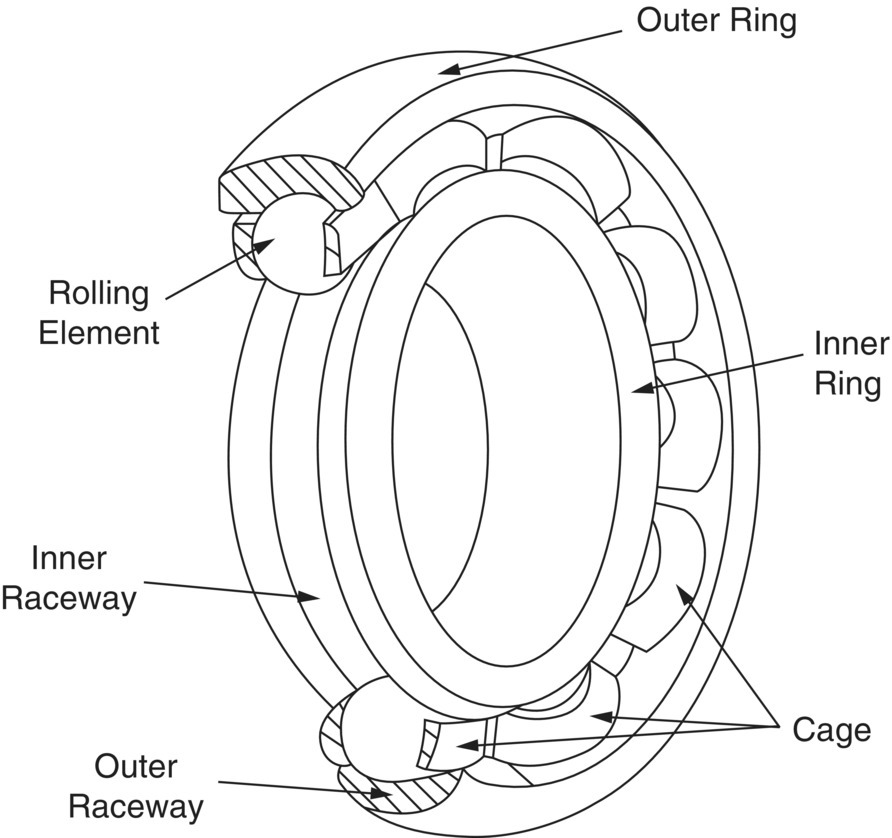
Rolling contact bearings consist of the rolling elements contained between the inner and outer raceways. The rolling elements are normally kept from touching each other by a cage. The rolling elements may be spherical, cylindrical, tapered, or barrel shaped [6]. Figure 11.5 shows a bearing with spherical rolling elements. The noise made by a rolling contact bearing is normally caused by vibration from two main sources: (i) rotation of bearing elements and (ii) resonances in the elements, raceways, or cage. Reference [3] has likewise identified discrete frequencies (and their harmonics) that are related to bearing geometry and rotational speed. The fundamental frequency is the shaft rotational frequency fs:
(11.2)
where N is shaft rotational speed in rpm.
The other frequencies are related to the shaft frequency fs by factors that depend on the roller diameter (drol), the pitch diameter of the bearing (dcg), the contact angle between the roller element and the raceway (ϕ), and the number of rolling elements (Zrol). Manufacturing imperfections and misalignment cause bearing noise. This noise can be increased further by wear. Approximate formulas for the calculation of the main harmonic frequencies signifying rolling bearing defects have been proposed [26]. These main harmonic frequencies are the cage rotational frequency ( FTF, Fundamental Train Frequency), the frequency of tumbling of rolling elements over the outer race ( BPFO, Ball Pass Frequency of Outer ring), the frequency of tumbling of rolling elements over the inner race ( BPFI, Ball Pass Frequency of Inner ring), and the rotational frequency of rolling elements ( BSF, Ball Spin Frequency). These formulas, in Hz, are given by:
(11.3)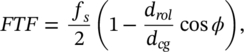
(11.4)
(11.5)
(11.6)
Bearing manufacturers normally provide tabulated values of FTF, BPFO, BPFI, and BSF normalized by the shaft rotational frequency. Thus, the main harmonic frequencies are found by multiplying these tabulated values by the rotational speed of the shaft.
EXAMPLE 11.3
A ball bearing is to operate at 3000 rpm. The bearing has 20 rolling elements, a roller diameter of 0.531 in., the pitch diameter of the bearing is 4.036 in., and the contact angle between the roller element and the raceway is 30°. What are the main harmonic frequencies signifying rolling bearing defects?
SOLUTION
First, we determine the shaft rotational frequency fs using Eq. (11.2) as fs = 3000/60 = 50 Hz. Then, the FTF is calculated from Eq. (11.3) as
FTF = (50/2) [1 − (0.531/4.036) × cos(30)] = 22.15 Hz. Now, the BPFO ring can be determined by multiplying FTF by the number of rolling elements, thus BPFO = 20 × 22.15 = 443 Hz. Finally, using Eqs. (11.5) and (11.6) we get that BPFI = 557 Hz and BSF = 187.5 Hz.
If the inner ring of the rolling bearing is fixed and the outer ring is rotational (e.g. wheel pairs), then the cage rotational frequency (FTF) in Eq. (11.3) should be changed by the frequency (fs − FTF). If the inner ring of the rolling bearing rotates and the outer ring is fixed (e.g. midshaft bearing in aviation engines), then the shaft rotational frequency (fs) in Eqs. (11.3)–(11.6) should be changed by the differential frequency (fs1 − fs2) (frequencies of rotation of rotors fs1 and fs2), while the cage rotational frequency should be changed by the sum frequency (fs2 + FTF).
Even a perfect bearing will make noise when loaded [2]. If a rolling bearing is manufactured to a higher grade of precision (smaller tolerance), then it normally becomes quieter (and more expensive). Classes of tolerance are specified in ISO Standard 492–1986. Methods to test bearings for noise and vibration are given in ANSI/AFBMA Standard 13–1970. The (American) Military Specification MIL‐B‐17913D defines permissible vibration limits for bearings.
Sliding contact bearings can be divided into three main types: (i) journal, (ii) thrust, and (iii) guide. Journal bearings are cylindrical in shape and allow rotation (see Figure 11.6). Thrust bearings are used to prevent motion along a shaft axis, while guide bearings are normally used for motion of a part in one direction without rotation (e.g. a piston sliding in a cylinder of an IC engine).
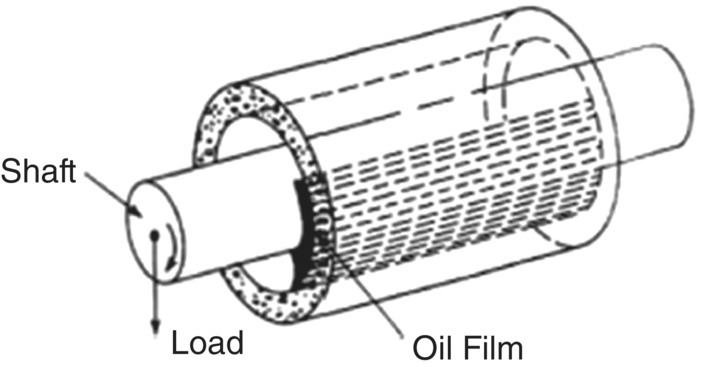
When shaft rotation occurs with a journal bearing, the shaft rides on a film of lubricant. Under some conditions, however, this film can break down, causing metal‐to‐metal contact and consequently wear, noise, and vibration. A well‐known instability condition called oil whirl can occur causing noise at a frequency of about half of the shaft rotational speed. This is because the average speed of the lubricant film is about half of the shaft speed. Oil‐whirl noise can be magnified if a shaft resonance frequency occurs near to half the shaft rotational speed.
To minimize sliding bearing noise, proper attention should be paid to lubricant viscosity, pressure, alignment, and structural stiffness. Proper installation of bearings is important to achieve low vibration and noise [27]. Increased bearing noise and vibration are an indication of wear and/or misalignment, and, if correctly analyzed, these can be indicative of potential bearing failure [28, 29]. Active control of special magnetic bearings for a fan has been undertaken in an attempt to set the fan blades into vibration so that they become a secondary out‐of‐phase sound source to cancel the primary fan noise. Noise reductions of up to 4 dB have been reported [30]. Reference [26] contains more detailed discussion on bearing noise. Further discussion can also be found in Refs.
Leave a Reply