Several noise indicators and rating measures are in use. The equivalent sound pressure level Leq (see Section 6.8 of this book) is used in many countries for the assessment of road traffic noise, although the statistical 10% level L10 (see Section 6.11 of this book) is used in Australia, Hong Kong, and the United Kingdom for target values and insulation regulations for new roads and planning values for new residential areas. The A‐weighted day–night average sound pressure level, DNL is currently the main descriptor of community noise in the United States (See Section 6.10 of this book). With DNL a penalty of 10 dB is added to noise made at night. The European Union (EU) has specified the use of the day–evening–night sound pressure level, DENL. Penalties of 5 dB are applied to noise in the evening and 10 dB at night. Chapter 6 discusses some of the descriptors that have been used. Reference [1] describes the current practice of evaluating community noise problems in Europe, the United States, and several other countries. Coelho has written a review of community noise in which the different types of community noise ordinances are described .
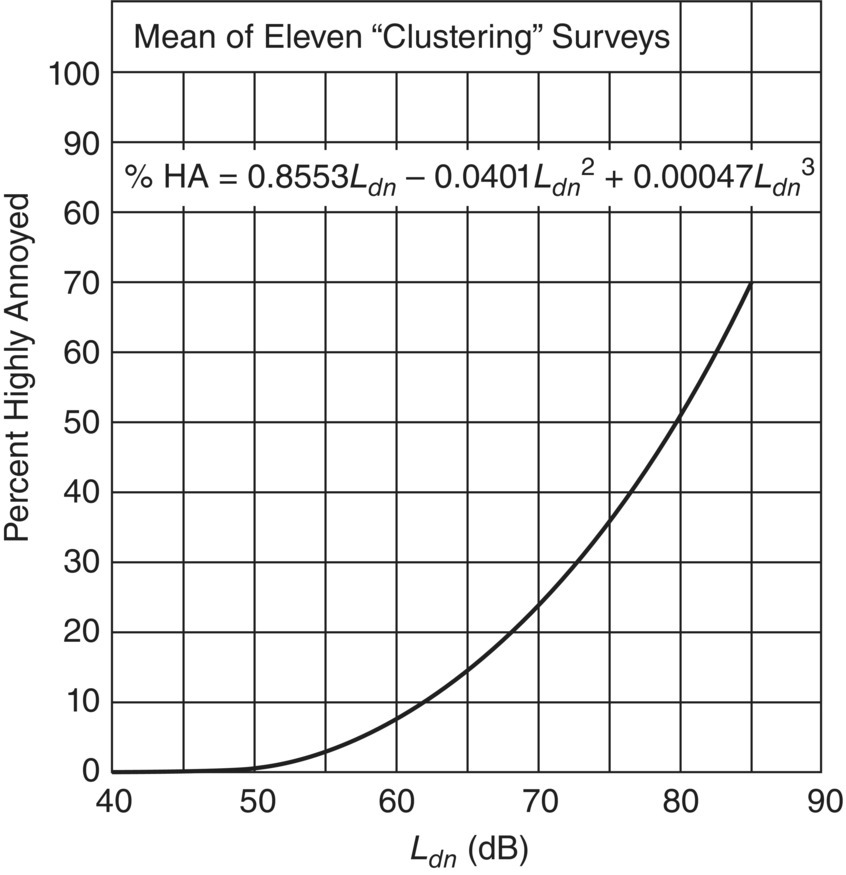
In the United States, the day–night average sound pressure level (DNL) has been in widespread use to assess community noise annoyance since its adoption by several federal agencies in the mid‐1970s. If the DNL of the community noise is below 70 dB, there is little danger of hearing loss. However, many people become highly annoyed (HA), and there can be significant sleep disturbance in the community. As discussed in Section 6.15.2 of this book, by evaluating the results of 11 clustering social surveys on noise annoyance in several countries, Schultz [3] produced in 1978 a curve relating the average annoyance response percentage of people HA with the day–night level (see Figure 16.1). The Schultz curve has been widely used since then, although in recent years considerable doubt has been expressed whether it can be applied with equal confidence to different sources of community noise, including road traffic, railroad, and aircraft.
As shown in Figure 6.16, later studies sponsored by the U.S. Air Force in the early 1990s have indicated that people have a moderate, but a different, reaction to aircraft, traffic, and railway noise at the same day–night average sound pressure level [4]. One possible explanation may be that aircraft noise near a busy airport has a greater variation in level in time and has a different frequency content (generally higher) than road or rail traffic. Another explanation may be the inadequacy of the day–night sound pressure level measure itself, which does not make any allowance for level or, even more importantly, for loudness.
In a more recent study, Miedema and Vos [5] came to a similar conclusion as Finegold et al. [4], although their results were slightly different in magnitude. At high values of DNL between 60 and 70 dB, the ranking of road traffic and railway noise differ a little from the earlier results of Finegold et al. [4] Their conclusions may be summarized as follows. Below a DNL of 40–45 dB, virtually no one is HA. As the DNL increases, so does the percentage of the population who are HA (%HA). The rate of increase in the %HA is greater for aircraft noise than road traffic noise, which in turn has a greater rate of increase than railway noise [5]. Some of the results of this study are given in Figure 16.2, which shows curves fitted to the data points by a least squares regression procedure. Since the 95% confidence limits for the three curves do not overlap, for the higher levels of DNL it can be concluded that the percentage of people that are HA, %HA, depends on the mode of transportation causing the noise [5].
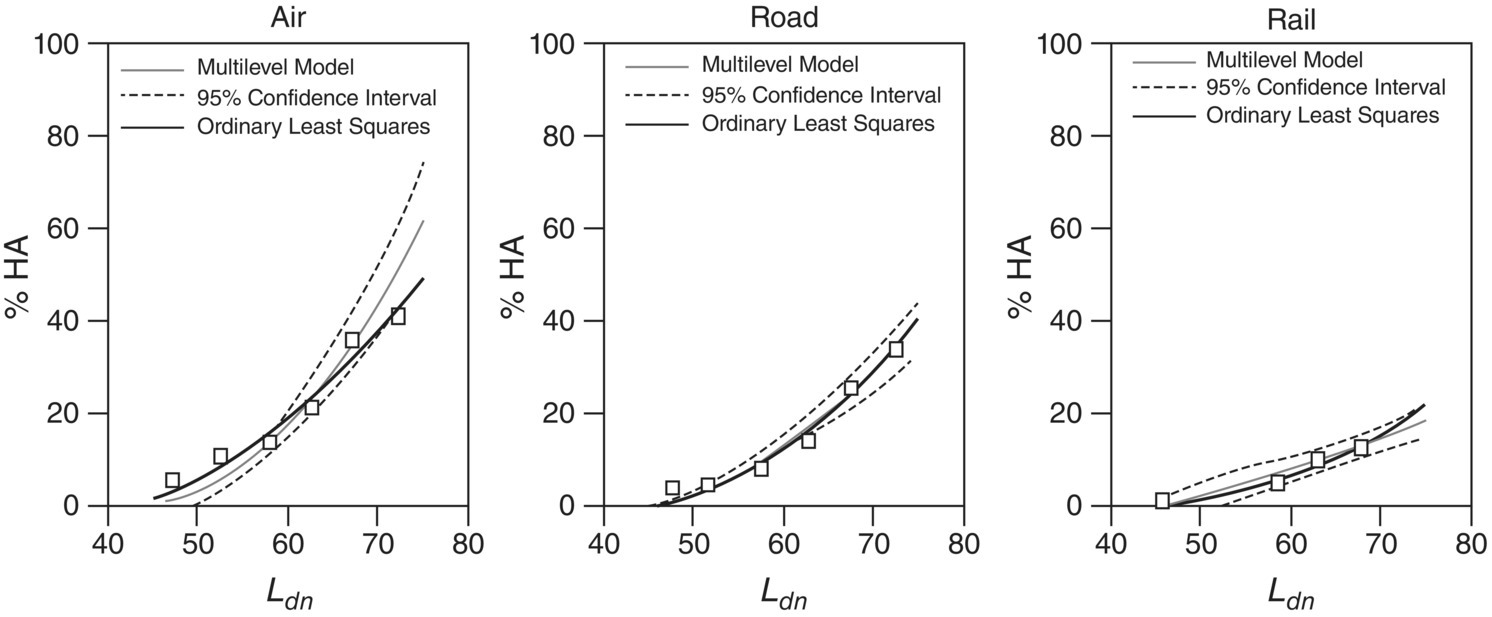
Equations fitting the data [5], assuming zero annoyance at an A‐weighted sound pressure level of 42 dB, are
(16.1)
(16.2)
(16.3)
EXAMPLE 16.1
Suppose there are five transportation noise events in a period of 24 hours near a residential community. Three events occurred during daytime and two events during nighttime. A‐weighted sound exposure levels of each event at the residential community are 96, 93, and 91 dB during daytime and 90 and 92 dB during nighttime. Determine the percentage of HA persons, if all the events correspond to (a) airplanes, (b) vehicles, and (c) trains.
SOLUTION
We determine the A‐weighted day‐night equivalent level for 24 hours (86 400 seconds) applying the 10‐dB penalty to the two nighttime events (see Chapter 6):


Now, replacing this level in Eqs. (16.1)–(16.3), we obtain
- Aircraft: %HA = 0.20 × (55.8 – 42) + 0.0561 × (55.8 – 42)2 = 13.4%
- Road traffic: %HA = 0.24 × (55.8 – 42) + 0.0277 × (55.8 – 42)2 = 8.6%
- Rail: %HA = 0.28 × (55.8 – 42) + 0.0085 × (55.8 – 42)2 = 5.5%
Therefore, 13.4, 8.6, and 5.5% of the residents would be HA if the noise is produced by aircraft, road traffic, and rail, respectively.
More recently Fidel and Silvati have also found that aircraft noise is more annoying than noise from other forms of transportation at the same values of DNL [6]. In this study, the authors find 14% HA by aircraft noise at DNL of 55 dB and 5% HA at DNL of 50 dB, so that they estimate that the airport attitudinal survey data, when grouped in 5‐dB wide “bins,” will yield 12% HA at about 54 dB [6]. As a result of these and other more recent studies, many standards that continue to use A‐weighted metrics such as Leq, DNL, and DNEL have applied various penalties for aircraft noise in using the original Schultz curve (Figure 16.1). The International Organization for Standardization (ISO) standard [7] applies a 3‐ to 6‐dB penalty, while the American National Standards Institute (ANSI) standard uses a 5‐dB penalty [8]. The ANSI penalty is phased in between 55 and 60 dB as shown in Table 16.1 (personal communication with P.D. Schomer, September 6, 2006). Schomer et al. have questioned the continuing use of metrics such as DNL, which are based on A‐weighting [9]. It is well known that the A‐weighting filter is independent of the sound pressure level, while the apparent loudness of the sound is not. Since annoyance is obviously related strongly to loudness, then use of metrics based on A‐weighting are likewise fraught with problems (see discussion in Chapter 4 of this book).
Table 16.1 Penalties for aircraft noise applied by ANSI to original Schultz curve.
Source: Personal communication with P.D. Schomer, September 6, 2006.
| Measured Value of DNL | New value of DNL |
|---|---|
| 50 | 50 |
| 55 | 55 |
| 56 | 57 |
| 58 | 61 |
| 60 | 65 |
| 65 | 70 |
Schomer et al. have suggested instead that consideration should be given to the use of a loudness level‐weighted sound exposure level (LLSEL) and loudness‐level‐weighted equivalent level (LL‐LEQ). They suggest that LLSEL and LL‐LEQ can be used to assess the annoyance of environmental noise. They conclude from their annoyance studies that, compared with A‐weighting, loudness‐level weighting better orders and assesses transportation noise sources, and with the addition of a 12‐dB adjustment, loudness level weighting better orders and assesses highly impulsive sounds. Thus, they state that significant improvements can be made to the measurement and assessment of environmental noise without resorting to the large number of adjustments that are required when assessing sound using just the A‐weighting [9]. Implementation of LLSEL and LL‐LEQ capabilities on type 1, hand‐held one‐third octave band sound level meters would also be inexpensive [9].
Some community noise ordinances and test codes or standards, such as those used to evaluate building site noise in Germany and the United Kingdom, require the intrusive noise to be compared with the ambient noise. If the noise is more than 10 dB above the ambient, it is deemed excessive, while if it is only 5 dB above, it may be tolerated. Fields claims such a procedure is not supported by large amounts of noise data and surveys [10]. According to Fields, the results of 70 000 evaluations of 51 noise sources by over 45 000 residents show that there is no evidence to support the long‐held assumption that the reactions of residents in a community to an intrusive noise is reduced when there are other environmental noises present [10]. In fact, Fields asserts that, provided residents are able to ascertain a logical estimate of their long‐term exposure to the actual noise levels of the intrusive events, the presence or absence of ambient noise does not affect their judgment of the amount of noise annoyance produced by the intrusive noise events [10]. This is an important finding since it suggests that noise limits should be given as an absolute number of decibels, rather than an amount exceeding the ambient noise. Of course, if DNL or the new European DNEL is used as the noise limit, different limits should be set for aircraft, road traffic, and railway noise.
Leave a Reply