The passive noise and vibration control techniques discussed above work well at mid and high frequencies or in a narrow frequency range but often have the disadvantage of added weight and poor low‐frequency performance. Active noise and vibration control has proved useful in the solution of many of these problems. Although the principle of active noise control has been known since the patent filed by Lueg in 1936 [131], advances in electronic and fast digital signal processing have only made these systems possible since the 1980s.
Active control systems reduce sound and vibration by applying the principle of destructive interference between the fields of the original (primary) source and a number of controllable (secondary) sources. The term active refers to the use of an external source of energy in the reduction process as compared to traditional passive methods such as those discussed in previous sections of this chapter.
When explaining the physical principles of active noise control it is easier to discuss the one‐dimensional problem of plane waves propagating in a duct. If the wavelength of the sound is large compared to the diameter of a duct we can assume that only plane waves will travel along the duct. If the primary source produces pure tones only, then a single secondary sound source can be used to cancel the sound by producing a waveform that is equal in amplitude but opposite in phase to the sound detected by a microphone placed downstream from the noise source (see Figure 9.43a). Although the principle is simple, the performance of the system will eventually be limited by small changes in temperature, airflow, etc. At higher frequencies, higher duct modes can be excited so multiple sound waves can propagate and then a large number of sources would need to be used to cancel the sound waves from the noise source.
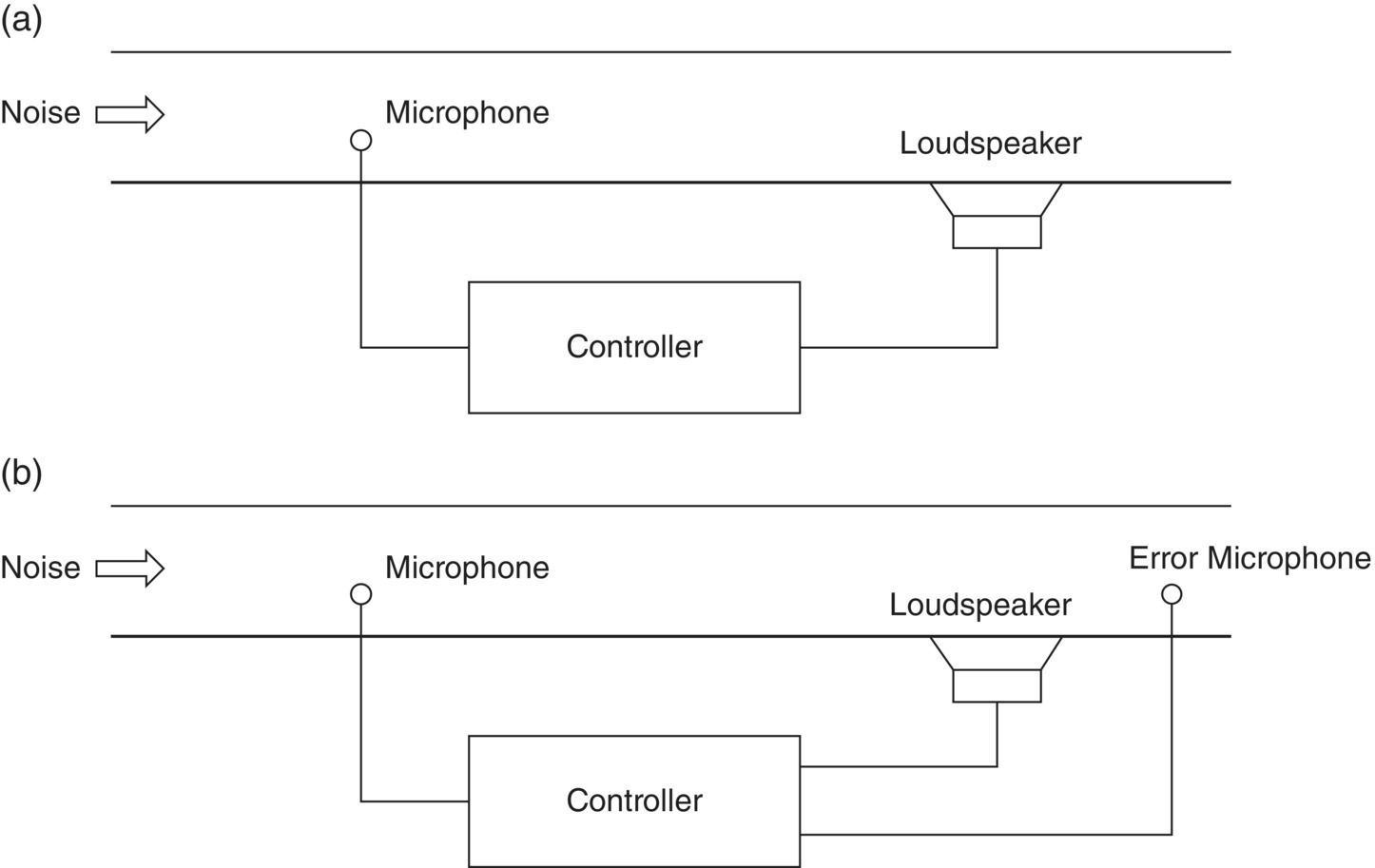
If the sound from the primary source has a more complicated frequency content and varies with time, the system must be able to adapt itself to changes in operating conditions using the signals from additional error microphones that detect some undesirable state in the canceling process. These error signals are fed back to an electronic controller that implements a control algorithm to minimize a cost function and drive the secondary acoustic sources in order to either reduce the noise or create zones of quiet (see Figure 9.43b). In this case, the controller makes use of adaptive digital filtering techniques in which the weightings of a digital filter are updated with time. Electrical signal processing controllers required to drive the secondary sources can either be feedback or adaptive feedforward controllers. Feedforward control can be applied when the designer has direct access to information about the primary field. On the other hand, feedback control has primarily been applied when the disturbance cannot be directly observed [132].
The number of secondary sources needed depends on the complexity of the sound field. To control a source in a free field, this number increases as the square of the distance of the secondary source away from the primary source. Acoustical modal overlap determines the number of secondary sources in active noise control applications in enclosures [132]. Zones of quiet of a useful size can be achieved in practice up to several hundred hertz. The theory and practical implementation of active noise and vibration control systems are rather complicated and they are beyond the scope of this book, but the reader is referred to Refs. [132, 133] and some textbooks [134–137].
Examples of current applications of active noise control include the control of sound in ventilation and exhaust ducts, active headsets, and the interiors of propeller aircraft and cars.
Active vibration control can also be used for a number of vibration problems using exactly the same principles as with active noise problems. In active vibration control, secondary vibration actuators provide the necessary inputs applied to a structure to modify its response. Error sensors, such as accelerometers or other vibration transducers, are needed to measure the system response and an electric controller implements the chosen control algorithm to reduce the unwanted vibration. Reference [138] discusses some of the principles of actuators used in active vibration control. Examples of practical active vibration control systems include active engine supports in vehicles and active vibration isolation systems for propeller aircraft powerplants [133].
Vibrating structures often radiate or transmit unwanted sound. An effective technique to control the structural sound radiation is called active structural acoustical control (ASAC). In this technique control inputs are applied directly to a structure in order to minimize the radiated sound or components of structural motion associated with the sound radiation [133]. ASAC systems have been successfully applied to propeller aircraft. In a commercial application, electrodynamic actuators are attached to the aircraft fuselage and a feedforward controller is used. Attenuations from about 10 dB at the propeller fundamental tone to 3 dB at the third harmonic have been reported [139]. In general, it is found to become less efficient and ineffective to use active noise and vibration control methods as the noise or vibration source frequency increases.
A very successful application of active noise control is in hearing protectors and communication headsets. In the case of hearing protectors, the cancelation is established at or very near the outer ear. The entrance of the ear canal is kept very close to the position of a secondary loudspeaker. The fundamental acoustical limitations of active noise control can generally be avoided up to a frequency of about 1 kHz. Active noise control has been incorporated into two types of at‐the‐ear systems: (i) those designed solely for hearing protection and (ii) those designed for one‐ or two‐way communications. Both types are further dichotomized into open‐back (or supraaural) and closed‐back (or circumaural earmuff) variations. In the former, a lightweight headband connects active noise control microphone/earphone assemblies that are surrounded by foam pads that rest on the pinnae. In that there are no earmuff cups to afford passive protection, the open‐back devices provide only active noise reduction [140].
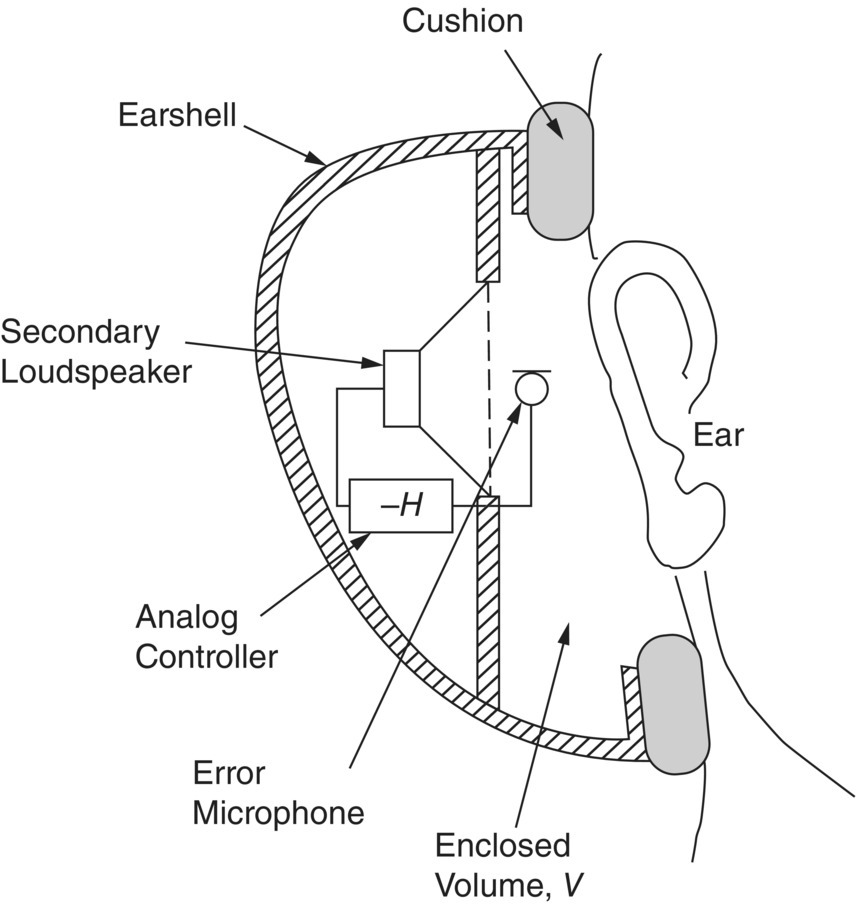
Closed‐back devices, which represent most active noise control‐based hearing protection devices, are typically based on a passive noise‐attenuating earmuff having good sound attenuation at high frequencies that houses the transducers and, in some cases, the electric signal processing controller. If backup attenuation is needed in the event of an electronic failure of the active noise reduction circuit, the closed‐back hearing protector is advantageous due to the passive attenuation established by its earcup. The main features of an active headset are illustrated in Figure 9.44, in which an analog feedback controller is used to control the low‐frequency sound pressure at a microphone located close to the ear. Some commercial noise reduction headsets include an input for external audio signals, such as the audio entertainment system in airplanes.
Fan noise control does not usually involve modifying the fan itself because such noise control modifications almost always result in a degradation of the aerodynamic performance of the fan [141]. Thus, active noise control has been used in reducing tonal noise from fans. Two approaches are possible: (i) create sound‐canceling zones from a loudspeaker, or an array of speakers, placed near the fan, or (ii) create an out‐of‐phase force with a mechanical shaker that is assumed to cancel the unsteady aerodynamic forces created by the fan [142–145]. Both approaches utilize a feedforward controller that requires a fan blade rotational sensor, like a tachometer. Both approaches have been effective in reducing the lower‐order blade passing frequency (BPF) tonal noise. Sound pressure level reductions of the BPF noise as much as 22 dB has been shown, while global sound power reductions of up to 14 dB have been reported. Reduction of broadband fan noise by active means is still in the developmental stage [141].
The application of active noise control to reduce turbofan noise has proven to be very challenging because of the complexity of noise sources, which typically consist of the propagation of many circumferential and radial modes for even a single tone. However, some research progress has been made in recent years in applications ranging from single‐frequency/mode cancelation to multiple frequency/mode cancelation involving both inlet and exhaust duct radiated fan noise. A typical turbofan active noise control system consists of ring(s) of actuators used to provide the source cancelation, a set of error microphones to monitor the sound pressure level, and a control algorithm to provide real‐time optimization of the noise cancelation. The secondary actuators have been placed in various locations the inlet and exhaust fan ducts and sometimes imbedded in the acoustical treatment [146].
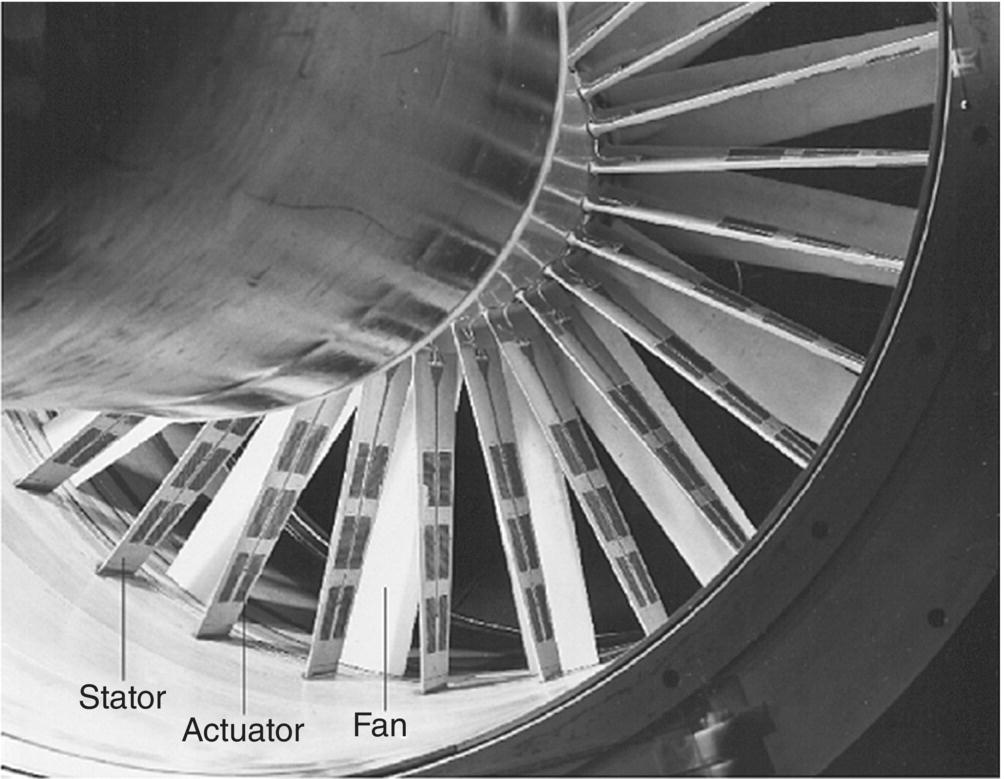
Bolt, Beranek & Newman and NASA performed a test [147] using actuators embedded in the stators to provide more control over the radial spinning modes (see Figure 9.45). A difficulty is that the number of error microphones and source actuators required to reduce fan noise sources (in particular at higher frequencies) is too large for practical applications. In addition, the actuators need to be robust, produce high‐amplitude sound, and be effective over a broad range of frequencies [146]. It is expected that further developments will reduce the system requirements and cost to make active noise control possible for aircraft engines. An overview of active noise control research for fans has been presented by Envia [148].
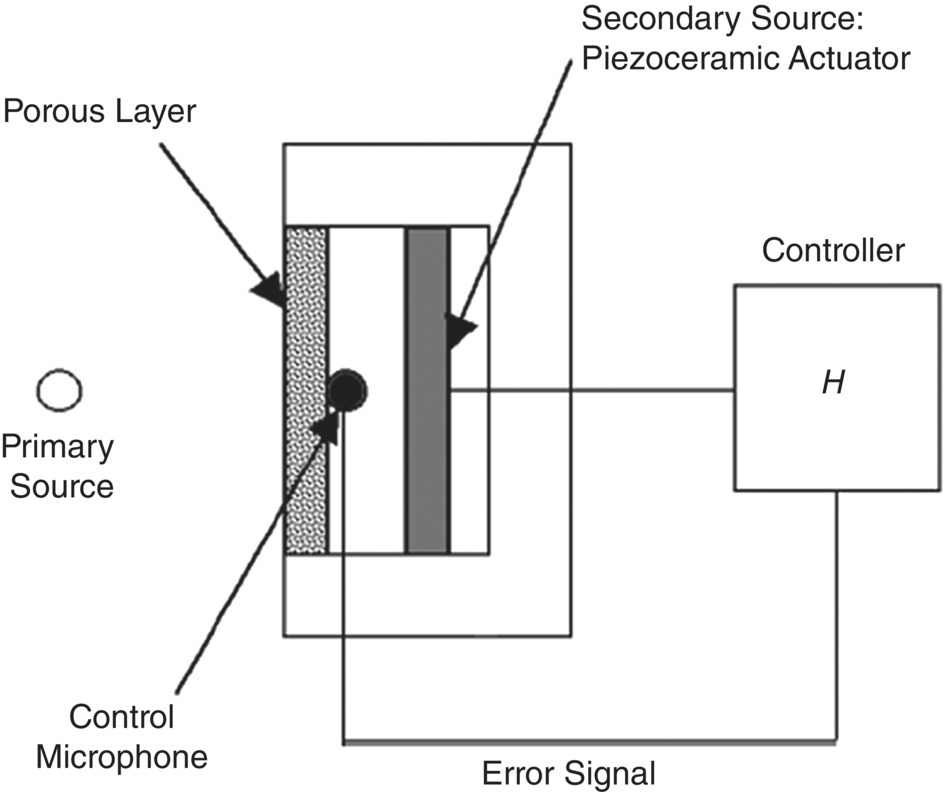
The use of active noise control has also been combined with passive control to develop hybrid absorbers. Active control technologies appear to be the only practical way to attenuate the low‐frequency turbofan noise components. A hybrid passive/active absorber can absorb the incident sound over a wide frequency range. Figure 9.46 shows the principle of such a system, which combines passive absorbent properties of a porous layer and active control at its rear face, and where the controller can be implemented using digital techniques [149, 150]. The use of piezoelectric actuators as a secondary sources and wire mesh as porous material has allowed the design of thin active liners, composed of several juxtaposed cells of absorbers, to be used in the reduction of noise in flow ducts [150]. The combination of active and passive control using microperforated panels has produced promising results for the application in absorbing systems [151]. This principle has been used in turbofan liners to make them more effective in reducing noise. An example of this hybrid active/passive approach has been developed by Northrop Grumman [152].
Active control systems for reducing tonal airplane cabin noise are generally based on either active noise control or ASAC. Broadband cabin noise may be attenuated with the aid of active headsets or silent seats. An application of active control of propeller aircraft cabin noise and vibration is presented in Chapter 15 of this book. Reference [153] presents a comprehensive discussion of active noise control in aircraft.
Other applications of active noise control have included active mufflers located in the gas exhaust systems for exterior noise reduction. Such systems provide effectiveness of 5 dB to 15 dB at some low frequencies (lower than 200 Hz) [154]. Practical application of active control systems for reducing the response of buildings to wind and earthquake loading still remains very limited and exists mainly only in full‐scale applications [155].
Leave a Reply